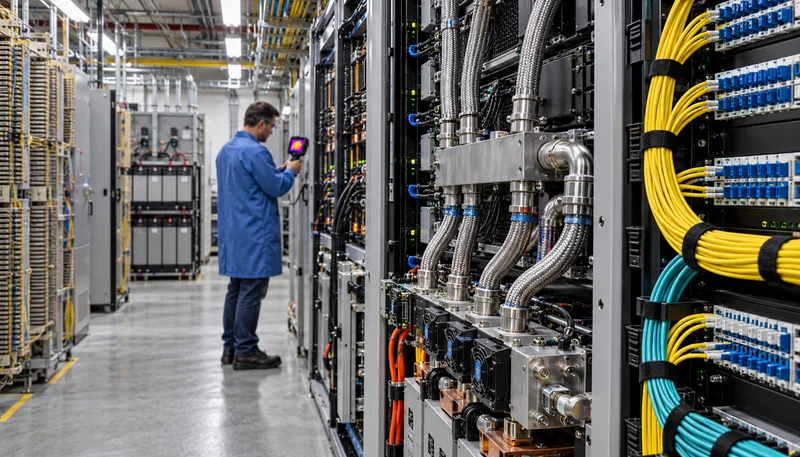
The Edge Hierarchy Reality: Why Metro Aggregation Hubs Dominate Over Cell Towers for AI Inference
The distributed edge architecture is fundamentally stratified across three tiers: the Far Edge (radio access network base stations, micro-RUs, and cell towers), the Metro Edge (local exchange wire centers, central offices, cable headends, and primary aggregation hubs), and the Hyperscale Cloud. Over the past cycle, architectural hype championed deploying multi-node neural processing hardware directly at the base of radio masts. Engineering reality, however, has exposed immutable thermodynamic and electrical boundaries. A modern edge AI inference cluster containing high-density accelerators demands continuous electrical delivery between 1.5kW and 8kW per chassis. Cell towers are inherently compromised by restricted utility feeds rarely exceeding 10kW to 15kW total capacity, severe environmental swings ranging from -30°C to +50°C, stringent acoustic emissions constraints in residential zones, and nonexistent physical footprints for coolant heat rejection loops or high-discharge-rate energy storage reserves.
Conversely, Metro Edge Central Offices represent optimal, strategically positioned real estate for hosting low-latency AI inference workloads. Historically deployed to handle circuit switching and regional routing, these facilities possess multi-megawatt utility drops, diverse dual-feed medium-voltage transformer interconnects, established structural concrete floors with elevated live-load ratings, and low-latency transport connectivity to metropolitan access networks (<5ms round-trip latency). By anchoring deep inference models, vector search indexing, and real-time vision pipelines at the aggregation tier, network operators can satisfy sub-10ms deterministic processing thresholds for enterprise consumers while centralizing operational maintenance, physical security, and thermal dissipation within a consolidated footprint.
Audit existing metro central office utility transformer capacities and medium-voltage switchgear headroom for multi-megawatt IT upgrades.
De-prioritize high-density accelerator rollouts at Far Edge cell sites in favor of localized 10GbE/100GbE optical backhaul into metro aggregation hubs.
Benchmark baseline network round-trip time (RTT) to ensure metro nodes deliver deterministic <5ms latency profiles to target enterprise zones.
Brownfield Thermal Modernization: Upgrading Low-Density Central Offices with RDHx and Modular In-Row CDUs
Legacy central offices were predominantly engineered during the digital switching era, optimized for uniform heat dissipation across 2kW to 4kW telecommunications frames utilizing rudimentary raised-floor perimeter Computer Room Air Conditioning (CRAC) or handling units (CRAH). When operators attempt to install modern edge AI server sleds—such as 8-way GPU assemblies dissipating up to 10.2kW within a compact 4U chassis—local heat flux instantaneously overwhelms standard open-room airflow architectures. Rack densities escalate rapidly from historical averages to 20kW–45kW per cabinet. Without localized micro-containment or liquid-assisted rejection, localized recirculation hot spots form rapidly, driving junction temperatures beyond silicon thermal throttle limits and precipitating cascade hardware faults.
Retrofitting these brownfield sites demands a phased thermal migration strategy. Where raised floors provide adequate under-floor plenum clearance, engineers must deploy rigid hot-aisle containment (HAC) systems aligned strictly with legacy structural column matrices to eliminate bypass air paths. To manage extreme localized fluxes without requiring extensive structural building chilled-water central plants, high-efficiency Rear-Door Heat Exchangers (RDHx) paired with external dry coolers are being deployed. These RDHx units capture 80% to 95% of server-generated thermal energy directly at the exhaust plane, returning neutral air to the whitespace. For facilities completely devoid of external hydronic piping, closed-loop in-row or in-rack Coolant Distribution Units (CDUs) utilize liquid-to-air heat rejection cycles, transferring heat from direct-to-chip cold plates to ambient airflow managed by modular overhead extraction ducts.
Implement hot-aisle containment retrofits configured to match structural pillar clearances and prevent bypass air recirculation.
Deploy active or passive Rear-Door Heat Exchangers capable of extracting 20kW to 45kW per rack using closed-loop hydronic loops.
Install modular in-row liquid-to-air CDUs with redundant canned-motor variable-speed pumps for direct-to-chip microchannel cold plate loops.
Power Distribution Evolution: Transitioning from -48V DC Busbars to High-Voltage Hybrid AI Racks
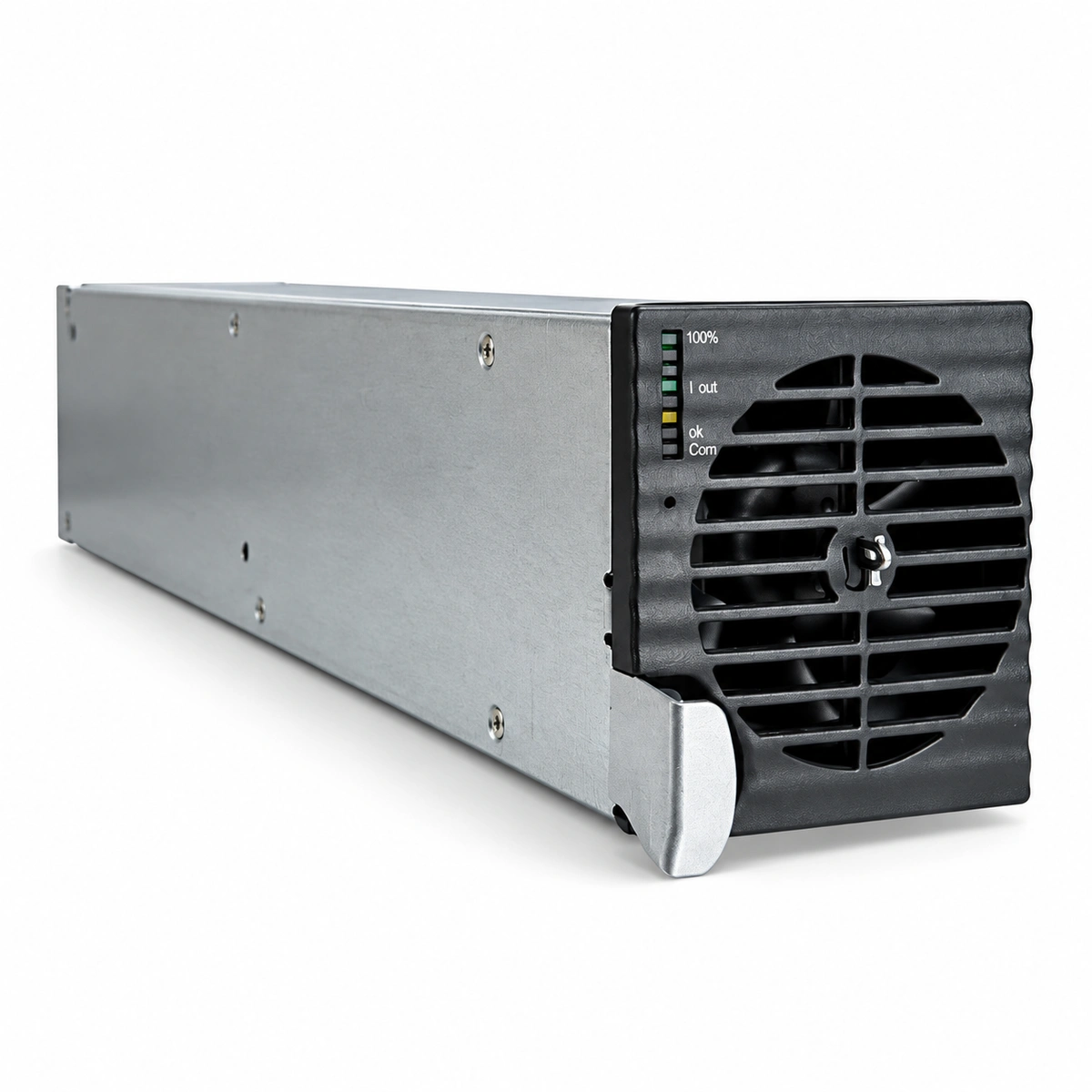
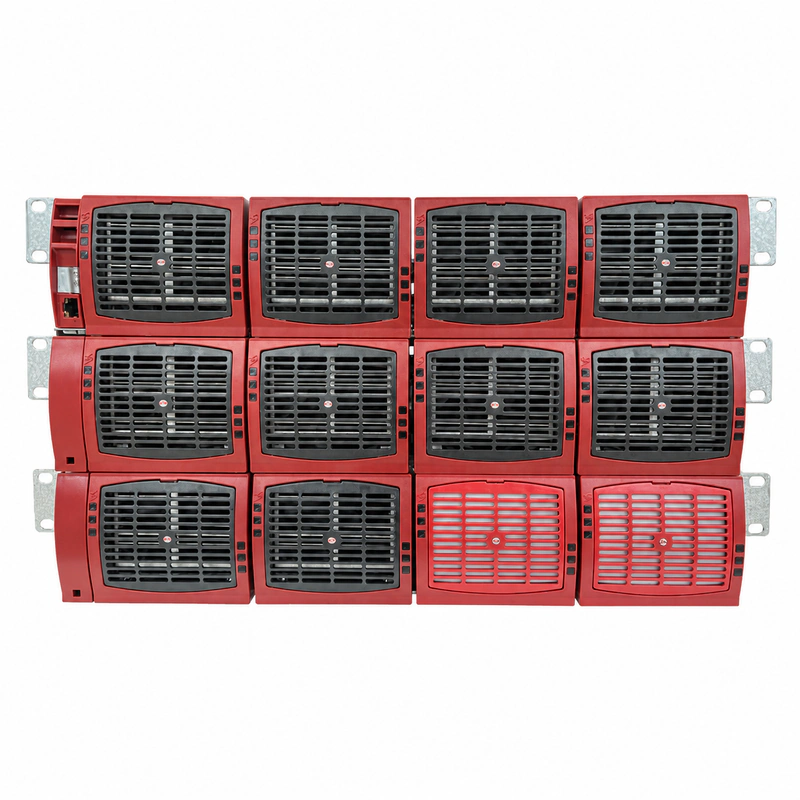
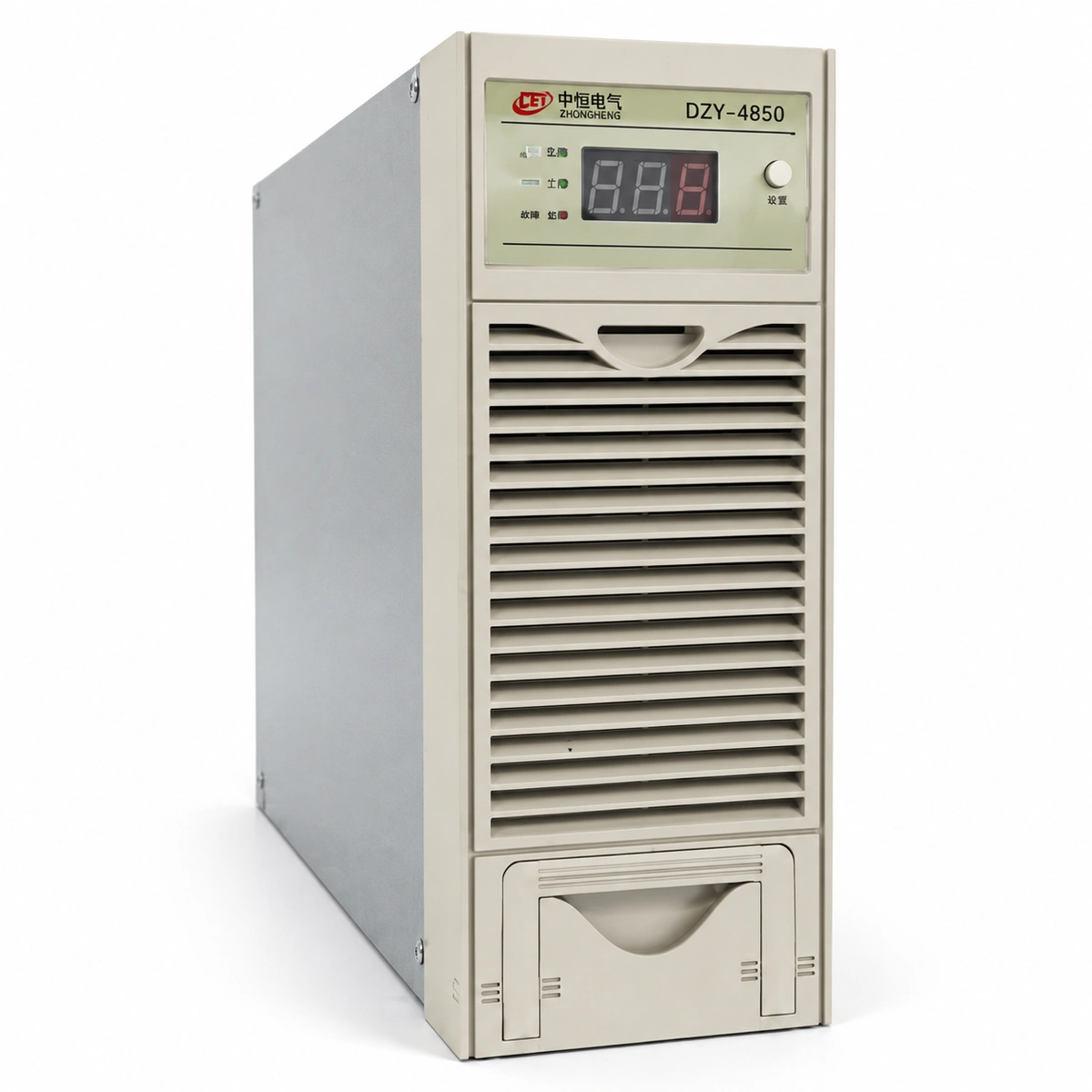
Telecom central offices have traditionally relied on central -48V DC rectifier bays and massive wet-cell or Valve Regulated Lead-Acid (VRLA) battery plants, chosen for their reliability and galvanic safety. However, scaling a modern 35kW AI inference rack entirely at -48V DC introduces severe physical limitations governed by Ohm's Law. Supplying 35kW at -48V DC necessitates circuit currents exceeding 729 Amperes per feed. Managing these continuous ampacities requires massive copper busbars or paralleled 750 kcmil cables per phase, leading to immense physical dead loads, catastrophic cable tray congestion, and prohibitive I²R thermal dissipation losses inside whitespace cable pathways.
Modernization requires transitioning central office infrastructure toward hybrid electrical topologies. Mission-critical power architects are deploying high-density, three-phase 400V/480V AC distribution directly to high-voltage power distribution units (ePDUs) mounted within the AI racks, or implementing ±400V DC busway architectures that step down to 48V DC or 12V DC via point-of-load (PoL) buck-boost converters internally within server power supply units (PSUs). Simultaneously, bulky VRLA battery bays are being decommissioned and replaced with high-energy-density Lithium Iron Phosphate (LiFePO4) or Nickel-Zinc (NiZn) in-rack Battery Backup Units (BBUs). This shift reclaims over 60% of legacy structural floor space, enabling telecom operators to repurpose power rooms into high-performance compute zones while elevating round-trip electrical efficiency above 96%.
Retire distributed -48V DC legacy drops for compute loads exceeding 10kW per rack, deploying 400V/480V AC 3-phase redundant feeds.
Evaluate space-reclamation business cases by migrating centralized VRLA battery plants to compact in-rack LiFePO4 or NiZn BBU shelves.
Implement dual-feed solid-state static transfer switches (STS) and localized DC-DC converters to maintain galvanic isolation for co-located telco gear.
Mitigating the Tyranny of Wires: Structured Optical Interconnects, Fiber Density, and ANSI/TIA-942 Standards
Clustered edge AI inference nodes require significant physical layer networking. Unlike legacy telecom deployments characterized by sparse North-South routing, modern distributed inference models, retrieval-augmented generation (RAG) vector stores, and real-time edge processing generate substantial East-West fabric traffic. Interconnecting multiple multi-accelerator nodes using RoCEv2 (RDMA over Converged Ethernet) or InfiniBand across 400GbE and 800GbE physical layers generates immense cable volume. When unstructured direct-attach copper (DAC) or unmanaged patch cords are installed haphazardly across legacy ladder racks, they choke cabinet exhaust pathways, disrupt designed thermal patterns, and create systemic physical risk during ongoing maintenance.
To enforce systematic discipline, physical plant retrofits must strictly comply with ANSI/TIA-942-C data center structural guidelines, integrated with the emerging TIA DCE 9000 edge infrastructure quality framework. High-density structured optical management requires the immediate replacement of open ladder racks with dedicated, enclosed overhead optical raceway systems (such as yellow FiberGuide pathways) to guarantee minimum bend radii and eliminate mechanical crushing. At the cabinet level, engineers must implement high-density Base-8 and Base-16 MPO/MTP structured trunk lines terminating in ultra-low-loss angled LC or MDC break-out cassettes. This modular approach maximizes port packing density, reduces front-of-rack optical bundle profiles, preserves intake aerodynamics, and guarantees compliance with Tier II or Tier III structural edge fault tolerances.
Migrate front-of-rack patching to structured Base-8 or Base-16 MPO/MTP trunk cables supporting 400G-SR4 and 800G-DR8 links.
Install dedicated overhead fiber raceways compliant with ANSI/TIA-942-C standards to protect bend-insensitive single-mode and OM4 fibers.
Validate physical layer edge compliance against TIA DCE 9000 specifications for mechanical stability, seismic bracing, and optical loss margins.
Workload Convergence: Co-locating AI-RAN and Physical AI Inference on Heterogeneous Compute
The economic viability of edge infrastructure transformations depends heavily on software-defined compute convergence. Historically, telecom infrastructure, core routing functions, and third-party compute services operated across siloed hardware appliances. The development of cloud-native Open RAN (O-RAN) alongside virtualized Distributed Units (vDU) and Centralized Units (vCU) enables operators to consolidate wireless baseband signal processing onto commercial off-the-shelf (COTS) heterogeneous compute servers. By combining unified chassis equipped with server-grade CPUs, real-time accelerators, and low-latency Data Processing Units (DPUs/IPUs), operators can run complex physical layer signal processing alongside containerized AI inference workloads.
This architectural convergence is critical for emerging 'Physical AI' applications—including smart port automation, high-speed machine vision for industrial manufacturing, localized electric grid stabilization, and autonomous logistics dispatching. These industrial use cases require sub-10ms closed-loop feedback and rigorous processing determinism that hyperscale cloud environments cannot reliably provide. By leveraging integrated resource orchestrators, telecom operators can allocate compute capacity dynamically: during peak cellular transmission periods, compute cycles prioritize vDU beamforming calculations; during traffic off-peak windows, compute clusters seamlessly reprioritize toward processing batch enterprise inference requests, model fine-tuning, and vector database updates.
Specify heterogeneous server platforms pairing modern multi-core x86/ARM host processors with PCIe Gen 5/6 hardware accelerators and DPUs.
Deploy Kubernetes-based edge orchestrators capable of dynamic compute slicing between real-time O-RAN L1/L2 workloads and AI inference tasks.
Establish hardware-enforced SR-IOV and real-time Linux operating system kernels to guarantee deterministic <2ms latency budgets for baseband processing.
Prefabricated Modular (PFM) Expansion and Lights-Out Autonomous Edge Operations
When structural constraints inside legacy Central Offices—such as inadequate floor-to-ceiling heights, spatial limits, structural floor load limitations under 12 kPa, or non-compliant environmental conditions—preclude physical interior expansion, operators are leveraging Prefabricated Modular (PFM) data center pods. These factory-integrated, ruggedized enclosures are designed to deploy on adjacent land, substation compounds, or secure exterior parking environments. Ranging from 100kW to 500kW in capacity, PFM blocks integrate medium-voltage power distribution, uninterruptible power supply (UPS) modules, liquid cooling loops, and physical security measures, bypassing lengthy brownfield construction timelines and achieving commissioning readiness within days of concrete pad delivery.
Because metro aggregation facilities often operate with minimal or zero resident engineering staff, operational success depends on implementing fully autonomous, 'lights-out' remote management architectures. Advanced Data Center Infrastructure Management (DCIM) platforms, enhanced by predictive telemetry models, monitor acoustic signatures, thermal delta vectors across liquid circuits, pump vibration, and power quality anomalies in real time. Platforms like RICEWIND enable operations teams to predict cooling loop failures, automate localized power throttling, and orchestrate workload migrations prior to physical component degradation, ensuring unbroken service availability across distributed metro edge portfolios.
Deploy all-in-one PFM structural modules when brownfield central office floor loading or ceiling heights cannot support high-density infrastructure.
Equip modular pods with automated environmental controls, fire suppression (e.g., Novec 1230), and multi-factor zero-trust access perimeter systems.
Integrate unified edge telemetry tools like RICEWIND for predictive CDU pump maintenance, power monitoring, and autonomous edge node management.
Engineering Procurement & Technical Desk
For technical datasheets, custom power topology design, or volume export quotations, reach out to HEFENGQI engineers.