The Liquid Cooling Blind Spot: Why Cold Plates Leave Storage, CXL Memory & Optical Transceivers Overheating
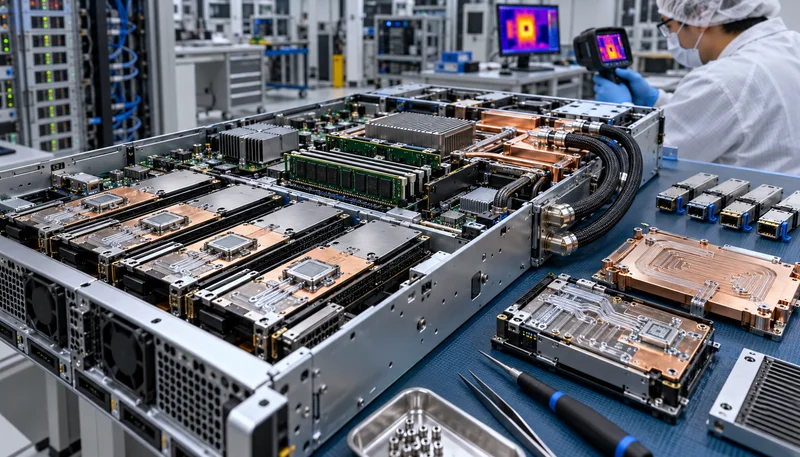
The rapid deployment of dense accelerated compute nodes, such as NVIDIA HGX B200 and AMD Instinct MI300X platforms, has cemented direct-to-chip (D2C) liquid cooling as an absolute necessity for hyperscale data centers. Liquid cold plates directly mounted to monolithic compute dies efficiently evacuate thermal loads ranging from 700W to beyond 1200W per package. However, this focused thermal strategy exposes a critical architectural vulnerability: peripheral components residing on the baseboard and peripheral interconnect fabric are entirely bypassed by primary liquid loops. High-throughput PCIe Gen5 and emerging Gen6 NVMe enterprise solid-state drives, Compute Express Link (CXL) memory expansion modules, PCIe retimer and redriver silicon, and 800G/1.6T OSFP optical transceivers continue to rely predominantly on convective heat transfer to surrounding air.
In modern 2U and 4U liquid-cooled AI chassis, macro-level system fans are either drastically throttled to minimize auxiliary parasitic energy consumption or eliminated altogether to optimize Power Usage Effectiveness (PUE). This intentional reduction of bulk air velocity creates severe internal flow stagnation zones. Without forced chassis-level airflow to sweep peripheral PCB surfaces, peripheral heat sinks experience thermal boundary layer buildup. High-performance PCIe Gen5/Gen6 SSD controllers, running continuous multi-stream sequential write workloads during AI model checkpointing, rapidly breach their critical junction threshold temperatures (Tj_max of 85°C to 105°C). The resultant thermal throttling reduces data throughput by 40% to 70%, transforming peripheral I/O and interconnect fabric into the primary operational bottleneck of modern AI training clusters.
Identify thermal dead zones across PCIe Gen5/Gen6 slots and front-panel drive cages in reduced-airflow liquid server chassis
Quantify convective heat transfer coefficients across peripheral heatsinks operating under laminar or stagnant boundary conditions (<0.5 m/s air velocity)
Audit optical cage internal temperatures on 800G/1.6T OSFP transceivers operating adjacent to liquid cold plate return manifolds
Fundamentals of Solid-State Active Micro-Cooling: PiezoMEMS Actuation, Micro-Jets & Zero-Bearing Longevity
Conventional mechanical air movers are fundamentally incapable of addressing localized hotspot cooling within tight server form factors. Rotary axial fans cannot be scaled down below 20mm to 30mm without suffering catastrophic aerodynamic stall, severe bearing wear, lubricant evaporation under sustained high ambient operating temperatures, and acoustic noise spikes. Solid-state active micro-cooling addresses these physical limitations by replacing rotational mechanics with monolithic silicon Micro-Electro-Mechanical Systems (MEMS). Built using standard semiconductor lithography and thin-film deposition techniques, these devices integrate piezoceramic thin-film actuators onto high-purity crystalline silicon membranes.
When an alternating electric field is applied, the piezoelectric actuator flexes at ultrasonic frequencies—typically exceeding 25 kHz. This high-frequency resonance drives the micro-machined silicon membrane in a precise positive-displacement cycle, ingesting air from ambient vents and ejecting discrete, high-velocity pulsed micro-jets through sub-millimeter silicon nozzles. Because the architecture features zero rotating components, zero sleeve or ball bearings, and zero sliding friction interfaces, there are no mechanical wear mechanisms. These solid-state micro-cooling chips achieve an enterprise-grade Mean Time Between Failures (MTBF) exceeding 100,000 operational hours while delivering IP58-rated resistance against airborne particulates and moisture, satisfying the strictest hyperscale reliability mandates.
Deploy lead zirconate titanate (PZT) thin-film actuators on single-crystal silicon diaphragms for high displacement consistency
Verify ultrasonic resonance operating frequencies (>25 kHz) to completely eliminate audible acoustic noise in mission-critical server environments
Validate operational lifespan against Telcordia GR-63-CORE reliability and environmental stress screening metrics for enterprise silicon
Eradicating Thermal Gradients in Enterprise PCIe Gen5/Gen6 NVMe SSDs to Prevent Thermal Throttling
Enterprise-grade solid-state drives in U.2, U.3, E1.S, and E3.S form factors dissipate between 20W and 25W+ under continuous AI workload conditions, such as deep learning dataset streaming and checkpoint ingest. In standard implementations, heat dissipation relies on top-cover passive extrusion heatsinks or single-sided contact with chassis structural members. This asymmetric thermal layout generates acute spatial thermal gradients across the drive assembly: the primary controller IC and upper NAND flash dice may remain stabilized near 45°C, while bottom-side raw NAND packages and surface-mounted Power Management ICs (PMICs) rapidly exceed 85°C to 90°C.
A sustained internal cross-package temperature differential (ΔT) exceeding 30°C introduces severe differential thermal expansion across the PCB substrate. This thermomechanical stress accelerates micro-crack propagation in fine-pitch Ball Grid Array (BGA) solder balls and triggers internal controller firmware protection routines. To prevent permanent memory cell wear and data corruption, the drive controller aggressively clamps transfer rates, dropping throughput from 14 GB/s down to 4 GB/s. By embedding ultra-thin piezoMEMS micro-cooling devices directly inside the SSD casing, active high-velocity laminar air is directed across bottom-side NAND packages and high-power PMIC surfaces. This internal active air loop flattens the structural thermal gradient to less than 5°C, preventing controller throttle triggers and ensuring 100% sustained wire-speed IOPS.
Implement embedded intra-enclosure piezoMEMS micro-pumps to maintain cross-substrate thermal gradients (ΔT) below 5°C
Map individual junction temperatures (Tj) across controller, PMIC, and secondary NAND layers using embedded thermocouple telemetry arrays
Evaluate solder joint integrity (SAC305/low-temp alloys) under cyclic thermal stress to prevent BGA fatigue failure in dense SSD packages
Aerodynamic & Fluid Dynamics Metrics: 1,300 Pa Back-Pressure, High-Impedance Micro-Channels & 150-240mW Ultra-Low Power
The true fluidic breakthrough of solid-state active micro-cooling lies in its extraordinary pressure generation under extreme flow restriction. High-density server packaging demands micro-channel heat sinks featuring sub-millimeter fin pitches (often <0.8mm) to maximize heat transfer surface area per unit volume. Conventional low-profile axial fans immediately stall when confronted with such high aerodynamic impedance, resulting in total boundary layer stagnation and zero net airflow across the fin matrix. In contrast, positive-displacement piezoMEMS micro-pumps act as high-impedance fluidic drivers capable of forcing air through narrow micro-channels that completely block rotary fans.
Quantitative benchmarks illustrate this distinct mechanical advantage: standard modules, such as the xMEMS XMC-2400 architecture, deliver an active airflow rate of up to 28 cm³/s against an extraordinary static back-pressure of 1,300 Pa, requiring merely 150 mW of input power. Scaled-up micro-coolers, such as the XMC-4800, achieve 48 cm³/s at 1,100 Pa while consuming only 240 mW. By generating pulsed, turbulent synthetic micro-jets, these solid-state silicon chips continuously disrupt the thermal boundary layer that forms on heatsink fin walls. This boundary-layer disruption yields local convective heat transfer coefficients that match or exceed those achieved by high-draw 15,000 RPM chassis fans, all while drawing sub-watt operational power.
Select piezoMEMS micro-actuators generating at least 1,100 Pa to 1,300 Pa back-pressure to bypass high-impedance micro-fin heatsinks
Design heatsink fin pitch down to 0.5mm-0.8mm to maximize active surface area without risking flow stall
Calibrate pulse-jet modulation frequencies to disrupt laminar thermal boundary layers and boost local convective coefficients (h > 120 W/m²·K)
Server-Level DC Power Delivery, Point-of-Load (POL) Regulation & BMC Telemetry-Driven Micro-Zonal Cooling
Integrating solid-state micro-cooling into hyperscale server motherboards requires an efficient, low-overhead power delivery and telemetry architecture. Modern AI server trays utilize 12V DC or centralized 48V DC busbars to distribute primary chassis power. Miniature point-of-load (POL) buck converters, situated adjacent to peripheral slots or embedded within peripheral carrier PCBs, step this distribution voltage down to 3.3V or 1.8V logic rails, which are subsequently boosted via dedicated high-efficiency driver stages to power the piezoelectric thin-film actuators. Due to the ultra-low sub-watt draw of solid-state micro-cooling, a 16-drive high-density E1.S NVMe enterprise storage pool consumes less than 4W total for active cooling—under 5% of the power demanded by a single 60mm counter-rotating chassis fan (which consumes between 30W and 60W).
Telemetry integration operates as a closed-loop digital feedback system connected directly into the server's Baseboard Management Controller (BMC) via I2C, SMBus, or Management Component Transport Protocol (MCTP) over PCIe. The OpenBMC firmware stack monitors real-time die-level junction temperatures from controller internal sensors, PMICs, and transceivers. By employing dynamic pulse-frequency modulation (PFM), the BMC can independently throttle micro-cooling performance on a micro-zonal basis. Each peripheral receives cooling strictly proportional to its instantaneous computational load, optimizing node efficiency and extending overall platform operational lifespan.
Incorporate compact point-of-load (POL) step-down converters converting 12V/48V busbar supplies to low-voltage piezoceramic driver rails
Establish BMC-to-actuator communication pathways using MCTP over PCIe or I2C/SMBus protocols within the OpenBMC ecosystem
Formulate closed-loop firmware control algorithms that dynamically tune piezoMEMS actuation frequency based on real-time internal ASIC junction telemetry
Future Thermal Architecture: Integrating Component-Level Silicon Cooling into Macro-Scale Direct-to-Chip & Immersion Liquid Cooling Systems
The evolution of enterprise compute hardware points toward a heterogeneous, three-tier thermal management hierarchy rather than a single unified cooling approach. Macro-level infrastructure (Tier 1) operates at the facility and rack level, deploying dry coolers, cooling distribution units (CDUs), and primary chilled water loops. Meso-level systems (Tier 2) manage dense heat generation at the chassis level via direct-to-chip (D2C) liquid cold plates and rear-door heat exchangers (RDHx). Solid-state active micro-cooling represents Tier 3: ultra-localized, component-level micro-cooling deployed precisely at high-impedance thermal dead zones where liquid piping cannot physically route without introducing unacceptable complexity, leakage risk, or unserviceable cost.
This multi-scale engineering approach eliminates the inefficient practice of over-cooling entire server rooms or driving system-level axial fans at maximum speed solely to mitigate localized hotspots on a handful of SSD controllers or optical transceivers. By isolating peripheral heat dissipation with piezoMEMS devices, data center operators can elevate primary liquid loop supply temperatures beyond 32°C to 35°C. This elevates chiller-less free-cooling hours and systematically drives modern hyperscale Data Center PUE toward optimal targets near 1.08. As AI hardware density accelerates toward Gen6 interconnects and 1.6T transceivers, RICEWIND expects solid-state active micro-cooling to become an indispensable building block of mission-critical platform design.
Implement a 3-tier thermal management hierarchy: Facility Liquid Loops (Tier 1), Chassis D2C Cold Plates (Tier 2), and PiezoMEMS Micro-Jets (Tier 3)
Raise facility liquid supply temperatures above 32°C by actively mitigating peripheral hot zones using targeted solid-state cooling
Coordinate system thermal modeling across computational fluid dynamics (CFD) platforms to simulate hybrid liquid-to-air micro-jet heat flux interactions
Engineering Procurement & Technical Desk
For technical datasheets, custom power topology design, or volume export quotations, reach out to HEFENGQI engineers.