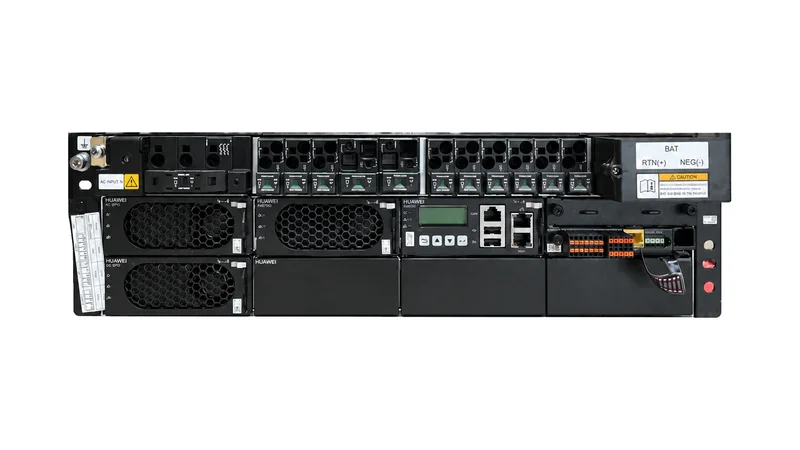
Subrack Architecture & High-Density Space Optimization
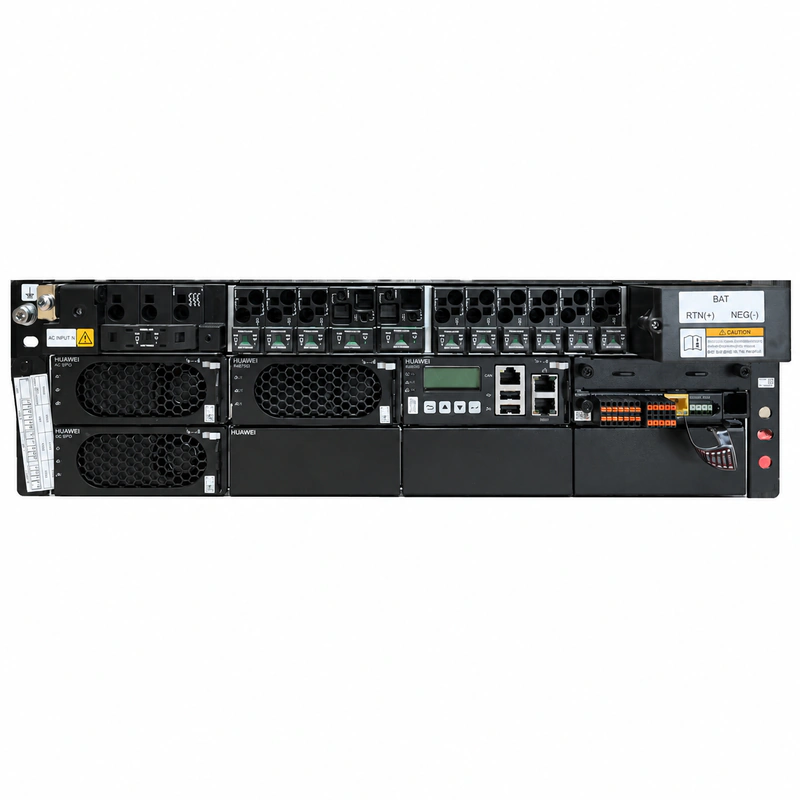
The Huawei ETP48400-C3B1 redefines spatial efficiency in carrier power infrastructure by housing up to 400A of continuous -48V DC output capacity (scalable up to 24kW total DC power) within a standard 19-inch 3U rack-mount envelope measuring 482.6 mm × 330 mm × 130.5 mm. In legacy telecommunications shelters and dense macro base stations, dedicated power bays consuming 9U to 12U of vertical rack space severely limit revenue-generating active radio and optical transport hardware. The ETP48400-C3B1 integrates AC mains input distribution, a high-current copper busbar matrix, an 8-slot modular rectifier bay, dual Low Voltage Disconnect (LVD) contactors, and multi-branch DC distribution into an ultra-dense 3U chassis, achieving an exceptional power-to-volume ratio suitable for outdoor cabinets, optical line terminal (OLT) central offices, and edge cloud micro-datacenters.
From an installation and serviceability perspective, the subrack incorporates a strictly front-access physical topology. All AC feed terminations, DC load circuit breakers, battery string hookups, signal wiring, and rectifier modules are managed directly through the front panel. This eliminates the operational requirement for rear access corridors in high-density carrier colocation facilities, enabling back-to-back rack deployment or flush-to-wall mounting. The internal busbar layout utilizes high-conductivity nickel-plated electrolytic copper, engineered for low parasitic resistance, balanced current distribution across all eight rectifier bays, and minimal thermal dissipation under full-load operation.
Chassis form factor: Standard 19-inch rack-mount subrack, 3U height (482.6 mm × 330 mm × 130.5 mm)
Busbar current rating: 400A continuous output rating delivering up to 24kW total DC capacity at -48V nominal
Installation ergonomics: 100% full front-access cabling, breaker actuation, and module maintenance
Modular Rectifier Topologies & Dynamic Efficiency Management
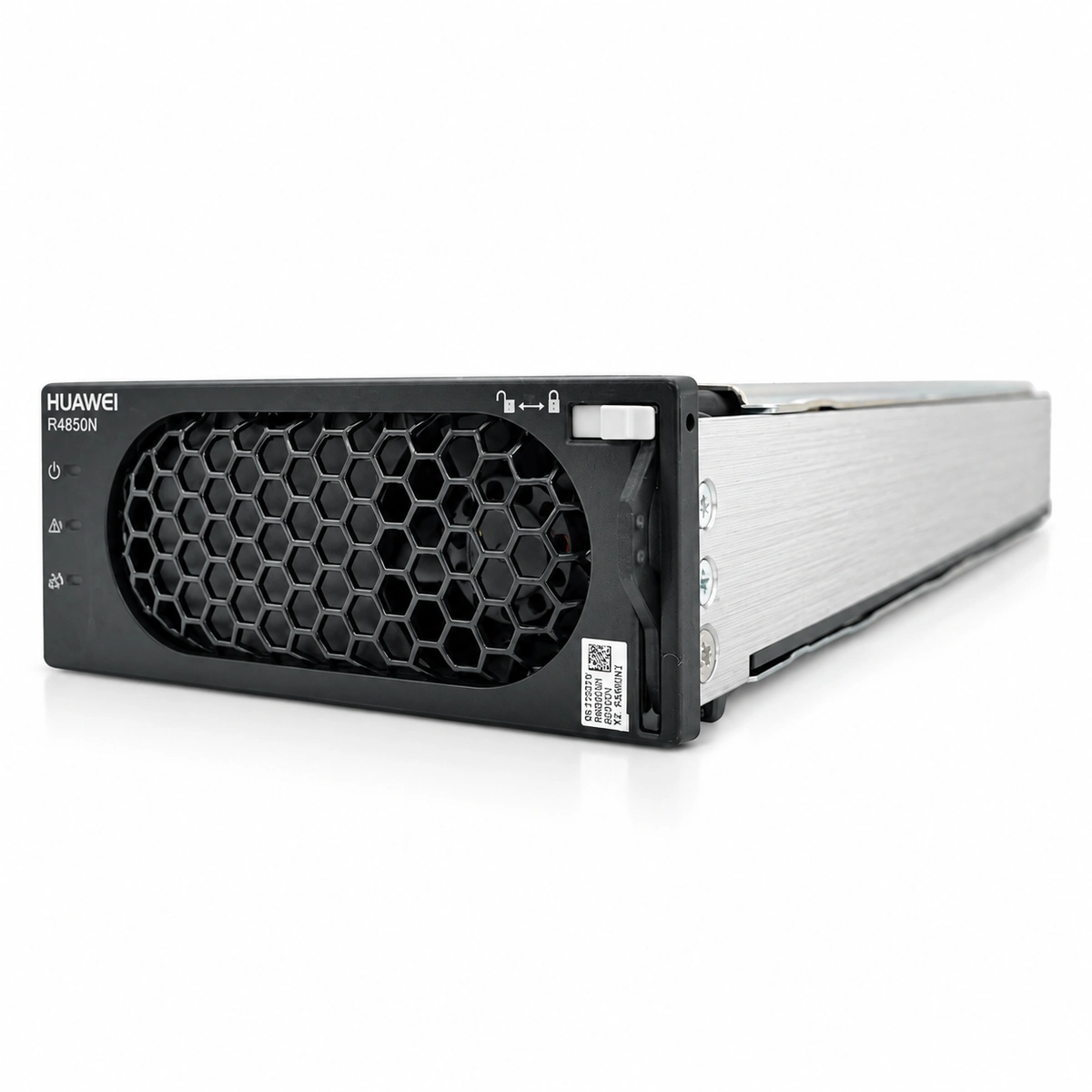
The ETP48400-C3B1 features an 8-slot rectifier architecture designed for flexible modularity and operational scaling. The system natively accepts multiple generations of Huawei 50A and 75A hot-swappable switch-mode rectifiers, including the standard high-efficiency R4850G2 (50A, 3000W, 96% peak efficiency), the super-high-efficiency R4850G6 (50A, 3000W, up to 98% peak efficiency), the cost-optimized R4850N1, and high-density R4875G1 (75A, 4000W) units. This multi-module interoperability permits telecommunications operators to implement robust N+1 or N+2 active redundancy strategies, ensuring uninterrupted DC bus voltage stability even during unexpected module failure or live hot-swap replacements under active 400A loads.
To maximize operational efficiency across variable daily telecommunications traffic profiles, the subrack integrates advanced dynamic energy-saving hibernation cycling. Traditional fixed-rectifier power plants run all modules simultaneously at low partial loads (often 20% to 30%), causing individual rectifiers to operate on the inefficient lower end of their conversion curves. Under the centralized control of the SMU02C, the ETP48400-C3B1 automatically hibernates redundant rectifier modules during off-peak network hours, concentrating load onto fewer active units to keep them running within their optimal 96% to 98% efficiency plateau. The controller applies intelligent operational wear-leveling algorithms, periodically rotating active and sleeping rectifiers to balance cumulative runtime and maximize overall system mean time between failures (MTBF).
Module compatibility: Interoperable with R4850G2 (96%), R4850G6 (98%), R4850N1, and high-output R4875G1
Redundancy configuration: Hot-swappable N+1 and N+2 modular redundancy with zero bus interruption
Eco-mode efficiency: Dynamic module hibernation and automated rotational wear-leveling for peak conversion efficiency
Dual LVD Battery Management & Power Continuity
Uncompromised power continuity for mission-critical carrier networks depends on resilient energy storage management. The Huawei ETP48400-C3B1 incorporates an independent Dual Low Voltage Disconnect (dual LVD) architecture equipped with heavy-duty electromagnetic contactors: Load Low Voltage Disconnect (LLVD) and Battery Low Voltage Disconnect (BLVD). During commercial grid failure, the system transitions instantaneously to battery backup without phase transfer spikes. If the outage extends and battery voltage decreases past the programmable LLVD threshold (default -43.2V DC), non-critical secondary loads—such as site comfort cooling and non-essential auxiliary telemetry—are shed, preserving remaining battery reserve strictly for critical baseband units (BBU), microwave links, and optical transport gear.
As discharge continues toward deep-cycle limits, the BLVD contactor actuates at a programmable lower threshold (default -42.0V DC) to isolate the battery strings entirely. This prevents irreversible cell reversal, plate sulfation, and permanent electrochemical destruction of expensive VRLA or lithium-ion (LiFePO4) battery arrays. Furthermore, the ETP48400-C3B1 incorporates intelligent temperature-compensated float and boost charging algorithms, automatic periodic online capacity discharge testing, and real-time state of charge (SOC) and state of health (SOH) predictive analytics. These automated diagnostics detect high internal cell resistance and deteriorating battery strings before catastrophic site dropouts occur.
Dual LVD topology: LLVD contactor (-43.2V DC default) for non-critical load shedding; BLVD contactor (-42.0V DC default) for cell cutoff
Battery branch capacity: Configured with 2x250A or 4x125A high-rupture circuit breakers for dual or quad battery strings
Predictive diagnostics: Temperature-compensated charging, float/boost automation, and algorithmic SOC/SOH capacity tracking
Wide-Band AC Grid Adaptability & Lightning Surge Suppression
Telecommunications infrastructure is frequently deployed in remote, harsh environments subject to unstable AC utility grids, long rural feeder lines, and volatile diesel generator power. The ETP48400-C3B1 addresses these grid anomalies with an ultra-wide AC input voltage window spanning 85V AC to 300V AC and an input frequency tolerance of 45Hz to 65Hz. The subrack supports both three-phase 380V/400V/415V AC (three-phase four-wire) feeds and single-phase 220V/230V AC configurations. Full 24kW output is sustained between 176V AC and 300V AC, while linear power derating is executed automatically down to 85V AC, preventing premature battery depletion during severe grid brownouts.
Surge immunity is engineered into the system through integrated Class C lightning surge arresters rated for a nominal discharge current of 20kA and a maximum surge capability of 40kA (8/20 μs waveform) on the AC input lines. The DC distribution bus features coordinated surge suppression, high-speed overvoltage latching circuits, and short-circuit current limiting protection. Combined with a wide operating thermal envelope ranging from -40°C to +65°C (with full 400A output maintained up to +55°C without thermal derating), the ETP48400-C3B1 delivers consistent carrier-grade reliability across extreme equatorial, arctic, and high-lightning geographic deployments.
AC input acceptance: Ultra-wide 85V AC to 300V AC operational range compatible with three-phase and single-phase feeds
Surge protection: Integrated Class C AC surge arrester rated at 20kA nominal / 40kA maximum (8/20 μs)
Environmental envelope: Continuous operation from -40°C to +65°C with full rated capacity up to +55°C
SMU02C Supervisory Controller & Carrier Network Telemetry
The intelligence of the ETP48400-C3B1 is anchored by the Huawei SMU02C centralized supervisory monitoring controller. Designed as a hot-pluggable front-mount controller, the SMU02C provides an intuitive LCD interface with multi-language navigation, enabling rapid on-site commissioning, real-time electrical parameter verification, and immediate alarm interrogation without requiring an external laptop. The controller continuously communicates with every seated rectifier module over an internal high-speed CAN bus, monitoring individual phase voltages, branch currents, internal diode temperatures, and fan speeds while governing load-share balancing within ±5%.
For centralized network operations, the SMU02C delivers robust northbound and southbound telemetry capabilities. Equipped with Fast Ethernet (RJ45), RS485, RS232, and multi-channel programmable dry contact relays, the controller natively supports SNMP v1/v2c/v3, Modbus protocols, and a secure HTTPS Web GUI. It integrates seamlessly into the Huawei NetEco Network Management System (NMS) or third-party enterprise OSS platforms, providing remote telecommunications power architects with granular real-time oversight of site power consumption, battery health metrics, environmental sensors (temperature, humidity, door contact), and automated diagnostic logs.
Supervisory controller: Huawei SMU02C equipped with backlit LCD screen and high-speed CAN bus digital telemetry
Telecommunications protocols: Full native support for SNMP v1/v2c/v3, secure HTTPS Web GUI, Modbus, and dry contacts
Ecosystem integration: Seamless connectivity with Huawei NetEco NMS and northbound REST/SNMP enterprise OSS platforms
Carrier-Grade Procurement, Testing & TCO Strategy
Procurement evaluation of carrier-grade DC power plants requires a holistic Total Cost of Ownership (TCO) methodology rather than a narrow focus on initial capital expenditure. By pairing the ETP48400-C3B1 chassis with high-efficiency R4850G6 rectifiers (98%), operators achieve significant energy savings over standard 92%-94% legacy systems. Over a typical 10-to-15-year telecom lifecycle, each 2% gain in conversion efficiency reduces annual grid kilowatt-hour consumption, lowers site air conditioning thermal loads, and decreases operational expenditures (OPEX) by thousands of dollars per site. Furthermore, carrier procurement specifications demand verified reliability metrics: system MTBF exceeding 500,000 hours, strict component provenance, and rigorous quality control.
As an authoritative global supplier of carrier-grade infrastructure, RICEWIND enforces comprehensive quality assurance protocols for all Huawei power systems. Every Huawei ETP48400-C3B1 chassis, along with its R4850G2/R4850G6 rectifiers and SMU02C supervisory units, undergoes 100% full-load burn-in load bank testing prior to warehouse dispatch. RICEWIND maintains genuine factory-certified stock, guaranteed lifecycle spare parts availability, and global engineering logistics to support rapid telecommunications rollouts. For architectural consultations, engineering design support, or direct procurement inquiries, contact our power systems team at Email: lee@ricewind.com or Phone/WhatsApp: +86 17621197907.
Quality assurance: 100% full-load burn-in load bank testing certification prior to warehouse dispatch
Hardware provenance: RICEWIND certified genuine Huawei subracks, genuine rectifiers, and factory-flashed controllers
Engineering procurement contact: Direct consultation available via lee@ricewind.com and Phone/WhatsApp +86 17621197907
Engineering Procurement & Technical Desk
For technical datasheets, custom power topology design, or volume export quotations, reach out to HEFENGQI engineers.