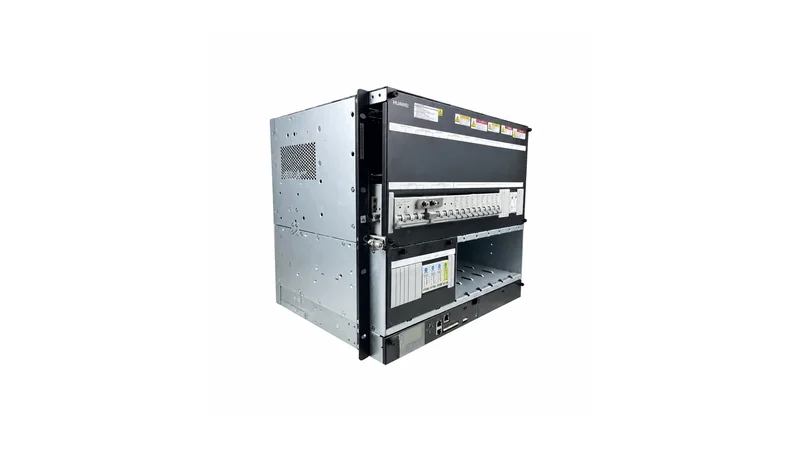
Subrack Architecture & Space Optimization
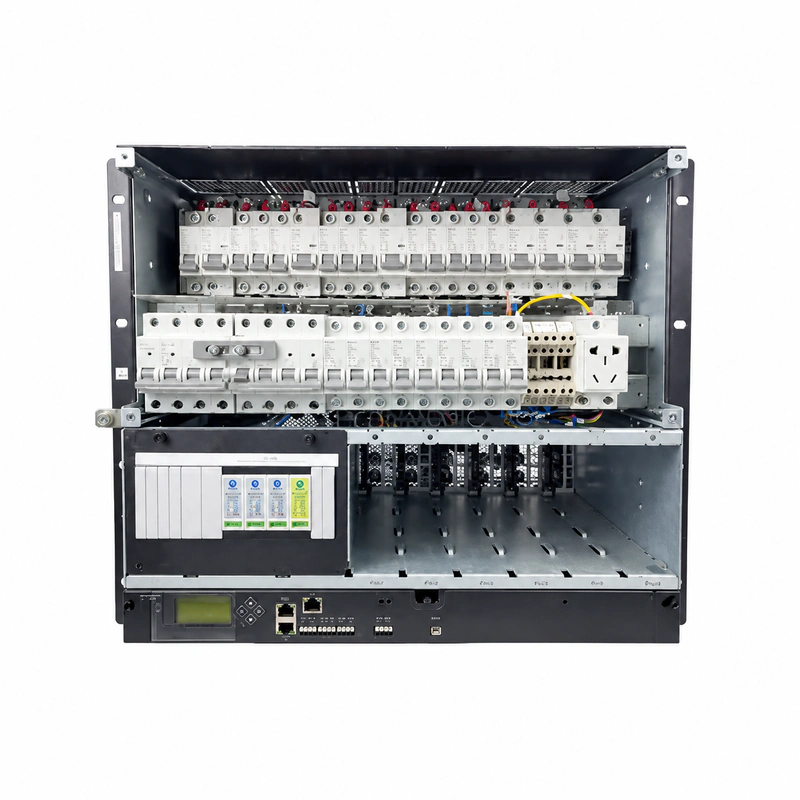
The Huawei ETP48300-C9A1 is engineered as an integrated 19-inch, 9U rack-mount power distribution frame (dimensions: 482.6 mm x 330 mm x 390 mm) designed specifically for space-constrained carrier environments such as 5G macro base transceiver stations (BTS), DWDM/OTN transmission hubs, and edge micro-data centers. By unifying AC distribution, DC rectification, battery management, and multi-branch load protection within a single mechanical shelf, the system achieves an exceptionally high volumetric power density, delivering up to 300A continuous DC output (up to 18kW total capacity) without necessitating auxiliary breaker panels or external distribution cabinets.
A foundational strength of the C9A1 mechanical chassis is its strict front-access maintenance and cabling design. Field engineers can perform AC cable entry, DC load breaker assignments, battery terminal hookups, and module replacements exclusively through the front portal. The modular bay accepts up to six hot-swappable Huawei 1U rectifiers alongside the central SMU02C controller. Internal DC busbars are precision-engineered to manage elevated thermal dissipation during peak load events, while compartmentalized partitioning separates AC high-voltage inputs from DC low-voltage distribution paths, ensuring technician safety and minimizing electromagnetic coupling.
Standard 19-inch 9U form factor optimizing floor-space and rack density in central offices
Continuous 300A / 18kW nominal output capacity across six dedicated 1U rectifier bays
100% full front-access cabling, breaker termination, and hot-swap module servicing
Rectifier Modularity & Conversion Efficiency
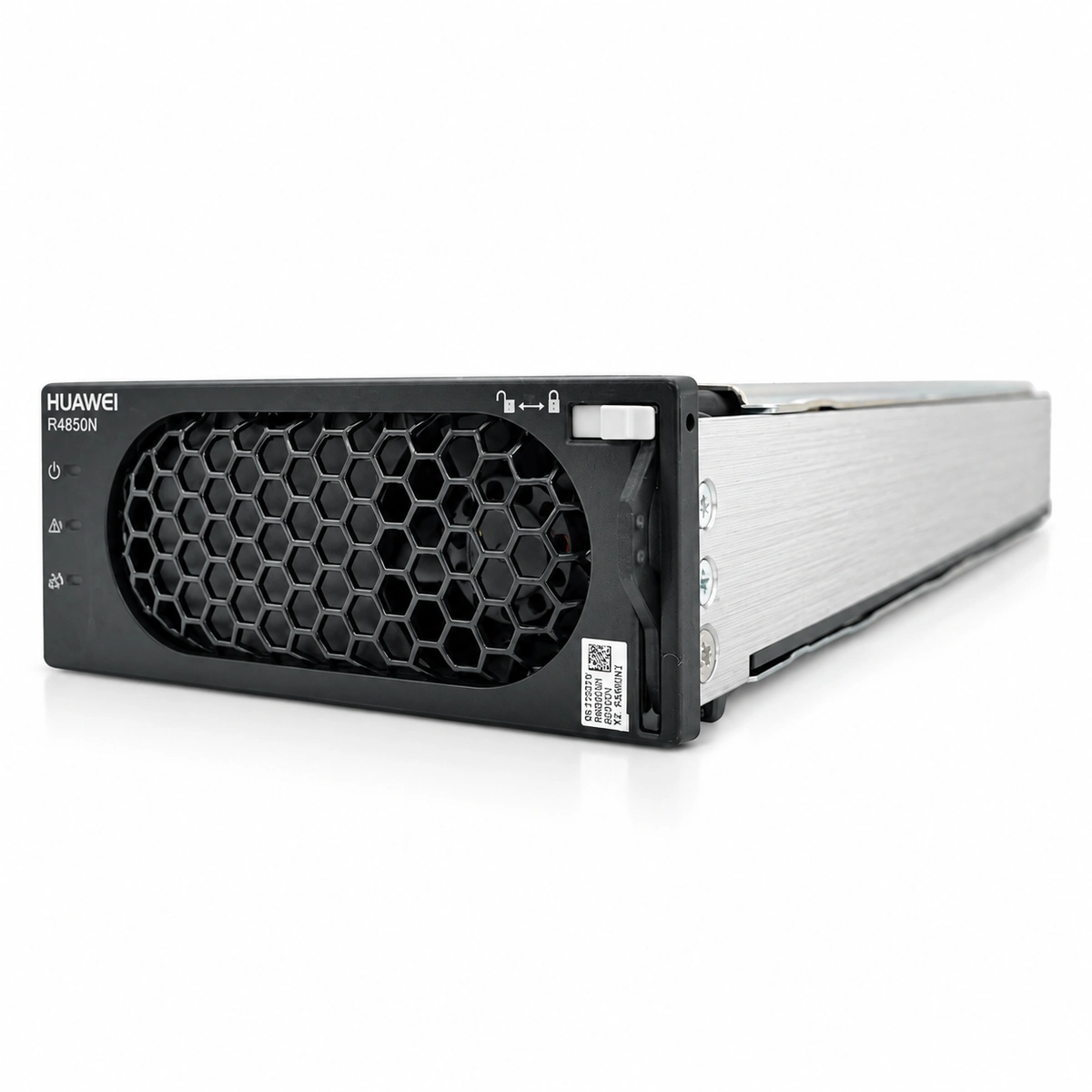
The ETP48300-C9A1 power shelf features a modular architecture compatible with Huawei high-density 50A rectifiers, including the standard-efficiency R4850G2 (96% peak efficiency), the super-high-efficiency R4850G6 (up to 98% peak efficiency), and the cost-effective R4850N1. With each module delivering 3,000W of stable -48V DC power (adjustable from -42V DC to -58V DC), telecommunications engineers can deploy an N+1 or N+2 redundancy topology tailored to site-specific power draw profiles, eliminating single-point failure vectors across the conversion subsystem.
Beyond hardware topology, the subrack utilizes advanced algorithmic control orchestrated by the supervisory controller to optimize operational expenditure. In conventional telecom power setups, rectifiers operating at low load percentages (below 30%) experience steep efficiency penalties. The ETP48300-C9A1 resolves this via dynamic energy-saving hibernation: the system continuously monitors aggregate current demand and automatically places excess rectifiers into an ultralow-power standby state, driving active units into their optimal 50%–80% thermal and electrical efficiency sweet spot. Crucially, the controller executes automated wear-leveling cycles, periodically rotating active and dormant rectifiers to equalize operating hours and maximize overall subsystem lifecycle reliability.
Full interoperability with Huawei R4850G2 (96%) and R4850G6 (98% titanium-class) rectifiers
Dynamic module hibernation algorithm driving operating rectifiers to peak efficiency curves
Automated operational wear-leveling cycling preventing premature component aging
Dual LVD Battery Management & Power Continuity
Uncompromising DC reserve integrity is guaranteed by the ETP48300-C9A1 dual Low Voltage Disconnect (LVD) contactor system. In the event of an extended utility outage exceeding battery capacity, the integrated Load Low Voltage Disconnect (LLVD) contactor initiates the first stage of defense at a software-programmable threshold (typically -43.2V DC), shedding auxiliary or non-essential branch circuits such as local comfort cooling, surveillance gear, or non-critical secondary radios. This mechanism preserves remaining battery reserves exclusively for core transmission routing and high-priority cellular baseband equipment.
If grid restoration does not occur and the DC bus falls to the terminal threshold (typically -42.0V DC), the Battery Low Voltage Disconnect (BLVD) contactor physically isolates the battery banks to prevent irreversible cell polarity reversal, sulfation, and deep-discharge damage. The system supports both traditional VRLA (AGM/Gel) battery strings and advanced lithium energy storage systems (such as Huawei SmartLi). The SMU02C manages precision temperature-compensated float charging, automated boost charge equalization, programmed periodic discharge capacity testing, and real-time state-of-charge (SOC) and state-of-health (SOH) predictive analytics.
Dual magnetic contactor topology establishing hardware-isolated LLVD and BLVD paths
Multi-chemistry charging algorithms engineered for VRLA AGM/Gel and smart lithium batteries
Predictive battery diagnostics including real-time SOC/SOH tracking and capacity health profiling
Grid Adaptability & Surge Suppression
Designed for deployment in regions plagued by unstable municipal power infrastructure, the Huawei ETP48300-C9A1 features an ultra-wide AC input operating window spanning 85V AC to 300V AC with an input frequency tolerance of 45Hz to 65Hz. The system supports three-phase 380V/400V/415V AC (dual live-wire compatibility) as well as single-phase 220V/230V AC wiring schemes. When input voltages fluctuate between 85V AC and 176V AC, the rectifiers transition into a linear derating mode rather than tripping offline, ensuring uninterrupted DC float feeding to critical telecommunications loads during severe brownouts.
Transient electrical protection is structurally integrated into the subrack's AC distribution bay. A robust Class C lightning surge protection device (SPD) rated at 20kA nominal and 40kA maximum discharge current (8/20 μs waveform) arrests high-energy atmospheric surges, switching transients, and lightning indirect couplings. Complementary protection circuitry includes input phase-loss alarming, output overvoltage latching, short-circuit current limiting, and reverse polarity warnings, ensuring survivability across harsh, unconditioned remote line-of-sight mountings.
Continuous electrical operation across an ultra-wide 85V AC to 300V AC input window
Integrated Class C 20kA/40kA lightning surge suppression on the primary AC interface
Industrial operational envelope rated from -40°C to +65°C with zero derating up to +55°C
SMU02C Central Monitoring & Network Telemetry
Supervisory governance of the ETP48300-C9A1 is anchored by the Huawei SMU02C intelligent monitoring controller. Featuring an onboard multi-language graphic LCD display and directional keypad, the SMU02C allows local field technicians to configure operational parameters, view real-time system metrics, and clear alarm conditions without requiring external diagnostic laptops. The controller orchestrates intra-system telemetry via a high-speed CAN bus linking each rectifier module, monitoring individual output currents, heatsink temperatures, and internal component statuses in real time.
For northbound network management system (NMS) integration, the SMU02C provides an enterprise-tier digital communications suite. Equipped with a 10/100M Fast Ethernet port, RS485/RS232 serial interfaces, and configurable dry contact input/output relays, it natively supports SNMP v1/v2c/v3 protocols for integration into third-party carrier OSS platforms. The built-in secure HTTPS Web GUI enables remote engineering teams to modify bus voltage limits, set alarm escalation thresholds, and monitor fleet assets via Huawei NetEco or unified SNMP management frameworks, reducing unnecessary truck rolls.
Intuitive local interface via SMU02C LCD display and multi-directional keypad navigation
Enterprise-grade remote telemetry supporting SNMP v3, HTTPS Web GUI, and Modbus protocols
Seamless northbound synchronization with Huawei NetEco and carrier-grade centralized OSS
Carrier-Grade Procurement, Testing & TCO Strategy
Procuring telecom power infrastructure requires evaluating lifecycle availability, supply chain authenticity, and total cost of ownership (TCO) rather than upfront equipment capital alone. The Huawei ETP48300-C9A1 system maintains a Mean Time Between Failures (MTBF) exceeding 500,000 hours, engineered with industrial-grade electrolytic capacitors, high-current busbar plating, and smart speed-controlled fan cooling (noise profile ≤ 55 dBA) to maximize service longevity in mission-critical applications.
RICEWIND is an established international supplier of genuine, carrier-grade Huawei telecom energy infrastructure. Every ETP48300-C9A1 subrack, R4850G2/R4850G6 rectifier, and SMU02C supervisory unit supplied by RICEWIND undergoes rigorous 100% full-load burn-in load bank test certification before global dispatch, accompanied by serialized inspection documentation. For project engineering consultations, bulk carrier rollouts, or spare parts provisioning, telecom engineering teams can contact RICEWIND technical procurement specialists directly via Email: lee@ricewind.com or Phone/WhatsApp: +86 17621197907.
Certified carrier-grade MTBF exceeding 500,000 hours for non-stop mission-critical service
Mandatory 100% full-load burn-in load bank validation on all RICEWIND dispatched systems
Direct engineering procurement and inventory support: lee@ricewind.com / +86 17621197907
Engineering Procurement & Technical Desk
For technical datasheets, custom power topology design, or volume export quotations, reach out to HEFENGQI engineers.