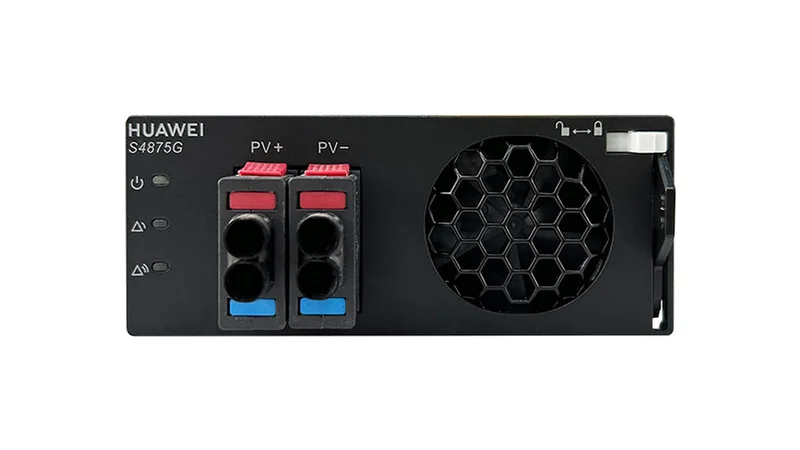
1. Core Electrical Specifications and Topology Architecture
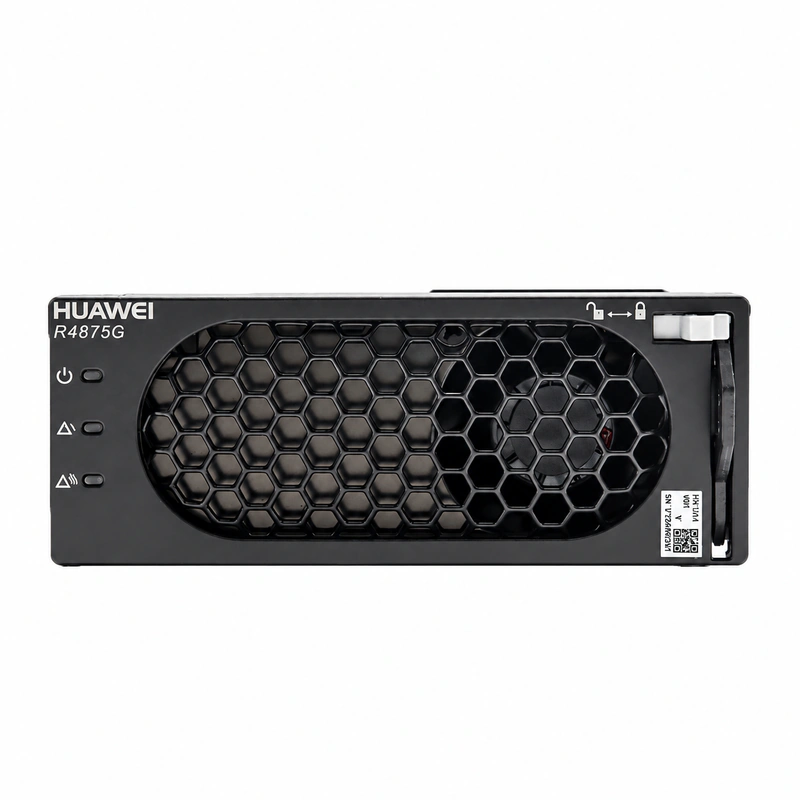
The Huawei R4875G1 is an ultra-high-density, single-phase AC-to-DC digital power rectifier engineered for 5G telecom stations and dense data center infrastructure. Operating under a nominal input of 200VAC to 240VAC, a single unit delivers up to 4000W with a nominal output current of 75A (peak capability up to 83.3A). The peak power conversion efficiency reaches 96.5%, with efficiency and any certification to be checked against the exact manufacturer specification and applicable test conditions.
The module features an ultra-wide AC input operating window spanning 85VAC to 300VAC. Between 85VAC and 176VAC, the integrated digital signal processor (DSP) may reduce available power at low input voltage; the actual curve and shutdown thresholds require the exact manufacturer documentation, and derating alone does not guarantee uninterrupted DC bus power. The unit provides 300VAC overvoltage withstand capability and 3000VAC input-to-ground dielectric isolation. Its DC output is adjustable between -42VDC and -58VDC, catering precisely to float and equalization charge profiles for VRLA and LiFePO4 battery banks.
Nominal Ratings: Single-phase 200-240VAC input, -48VDC/75A nominal output, 4000W power capacity The nominal -48V bus designation and the rated power operating point are distinct; verify the manufacturer voltage/current curve for the exact version rather than treating these values as one simultaneous rating.
Wide Input Tolerance: 85VAC to 300VAC operational window with linear derating below 176VAC
High Conversion Efficiency: Peak efficiency greater than or equal to 96.5%, Power Factor (PF) >= 0.99, THD <= 5%
Thermal and Acoustic Design: Intelligent dual-fan forced cooling, variable speed control, acoustic noise <= 55 dBA at 25C
2. Subrack Chassis and Supervisory Monitoring Compatibility Matrix
Before procuring R4875G1 modules for capacity expansion, telecom engineers must verify the continuous current rating of the subrack chassis backplane connectors and internal DC busbars. Because each R4875G1 delivers 75A, thermal dissipation and contact current density significantly exceed legacy 50A units such as R4850G2.
For ETP48300-C9A1, ETP48400, ETP48600, MTS9606B and MTS9000, obtain manufacturer approval for the exact rectifier part number, chassis, backplane and firmware combination. SMU02B or SMU02C naming alone does not establish CAN functions, addressing, current sharing or battery compensation support. Installing R4875G1 units into low-ampacity 1U subracks without busbar rating evaluation risks severe contact overtemperature.
Subrack verification: Obtain the exact manufacturer compatibility record for the proposed ETP or MTS chassis; series names alone are not approval.
Chassis Restrictions: Avoid unverified deployment in low-capacity 1U/2U subracks such as early ETP4890
Supervisory unit verification: Confirm the exact SMU02B / SMU02C hardware, firmware and approved communication functions.
Parallel operation: Use only the module count, total current and hot-swap procedure approved for the exact chassis and controller configuration.
3. Retrofit Strategies and Capacity Expansion from Legacy Units
Replacing R4850G2, R4850N1 or R4830G1 with R4875G1 requires manufacturer approval for the exact chassis, backplane and controller combination. Comparing 50A with 75A does not by itself establish a compatible retrofit or a corresponding power-density increase.
A successful retrofit requires three checks: qualified personnel must size AC protection from the actual input voltage, continuous load, conductor ampacity, installation conditions and applicable protection rules, rather than prescribe 40A or 63A from output wattage alone. Verify DC conductor and busbar ampacity and allowable temperature rise against the approved design. Set battery recharge limits from the actual battery/BMS specifications and approved controller configuration.
Per-slot capacity: Confirm approved mechanical fit and current rating before replacing a 50A module with a 75A module.
AC breaker sizing: Qualified personnel must calculate protection from input voltage, continuous load, conductor ampacity and applicable installation rules; no universal replacement rating is specified.
DC cabling and bus verification: Calculate conductor size from continuous current, routing, ambient temperature, allowable voltage drop and protection coordination; do not assume a universal cross-section.
Monitoring Parameters: Update rectifier profiles and battery charge current limits within the SMU supervisor
4. Procurement Risk Mitigation, Authenticity Inspection, and Testing Protocols
Due to high commercial demand, the secondary and refurbished telecom market contains remarked labels, resprayed chassis, and units with compromised internal components. Procuring reliable hardware requires a systematic technical inspection protocol.
First, verify that the laser-etched matrix barcode on the chassis matches the silk-screened serial label, cross-referencing serial numbers against manufacturer batch records. Second, inspect the rear blind-mate edge connectors for gold-plating wear; genuine unissued units exhibit clean, uniform gold deposition without insertion gouges or oxidation. Third, inspect internal filtering capacitors through ventilation slots; authentic industrial units employ 105C long-life Japanese electrolytics (such as Nippon Chemi-Con or Rubycon). Finally, agree a load-bank test at a manufacturer-approved voltage/current operating point, temperature, duration and ripple limit for the exact version; record the measured results against its serial number.
Barcode Traceability: Laser-etched chassis codes and adhesive labels must correlate with motherboard serials
Connector Integrity: Rear gold-finger contacts and alignment pins must show zero arc burns or re-soldering
Component Quality: Internal topology must feature original 105C industrial-grade electrolytic capacitors
Load-test evidence: Request serial-number-linked results with the actual voltage, current, temperature, duration and acceptance limits agreed for the exact version; certification is not established here.
5. RICEWIND Global Inventory and Engineering Support
For Huawei R4875G1, R4850G2, ETP48300, Vertiv NetSure and ZTE ZXDU procurement, request current availability, unit condition, serial-number-linked inspection evidence, pricing and a written dispatch estimate from RICEWIND. This article does not establish ready stock, completed testing or immediate delivery.
Request actual serial-number-linked load and isolation test records and written warranty terms for the offered units; completed testing and coverage are not established by this article. For datasheets, bulk price quotations, or technical retrofit support, contact our engineering team directly at lee@ricewind.com or telephone/WhatsApp: +86 17621197907.
Supply enquiry: Confirm current availability and condition for the exact Huawei, Vertiv, ZTE or Delta part number.
QA evidence: Request actual serial-number-linked load-test and safety inspection records; do not assume every unit has passed full-load testing.
Fast International Logistics: Air and ocean freight dispatch tailored for mission-critical project timelines
Direct Engineering Contact: Inquiries and technical support via lee@ricewind.com or +86 17621197907
Engineering Procurement & Technical Desk
For technical datasheets, custom power topology design, or volume export quotations, reach out to HEFENGQI engineers.