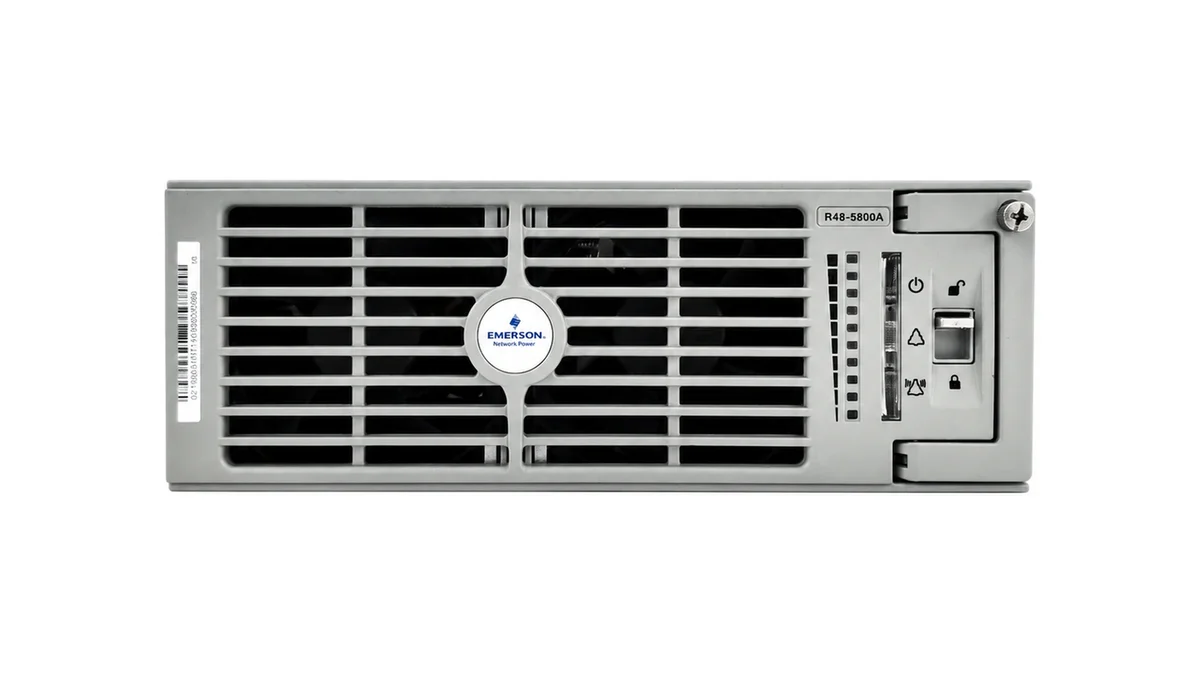
Section 1: High-Density Power Architecture & Thermal Mechanics
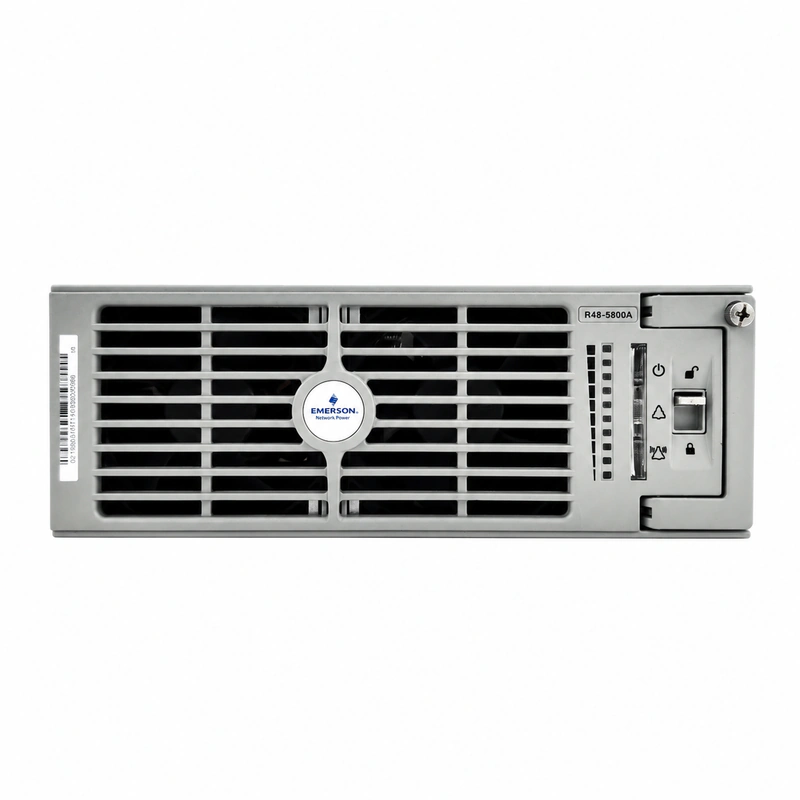
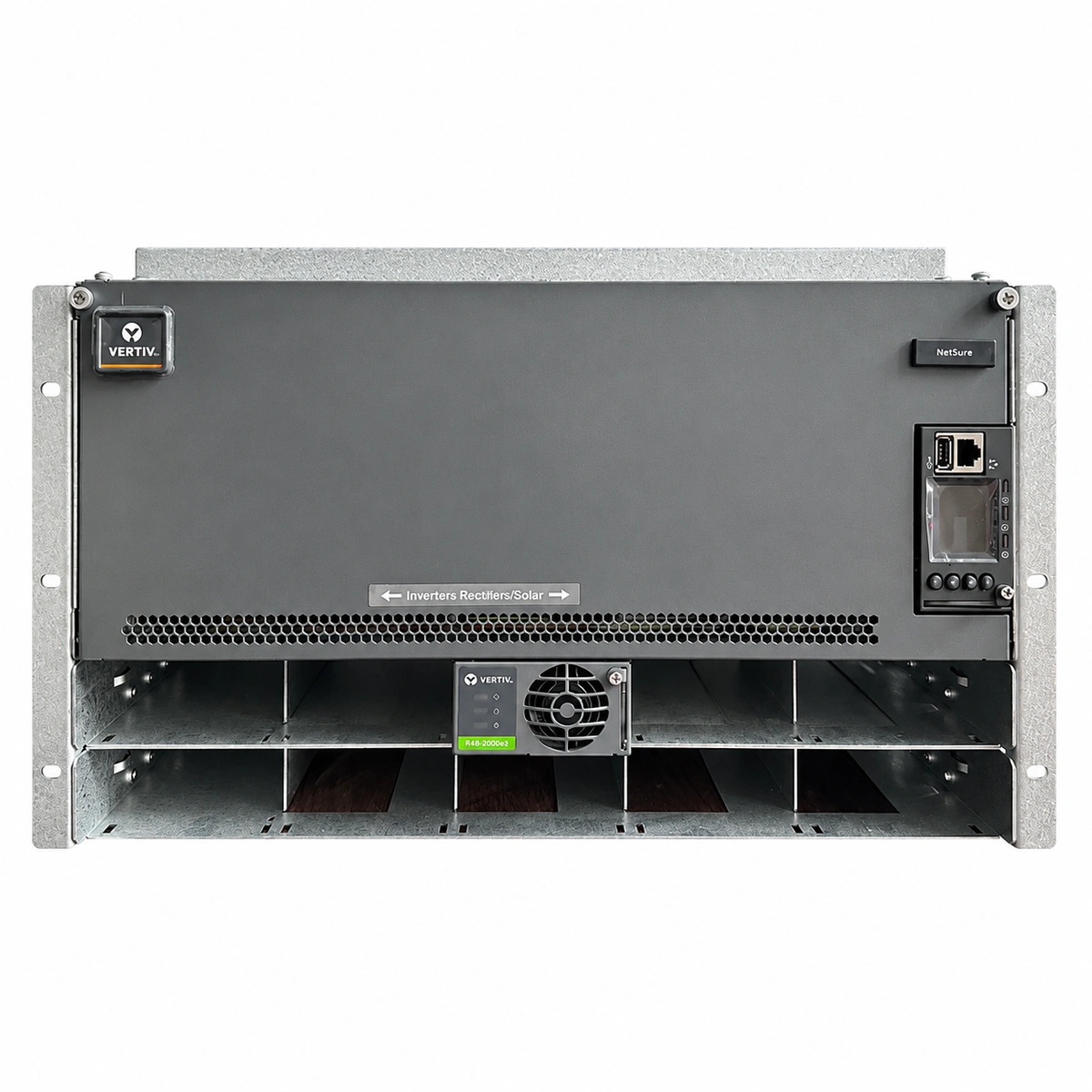
The physical architecture of the Vertiv R48-5800A is optimized for extreme volumetric power density within large-scale telecommunications and mission-critical data center power enclosures. Housed within a ruggedized electro-galvanized cold-rolled steel cassette measuring 88 mm in height (standard 2U form factor), 244 mm in width, and 372 mm in depth, the module achieves an outstanding power density exceeding 730 W/L (12 W/in³). This mechanical profile allows high-capacity central office power plants, such as the Vertiv NetSure 801 and NetSure 808 platforms, to pack up to 40 to 80 rectifier modules within a standardized dual-rack footprint, aggregating massive continuous DC currents ranging from 4,000 A to 8,000 A. The module enclosure is rated IP20, engineered explicitly for controlled telecom white-space and centralized DC power rooms utilizing filtered indoor airflow.
Crucial to the structural and operational reliability of the R48-5800A is its rear interconnect subsystem, which features a multi-pin, blind-mate, gold-plated high-current blind-insertion connector. This connector array integrates heavy-gauge primary DC bus blades, single-phase AC input lugs, auxiliary power contacts, and precision CAN bus signal pins into a single self-aligning mechanical interface. The gold-plated contact surfaces provide an ultra-low contact resistance of less than 0.15 milliohms per DC blade, minimizing localized Joule heating under maximum 100 A continuous output conditions. Reinforced guide pins on the module chassis provide lateral and vertical alignment tolerances of up to ±2.0 mm, guaranteeing smooth insertion and extraction cycles rated for more than 500 mating iterations without pin galling or degradation of interfacial contact pressure. An ergonomic front-panel mechanical cam-lever extraction handle ensures controlled engagement and disengagement forces, preventing sudden mechanical shocks to internal high-power magnetic components and surface-mount assemblies.
Thermal management is executed via an isolated, straight-through front-to-back forced-air tunnel driven by dual internal pulse-width modulated (PWM) brushless DC axial fans. Unlike legacy designs utilizing a common open-air cavity, the R48-5800A segregates sensitive control circuitry, gate-driver boards, and microprocessor controllers from the primary thermal convection path containing high-temperature planar transformers, resonant inductors, and power MOSFET heatsinks. The dual-fan system operates on an intelligent closed-loop speed regulation algorithm that queries internal negative temperature coefficient (NTC) thermistors positioned directly on the primary silicon heatsinks. At nominal load and standard ambient temperatures (+25°C), the fans run at reduced duty cycles, suppressing acoustic noise to under 55 dBA. In the event of an individual fan rotor stall or tachometer pulse failure, the integrated controller drives the operational companion fan to 100% duty cycle and reports an urgent thermal warning over the CAN bus while preserving module uptime through active power limiting if ambient conditions warrant.
Section 2: Utility Grid Compatibility & Multi-Phase Power Factor Conditioning
The R48-5800A features an ultra-wide single-phase AC input operating window spanning 85 V AC to 300 V AC, supporting nominal utility configurations of 200 V AC to 250 V AC line-to-neutral (L+N+PE) derived from three-phase 380 V/400 V/415 V AC electrical distribution topologies. The module incorporates internal two-phase interleaved boost power factor correction (PFC) circuitry operating at high switching frequencies. By interleaving two out-of-phase boost stages, the input ripple currents partially cancel out, drastically reducing conductive stress on the internal input electromagnetic interference (EMI) filter stages. The PFC stage forces the input current waveform to precisely track the sinusoidal profile of the utility voltage, yielding a power factor (PF) greater than or equal to 0.99 from 50% to 100% of full rated output, and a Total Harmonic Distortion (THDi) of less than 5% across the entire standard operating envelope, satisfying the stringent requirements of IEC 61000-3-2 and IEEE 519.
To safeguard against utility phase-loss events, severe voltage sags, and catastrophic floating-neutral conditions in unstable industrial grids, the front-end circuitry of the R48-5800A exhibits sustained overvoltage ride-through durability up to 415 V AC continuous without component breakdown or dielectric puncture. High-energy metal oxide varistors (MOVs) rated for Class C and Class D lightning and switching transient suppression are integrated upstream of the bridge rectifier, clamping high-voltage surges up to 6 kV/3 kA according to ANSI/IEEE C62.41 specifications. When utility line voltages surge above 300 V AC, the module executes an autonomous electronic overvoltage shutdown to preserve internal electrolytic bus capacitors, returning to online operation automatically as soon as the AC bus stabilizes within the 85 V to 300 V AC operational window.
Because utility networks in developing or rural telecommunication corridors frequently suffer from severe brownouts, the R48-5800A integrates a linear low-voltage power derating profile rather than abrupt undervoltage tripping. The module delivers its full 5800 W continuous rated capacity from 176 V AC to 300 V AC. For utility voltages dipping between 176 V AC and 85 V AC, the available output power derates linearly according to the operational transfer function P_out(V_in) = P_rated * ((V_in - 85) / (176 - 85)), terminating at approximately 40% of rated capacity (2320 W) at 85 V AC. This progressive foldback prevents tripping upstream circuit breakers due to excessive primary input currents, allowing uninterrupted battery charging and transmission load support during acute grid collapse events without requiring immediate diesel generator startup.
Section 3: DC Conversion Dynamics & Ultra-Low Noise Regulation
Downstream of the high-voltage intermediate DC link, the Vertiv R48-5800A employs a high-efficiency active zero-voltage-switching (ZVS) and zero-current-switching (ZCS) LLC half-bridge resonant DC-DC converter topology. Coupled with secondary-side active synchronous rectification utilizing ultra-low RDS(on) trench-gate power MOSFETs, the system eliminates traditional diode conduction losses. This conversion topology delivers a certified peak electrical conversion efficiency exceeding 96.0%, accompanied by an exceptionally flat efficiency curve that maintains greater than 95.5% efficiency from 30% through 90% load utilization. The resulting minimization of waste thermal dissipation not only reduces HVAC chiller loads within carrier facilities but also lowers internal operating junction temperatures, extending component operational longevity.
The DC output characteristics are engineered to meet the hyper-sensitive power quality requirements of carrier-grade optical transport platforms (OTN/DWDM), Multi-Protocol Label Switching (MPLS) core routers, and sensitive high-speed serial links. Across an adjustable output range of -42 V DC to -58 V DC (delivering a continuous 100 A at -58 V DC for float-charging VRLA or lithium-ion battery banks), the steady-state voltage regulation accuracy remains tighter than ±0.5%. Peak-to-peak wideband ripple and noise across a 20 MHz bandwidth is constrained below 150 mVp-p. Most critically for legacy and broadband voice-over-packet switching infrastructure, the weighted psophometric noise measured in accordance with ITU-T Recommendation O.41 remains below 1.0 mV, preventing audio-band harmonic cross-talk, jitter, and frame transmission errors in dense communication networks.
Dynamic transient response and multi-unit load balancing are governed by high-speed digital signal processor (DSP) routines. When subjected to an aggressive 10% to 90% step load variation, the output voltage recovers to within ±1.0% of its nominal setpoint in less than 200 microseconds, preventing dangerous DC bus voltage dips that could trigger low-voltage disconnects on high-density computing loads. In multi-module configurations comprising up to 80 units connected to a common low-impedance copper busbar, the R48-5800A utilizes an autonomous, active digital current-sharing algorithm running across its integrated CAN communication interface. Without requiring dedicated analog share-bus wiring, the system achieves a steady-state current sharing error margin of less than ±3% between adjacent rectifiers, preventing localized thermal hotspotting and ensuring identical wear profiles across all installed modules.
Section 4: System-Level Central Office Integration & Intelligent Sleep Scheduling
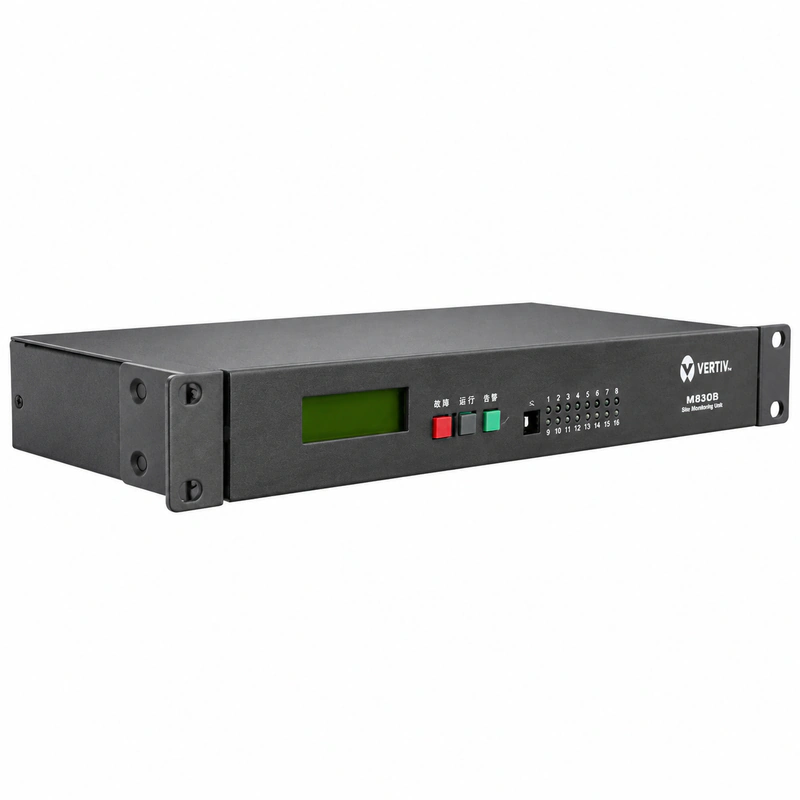
In enterprise telecommunication central offices and modular edge data centers, the R48-5800A functions as the core building block of modular power systems such as the Vertiv NetSure 801, NetSure 808, and PS481200 series. Module-to-supervisor coordination is established via dual-redundant high-speed CAN bus channels operating on a deterministic carrier-sense multi-access protocol. Real-time telemetry frames are continuously transmitted to the Vertiv NetSure Control Unit (NCU, M830B, or M221S controllers), conveying comprehensive internal sensor metrics including per-phase AC input voltage, input current, DC output bus voltage, individual output current, primary heatsink temperatures, ambient intake air temperature, individual fan RPM values, and active internal firmware diagnostic warning registers.
To maximize plant efficiency under variable IT workloads, the R48-5800A supports dynamic multi-module energy-saving sleep scheduling orchestrated by the centralized system supervisory controller. In typical telecom operations, network traffic plummets during late-night hours, driving the overall power plant load down to 15% to 25% of its total N+1 or N+2 design capacity—a range where legacy rectifiers operate at suboptimal conversion efficiencies. The NCU supervisor monitors the aggregate load and automatically commands surplus R48-5800A modules into a low-power deep-sleep standby mode (consuming less than 5 W per dormant module). The active modules are dynamically concentrated into their 50% to 80% operational sweet spot, sustaining system efficiency above 96.0%. The control system cycles the active and sleeping modules on a rotational timer to balance cumulative operating hours across all units. Should a sudden network load transient occur or an active rectifier fail, sleeping modules wake and achieve full 100 A power injection within 50 milliseconds, ensuring zero disruption to the critical DC bus.
The R48-5800A integrates comprehensive, multi-tiered protection mechanisms to ensure uninterrupted power delivery and hardware survivability. Output overvoltage conditions are managed via independent dual-path detection: a high-speed hardware crowbar circuit that latches the module off within 10 microseconds if output levels exceed preconfigured thresholds (typically -59.5 V DC), alongside a secondary software-monitored clamp. Output short circuits are mitigated via constant-current limiting down to zero volts, transitioning into an automatic cyclic hiccup mode under sustained metallic dead-short conditions to eliminate thermal runaway. Over-temperature protection features progressive foldback algorithms that scale down maximum continuous current output if ambient cooling becomes severely compromised, preserving basic DC bus support while notifying facility operators via SNMP traps transmitted through the plant controller.
Section 5: Mission-Critical Applications & Extreme Thermal Envelope
The structural engineering and operational tolerance of the Vertiv R48-5800A position it as an ideal primary power engine across demanding mission-critical sectors. In Tier 3 and Tier 4 Telecommunication Central Offices and Mobile Switching Centers (MSC), the module powers dense arrays of optical cross-connects, core edge routers, and Baseband Units (BBUs). With the transition of hyperscale computing facilities toward high-density -48V DC architectures to power artificial intelligence (AI) server pods, high-current GPU clusters, and custom Open Compute Project (OCP) busbar racks, the R48-5800A provides the massive current output and instantaneous dynamic step-load capacity needed to mitigate the microsecond-level load transients inherent to modern AI inference and training workloads.
In critical infrastructure such as metropolitan optical transport networks (OTN/DWDM sub-stations), railway signaling systems, and electric utility distribution substations, DC power plants must operate flawlessly under severe environmental stress. The R48-5800A is certified for continuous operation across an ambient temperature range of -40°C to +75°C (-40°F to +167°F). It delivers its full 5800 W continuous rated output at ambient temperatures up to +55°C (+131°F). Between +55°C and +75°C, an integrated thermal management algorithm executes a controlled, linear power derating down to 50% of rated capacity at +75°C, ensuring that safety-critical monitoring, signaling, and remote telemetry units (RTUs) retain uninterrupted primary DC power even during facility HVAC catastrophic failure events.
Acoustic and vibrational design principles further expand the application profile of the R48-5800A. The dual-fan assembly is suspended on silicone elastomeric vibration dampers, decoupling mechanical resonance from the external sheet metal casing and central office cabinet frames. Advanced computational fluid dynamics (CFD) modeling of the internal heatsink fins and planar transformer core assemblies eliminates aerodynamic whistling, maintaining acoustic emissions below 55 dBA during normal load conditions. This compliance allows the deployment of high-capacity DC power bays within mixed-use technical facilities, edge micro-data centers, and indoor communication hubs adjacent to human workspaces without exceeding occupational noise safety limits.
Section 6: Procurement Verification, Genuine OEM Module Identification & 10-Year Lifecycle TCO
Because of the critical operational roles occupied by the Vertiv R48-5800A, procurement integrity is paramount. Gray-market supply chains and unauthorized third-party refurbishers frequently distribute cloned, reworked, or counterfeit units masquerading under OEM part markings. Procurement engineers must verify authenticity through physical and firmware validation protocols. Genuine R48-5800A modules feature high-grade automotive-grade conformal coating (inspected under UV blacklight to confirm uniform, bubble-free coverage over all surface-mount ICs), factory laser-etched serial numbers matching the internal non-volatile EEPROM manufacturing registers, and unbroken OEM security calibration tamper seals over the internal chassis joinery. Furthermore, authentic modules report authorized hardware revision codes, compiled digital signatures, and factory burn-in test logs via CAN bus interrogation when queried by a certified Vertiv NCU controller.
From a Total Cost of Ownership (TCO) perspective, the high initial conversion efficiency and robust component selection of the R48-5800A deliver compelling financial returns across a typical 10-to-15-year telecom infrastructure asset lifecycle. Incorporating premium 105°C-rated long-life metallized film capacitors, military-spec ceramic bypass arrays, and magnetic elements utilizing high-flux-density nanocrystalline cores, the module demonstrates a calculated Mean Time Between Failures (MTBF) exceeding 350,000 hours in accordance with Telcordia SR-332 standards. The incremental 2% to 4% efficiency advantage delivered by the R48-5800A over legacy -48V rectifiers yields significant electrical energy savings. In a typical 4,000 A central office operating continuously at 70% average load, this efficiency differential prevents thousands of kilowatt-hours of annual dissipation, reducing direct utility consumption while lowering HVAC heat extraction costs in equal measure.
Engineering procurement teams, datacenter infrastructure architects, and mission-critical facility operators requiring validated OEM supply, factory warranty assurance, and specialized integration advisory for the Vertiv R48-5800A power platform should engage directly with the engineering distribution desk at RICEWIND. RICEWIND maintains end-to-end trace-level chain-of-custody verification, providing full factory certification documentation, automated test bench acceptance records, and system-level configuration consulting for large-scale multi-rack deployments. Direct engineering inquiries, technical RFP specifications, and procurement schedules can be directed to the RICEWIND specialist team via email at lee@ricewind.com or by Phone, WhatsApp, and WeChat at +86 17621197907.
Engineering Procurement & Technical Desk
For technical datasheets, custom power topology design, or volume export quotations, reach out to HEFENGQI engineers.