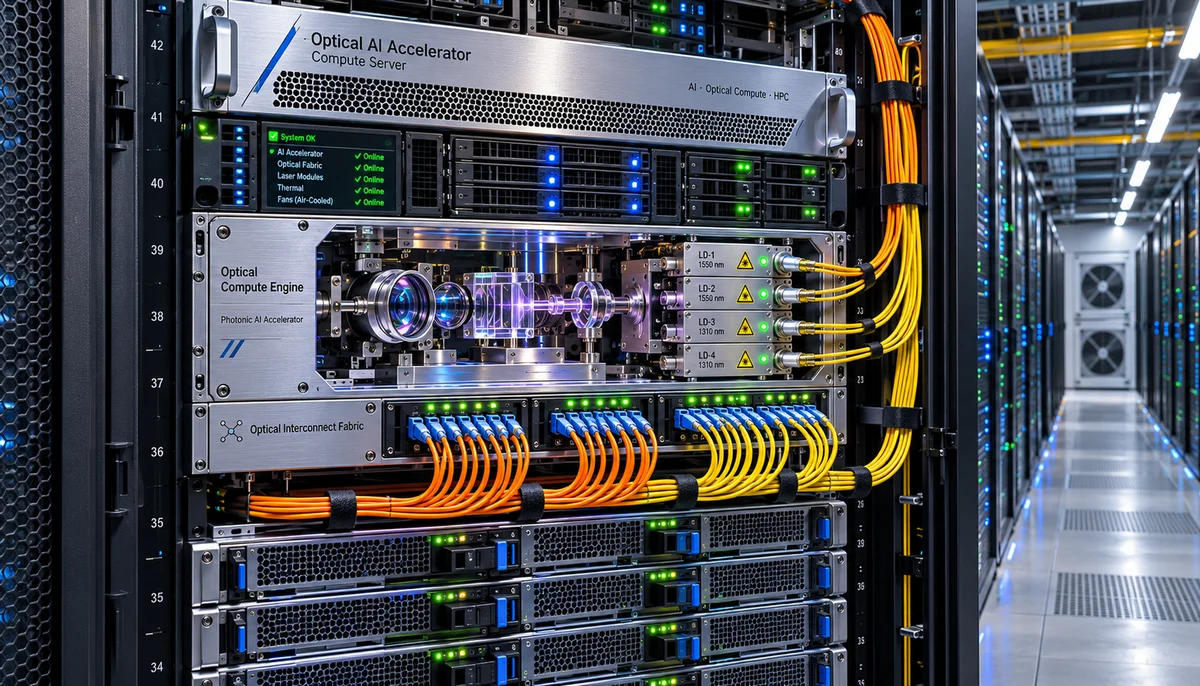
Photonic GEMM Physics: Bypassing CMOS Capacitive and Thermal Limits
Modern deep learning workloads are structurally dominated by dense General Matrix Multiply (GEMM) routines. In advanced sub-3nm silicon CMOS processors, executing these operations requires routing billions of electrical charges through metal-oxide-semiconductor field-effect transistors. Each switching cycle dissipates energy directly proportional to gate capacitance, clock frequency, and operating voltage squared. Furthermore, parasitic resistance and capacitance within copper interconnects compound thermal throttling, establishing an asymptotic energy barrier between 1.0 and 3.0 picojoules per Multiply-Accumulate (MAC) operation. As tensor processing units scale toward multi-gigawatt cluster deployments, dynamic switching energy and leakage currents increasingly restrict computational density.
Optical compute engines fundamentally sidestep transistor switching overhead by performing tensor operations entirely within the analog optical domain. Input activations are modulated onto coherent, continuous-wave laser carriers using dense Wavelength Division Multiplexing (WDM) and high-speed electro-absorption modulators. These optical signals propagate through passive matrix units comprising micro-ring resonator arrays, cascaded Mach-Zehnder Interferometers (MZIs), or free-space diffractive optical elements. The physical interference, phase shifting, and attenuation of light waves instantaneously perform parallel analog multiplications and coherent summations at the speed of light. Because passive photonic structures experience no dynamic capacitive charging, fundamental energy dissipation falls below 0.1 pJ per MAC, generating virtually zero operational heat during matrix calculation.
Sub-0.1 pJ/MAC operational efficiency in passive optical matrix units versus 1.0-3.0 pJ/MAC in leading 3nm CMOS nodes
Wavelength Division Multiplexing (WDM) across standard 1310nm O-band and 1550nm C-band optical channels
Zero dynamic capacitive switching loss across passive waveguide and free-space diffractive propagation paths
Linear propagation compute execution speed bounded purely by the refractive index of silicon nitride and silica waveguides
Prefill-Decode Disaggregation: Exploiting Inference Computational Asymmetry
Autoregressive transformer inference exhibits a bifurcated execution profile governed by two distinct operational phases: the prefill phase and the decode phase. The prefill phase processes the incoming prompt context and is strictly compute-bound. In this stage, all model weights are reused across every input token within dense tensor matrices, producing exceptionally high arithmetic intensity. Conversely, the subsequent decode phase is memory-bandwidth-bound, generating output tokens sequentially in a single-token autoregressive loop. Decode throughput is gated not by raw arithmetic core capability, but by memory transfer latency across High Bandwidth Memory (HBM3e/HBM4) buses.
Disaggregated serving topologies exploit this operational divergence by dedicating heterogeneous hardware pipelines to each phase. By deploying optical AI accelerators (such as the Lumai Iris Nova architecture) exclusively within prefill clusters, hyperscalers isolate compute-dense Key-Value (KV) cache generation on photonic engines. The resulting KV caches are packetized and streamed over ultra-low-latency 800Gbps/1.6Tbps RoCEv2 or InfiniBand fabrics directly to memory-optimized GPU or custom ASIC clusters dedicated solely to token generation. Software orchestration frameworks, including vLLM with Chunked Prefill offloading and SGLang, dynamically schedule context ingest across optical engines to maintain saturated memory pipelines on downstream decode nodes.
Prefill cluster specialization optimized for dense arithmetic intensity exceeding 150 FLOPs per byte
KV cache handoff over 800Gbps RoCEv2 and InfiniBand fabrics supporting zero-copy RDMA primitives
Preservation of high-capacity HBM3e/HBM4 bandwidth exclusively for sequential token generation in decode pools
Framework integration across vLLM Chunked Prefill, PagedAttention offload, and SGLang scheduling runtimes
Thermal and Power Budgets: Air-Cooled Integration in Brownfield Facilities
Hyperscale and enterprise data center operators face severe power and cooling bottlenecks. Modern liquid-cooled AI compute racks frequently exceed 100kW per footprint, necessitating multi-million-dollar capital expenditures to install Coolant Distribution Units (CDUs), secondary fluid loops, and dedicated dry coolers. Concurrently, thousands of legacy brownfield facilities remain restricted to 10kW to 20kW rack envelopes cooled exclusively by conventional computer room air handlers (CRAHs) under ASHRAE A1/A2 environmental baselines. Transitioning these standard air-cooled facilities to support high-density AI clusters is economically and structurally unviable without radically reducing compute heat generation.
Optical AI accelerators resolve this infrastructure impasse through a hybrid electro-optic architecture. Passive photonic engines execute power-intensive linear matrix multiplications with negligible thermal output, while localized digital microcontrollers and integrated SRAM/DRAM manage non-linear operations such as Softmax, LayerNorm, and SiLU activations. Consequently, a high-throughput 2U/4U optical accelerator chassis consumes only 1.5kW to 2.5kW of total electrical power. These modest profiles allow full rack integration within standard EIA-310 19-inch cabinets operating on traditional hot-aisle/cold-aisle containment, completely circumventing facility-level plumbing retrofits while delivering petascale prefill processing.
Chassis power envelope constrained to 1.5kW - 2.5kW per 2U/4U enclosure under full tensor processing load
Complete compatibility with standard EIA-310 19-inch rack frames and N+1 raised-floor air cooling systems
Compliance with ASHRAE A1/A2 facility operating temperature standards ranging from 15°C to 35°C
Hybrid architectural partitioning isolating linear optical GEMM from low-power digital non-linear layers
Optoelectronic Component Supply Chain and Environmental Robustness
The economic and operational viability of optical AI accelerators relies heavily on standard telecom and datacom component supply chains. Rather than depending on exotic optical substrates, modern accelerators leverage mass-manufactured Indium Phosphide (InP) and Silicon Photonics (SiPh) platforms. Laser arrays utilize commercial continuous-wave Distributed Feedback (DFB) laser diodes and standard electro-absorption modulators operating within the 1310nm (O-band) or 1550nm (C-band) spectral windows. Interconnect inputs take advantage of ubiquitously sourced OSFP and QSFP-DD optical transceiver form factors, utilizing mature packaging lines already established for enterprise networking.
Environmental stability remains a primary engineering vector in data center deployment. To counter thermal drift and ambient mechanical vibration, optical compute modules incorporate closed-loop, phase-locked interferometric monitoring circuits coupled with localized thermoelectric coolers (TECs). These active feedback loops maintain optical phase alignment and constrain laser wavelength drift to less than 0.01 nm/°C across broad operating ranges (10°C to 45°C). Furthermore, anti-reflective optical facet coatings and optimized waveguide grating couplers suppress insertion losses to ensure the optical signal-to-noise ratio (SNR) consistently satisfies dynamic range requirements for INT8 and FP8 precision inference.
Utilization of standard InP and SiPh continuous-wave Distributed Feedback (DFB) laser arrays
Phase-locked interferometric feedback circuits maintaining optical wavelength stability below 0.01 nm/°C
Packaging standardization on mass-produced OSFP and QSFP-DD high-density optical transceiver modules
Optical insertion loss mitigation ensuring signal-to-noise ratios tailored for native FP8 and INT8 numerical formats
Hyperscale Economics: Stranded Power Reclamation and TCO Realignment
Data center capacity is fundamentally bounded by utility substation grid feeds. When power delivery is capped at the facility boundary, deploying power-dense GPU clusters forces operators to strand physical floor space and unallocated rack positions once the electrical megawatt ceiling is reached. By replacing energy-inefficient electrical prefill computation with optical accelerators, operators reallocate 60% to 70% of the energy historically consumed during prompt evaluation. This recovered electrical headroom can be redirected to power additional decode nodes or host clusters, enabling up to a 3x increase in prompt-processing concurrency within identical substation boundaries.
Empirical trials conducted within pilot initiatives, such as the UK ARIA (Advanced Research and Invention Agency) Scaling Inference Lab, demonstrate the enterprise reliability and sustainability of optical acceleration in production. Accelerated workloads achieve zero dependency on evaporative cooling towers, slashing Water Usage Effectiveness (WUE) metrics to absolute zero while driving facility Power Usage Effectiveness (PUE) toward theoretical minimums. Integrated seamlessly into orchestration layers via Kubernetes device plugins and KServe endpoints, production photonic servers demonstrate hardware Mean Time Between Failures (MTBF) exceeding 100,000 hours, validating optical AI as a robust infrastructure pillar.
Reclamation of up to 70% inference power allocated to prompt prefill for expanded cluster concurrency
Complete elimination of evaporative cooling dependency, driving facility WUE to near-zero levels
Demonstrated system Mean Time Between Failures (MTBF) exceeding 100,000 operational hours in testbeds
Production workload orchestration via standard Kubernetes device plugins, Ray Serve, and KServe
Engineering Procurement & Technical Desk
For technical datasheets, custom power topology design, or volume export quotations, reach out to HEFENGQI engineers.