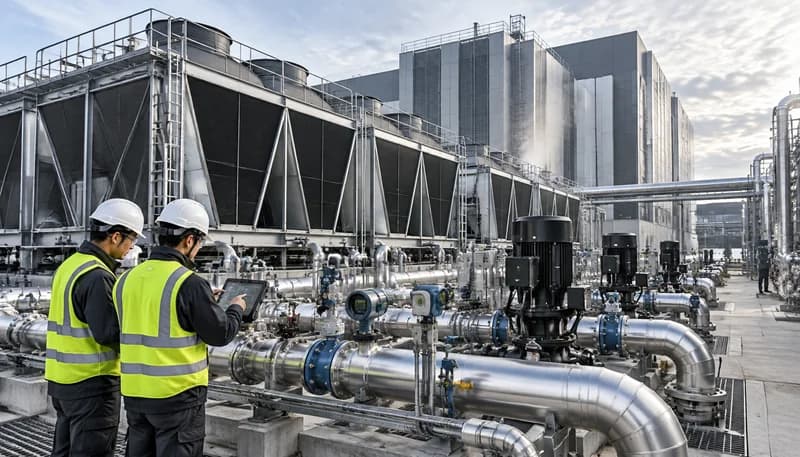
The Hydrological Siting Boundary: Aquifer Depletion and Peaking Factor Realities
Hyperscale computing clusters and dense artificial intelligence training topologies dissipating between 40 kW and 120 kW per rack have shifted data center siting constraints from power availability to local hydrological capacity. While legacy facilities historically treated municipal potable infrastructure as an infinite utility sink, regional water authorities increasingly view multi-megawatt facilities as critical grid risks. In high-density corridors such as the Virginia Coastal Plain, regulatory assessments by environmental protection agencies indicate that modeled sustainable groundwater withdrawal capacity along primary transport routes sits below 30,000 gallons per day (GPD), with extreme regional limits capped at 360,000 GPD in outlying basins. These regulatory ceilings conflict directly with standard evaporative hyperscale campuses, which frequently demand 1.0 to 3.5 million gallons per day during design-basis summer peaks.
The reliance on annual Water Usage Effectiveness (WUE, defined as annual cooling water consumption in liters divided by IT energy consumption in kilowatt-hours) creates a dangerous false sense of security. An annual average WUE of 0.25 to 0.45 L/kWh routinely masks acute peak-day operating dynamics, where continuous high wet-bulb temperatures and maximum IT workloads cause instantaneous water draw to escalate by 400% to 600%. During these coincident environmental and computational peaks, municipal water treatment plants and distribution networks face localized pressure drops, leading water utilities to issue curtailment mandates that threaten continuous critical operations.
Consequently, facility designers must pivot from annualized metrics to instantaneous peak-stress modeling. The mechanical design must incorporate regional watershed stress indices, 50-year drought recurrence intervals, and municipal peaking factors to establish an authentic hydrological boundary. Siting analyses conducted by our engineering research institute now require simultaneous assessment of hydraulic infrastructure delivery capacity, fire-loop recharge isolation, and worst-case summer afternoon water extraction rights before finalizing thermal topology baselines.
Audit municipal hydraulic delivery capacity against peak coincident wet-bulb operations rather than annual average demand profiles.
Establish regional groundwater permit ceilings, verifying local aquifer recharge rates against continuous multi-megawatt heat rejection demands.
Incorporate 99.6% ASHRAE peak ambient design conditions to calculate instantaneous water extraction spikes and municipal surge penalties.
Thermodynamic Physics: Open Evaporation versus Closed-Loop Adiabatic Rejection
The thermodynamic rationale for evaporative heat rejection rests entirely on the latent heat of vaporization of water, which delivers approximately 2,260 to 2,420 kJ/kg of heat absorption depending on saturation temperature. By rejecting heat to the ambient wet-bulb temperature, open cooling towers permit chiller condenser water to leave the plant at 29°C to 31°C, even when ambient dry-bulb conditions exceed 40°C. This low condensing temperature optimizes the thermodynamic efficiency of centrifugal chillers, producing exceptionally low Power Usage Effectiveness (PUE) values between 1.10 and 1.18. However, this electrical optimization comes at a staggering hydrological expense, consuming up to 2.5 liters of potable water per kilowatt-hour of heat dissipated across the condenser loop.
Conversely, pure dry-cooling configurations reject thermal energy strictly through sensible heat exchange governed by the ambient dry-bulb temperature. Because summer dry-bulb temperatures can exceed 42°C in temperate and arid zones, pure air-cooled chillers require substantial compressor lift, elevating condensing temperatures above 50°C. This compressor penalty increases chiller power consumption by 25% to 45%, introducing significant electrical substation and transformer sizing burdens. To resolve this thermodynamic tension, closed-loop adiabatic dry coolers deploy an intermittent, micro-misted wetted media or direct high-pressure aerosol injection upstream of finned heat exchanger coils, operating strictly when ambient dry-bulb levels exceed a predetermined economic threshold (typically 24°C to 28°C).
By restricting adiabatic pre-cooling to peak thermal hours, a closed-loop adiabatic plant can reduce gross annual water consumption by 85% to 95% compared to open evaporative towers, while capping the peak condensing temperature seen by mechanical chillers. Fluid containment within sealed coils eliminates open evaporation drift, atmospheric contamination, and legionella aerosol dispersion risks. The engineering design trade-off shifts from continuous water sourcing to precision psychrometric controls, balancing seasonal fin-coil approach temperatures with micro-droplet evaporation efficiency to ensure total droplet vaporization prior to fin contact, thereby preventing fin pack scaling.
Model psychrometric transition curves to set adiabatic wetted-media actuation setpoints between 24°C and 28°C ambient dry-bulb.
Specify variable-frequency drive electronically commutated (EC) fans paired with high-pressure aerosol humidification nozzles rated at greater than 70 bar.
Design finned-tube coil metallurgy using hydro-phobic epoxy coatings or marine-grade aluminum alloys to withstand intermittent wetting cycles.
Direct-to-Chip (D2C) Liquid Cooling as an Ultimate Water Abatement Strategy
The widespread transition toward Direct-to-Chip (D2C) cold plates and secondary single-phase immersion loops fundamentally rewrites data center water consumption economics. Traditional chilled-water air-handling architectures require low secondary supply water temperatures (typically 12°C to 18°C) to maintain server inlet air temperatures within ASHRAE A1 boundaries (18°C to 27°C). Rejecting heat from a 12°C loop during warm ambient conditions necessitates either energy-intensive mechanical refrigeration or evaporative cooling tower approach temperatures, locking the facility into continuous water consumption.
In contrast, D2C microchannel cold plates directly capture 75% to 85% of total processor thermal output (accommodating thermal design powers exceeding 1,000 watts per silicon package) using circulating treated water-glycol or dielectric solutions. Operating within ASHRAE W3 or W4 liquid cooling classifications permits facility entering water temperatures (EWT) between 32°C and 45°C. At an EWT of 40°C, the temperature differential between the process fluid and the outside ambient air remains positive under virtually all global summer dry-bulb extremes. This high delta-T enables year-round, 100% dry sensible heat rejection using unassisted dry coolers, completely eliminating evaporative towers and adiabatic assist from the primary processor cooling path.
Implementing D2C cooling decouples compute density from ambient wet-bulb psychrometrics. The remaining 15% to 25% of residual air heat generated by auxiliary server board components, power supplies, and storage media can be managed via rear-door heat exchangers (RDHx) or secondary air handling units operating on elevated chilled water loops (20°C to 24°C). This allows the entire facility to operate without consuming a single liter of evaporative water during normal operations, reducing overall campus WUE to near-zero values (less than 0.05 L/kWh, accounting purely for domestic and humidification demands) while simultaneously maintaining total facility PUE below 1.15.
Deploy liquid-to-liquid Coolant Distribution Units (CDUs) configured for ASHRAE W4 thermal envelopes (up to 45°C entering facility water).
Engineer completely dry sensible heat rejection loops sized for peak dry-bulb ambient conditions with zero evaporative trim.
Integrate rear-door heat exchangers (RDHx) operating on elevated 20°C to 24°C loops to abate residual sensible air heat without open tower consumption.
Water Chemistry, Concentration Cycling, and Blowdown Effluent Dynamics
Where open evaporative systems remain deployed, chemical balance and effluent management represent significant regulatory and operational liabilities. As water vaporizes within an open cooling tower, dissolved minerals—primarily calcium, magnesium, silicates, and chlorides—remain trapped in the recirculating basin. The ratio of dissolved solids in the circulating water to that in the raw makeup water defines the Cycles of Concentration (CoC). Operating at low concentration cycles (CoC 2 to 3) minimizes mineral precipitation but drastically inflates makeup water consumption and municipal sewer discharge volumes. Pushing systems to high concentration cycles (CoC 6 to 8) yields diminishing hydrological returns while exponential scaling risks emerge.
Precipitation dynamics are governed by the Langelier Saturation Index (LSI) and Ryznar Stability Index (RSI). When evaporation drives water chemistry into positive LSI ranges (> +1.5), calcium carbonate ($CaCO_3$) and silica ($SiO_2$) precipitate onto condenser heat-exchanger tube walls. Even a microscopic scale layer of 0.1 mm thickness degrades shell-and-tube heat transfer efficiency by up to 10%, causing chiller compressor lift and electrical power draw to skyrocket. Silica scaling is particularly catastrophic, as amorphous silica forms a glass-like barrier at concentrations exceeding 150 to 180 mg/L that resists standard chemical descaling acid washes, requiring mechanical drilling or tube bundle replacement.
Simultaneously, the blowdown stream flushed to the municipal sanitary sewer carries concentrated chemical burdens, including oxidizing biocides (chlorine dioxide, hypochlorite, or stabilized bromine), non-oxidizing biodispersants, and phosphonate corrosion inhibitors. Municipal wastewater treatment authorities impose stringent constraints on blowdown temperature (frequently mandating discharge temperatures below 35°C), total dissolved solids (TDS), and adsorbable organic halogens (AOX). Facilities failing to continuously monitor and neutralize effluent risk emergency municipal discharge cutoffs, immediately forcing either an unpermitted environmental release or a complete mechanical shutdown.
Deploy automated toroidal conductivity sensors and motorized blowdown control valves to dynamically balance CoC between 4.5 and 6.0.
Maintain circulating water silica concentrations strictly below 150 mg/L via precise makeup water blending or weak-acid cation dealkalization.
Install blowdown tempering and neutralization basins equipped with sodium bisulfite injection to quench free halogens prior to sewer discharge.
Alternative Hydrology: Sourcing Strategies Beyond Potable Municipal Water
To insulate data centers from municipal drinking water moratoria and community pushback, infrastructure engineers are redesigning mechanical plants to consume alternative, non-potable hydrological streams. The primary enterprise alternative is Title 22 tertiary-treated reclaimed municipal effluent (graywater). While abundant and economically discounted, reclaimed wastewater carries elevated background TDS, ammonia, organic matter, and dynamic phosphate loads that rapidly induce biological fouling and accelerated copper tube micro-biologically influenced corrosion (MIC). Integrating reclaimed water mandates advanced on-site polishing skids, incorporating multi-media depth filtration, continuous ultraviolet (UV) sanitation, and scale-inhibitor dosing specialized for high-phosphate feedstocks.
Industrial wastewater recycling and on-site stormwater harvesting offer localized supplementary sources but introduce sharp seasonal volume fluctuations and heavy sediment burdens. Stormwater retention infrastructure requires dedicated settling basins, sand filtration, and continuous conductivity monitoring to isolate initial highway runoff containing heavy de-icing salts or hydrocarbon traces. For coastal data centers, deep-well brackish extraction or direct seawater heat sinking eliminates freshwater consumption entirely. However, direct open seawater cooling demands expensive titanium (Grade 2) plate-and-frame heat exchangers, specialized concrete intake structures, and continuous hypochlorite dosing to prevent marine biofouling.
An emerging engineering alternative for saline environments is the Wet Surface Air Cooler (WSAC). In a WSAC system, process fluids flow through closed, serpentine tube bundles that are externally drenched with brackish or seawater while axial fans induce concurrent air and spray water flow. The heavy-gauge titanium or super-duplex stainless steel (alloy 2507) tube bundles tolerate total dissolved solids levels exceeding 30,000 mg/L, allowing low-grade saline sources or even cooling tower blowdown from neighboring industrial facilities to be utilized as heat rejection media without consuming potable water reserves.
Incorporate on-site tertiary polishing with continuous ultraviolet disinfection and automatic backwashing disc filters for reclaimed wastewater intake.
Specify Grade 2 Titanium plate-and-frame heat exchangers when tapping brackish aquifers, seawater loops, or high-chloride effluent sources.
Evaluate Wet Surface Air Cooler (WSAC) topologies to directly utilize unrefined, high-TDS industrial wastewater for peak latent rejection.
Mission-Critical Water Resilience: The Engineering Audit and Curtailment Matrix
A robust hydrological resilience plan treats incoming municipal cooling water with the same rigorous redundancy applied to medium-voltage electrical utility feeds. Enterprise facilities relying on evaporative or hybrid adiabatic rejection must implement dual-redundant, geographically separated municipal water mains, originating from distinct distribution pump zones to eliminate single-point-of-failure vulnerabilities caused by off-site municipal water main bursts. On-site critical water storage must be structurally integrated into the campus civil design, sized to sustain 100% full-load mechanical operations for a minimum duration of 24 to 72 hours under design-basis peak ambient wet-bulb conditions.
On-site water storage systems require continuous water-quality lifecycle management. Stagnant bulk water within concrete or bolted-steel storage tanks undergoes disinfectant dissipation, leading to microbial proliferation, biological slime development, and the growth of Legionella pneumophila. Storage designs must incorporate active recirculation loops, hydrodynamic mixing nozzles, automated secondary biocide dosing, and temperature monitoring to keep bulk storage fluid temperatures below 20°C. Ultrasonic transit-time flow meters must be deployed at all critical junctions—including makeup lines, individual tower basins, chiller blowdown outlets, and adiabatic misting manifolds—to provide real-time mass-balance leak detection across the entire campus.
Finally, the facility Building Management System (BMS) must be programmed with an automated, multi-stage Hydrological Curtailment Matrix. When incoming municipal line pressure decays below critical limits or on-site storage depletion crosses critical operational thresholds, the BMS must automatically initiate deterministic load-shedding and thermal trim protocols. These protocols switch adiabatic coolers into dry forced-convection mode, permit server ambient envelope temperatures to ride up toward the ASHRAE allowable limits (up to 32°C for brief durations), trigger compute-cluster frequency throttling (capping AI GPU power dissipation by 15% to 30%), and signal secondary chillers to run on mechanical compression, preserving the remaining water reserves exclusively for mission-critical IT equipment preservation.
Engineer on-site thermal storage tanks sized for a minimum of 48 hours of continuous peak wet-bulb heat rejection with active hydrodynamic circulation.
Deploy high-frequency ultrasonic mass-balance flow meters across all makeup and blowdown loops, integrated with automated leak-isolation valves.
Program multi-stage BMS emergency interlocks to automatically throttle GPU dynamic clock frequencies and force dry mechanical cooling during water curtailment.
Engineering Procurement & Technical Desk
For technical datasheets, custom power topology design, or volume export quotations, reach out to HEFENGQI engineers.