Section 1: High-Density Solar Telecom Architecture & 1U Form Factor Mechanics
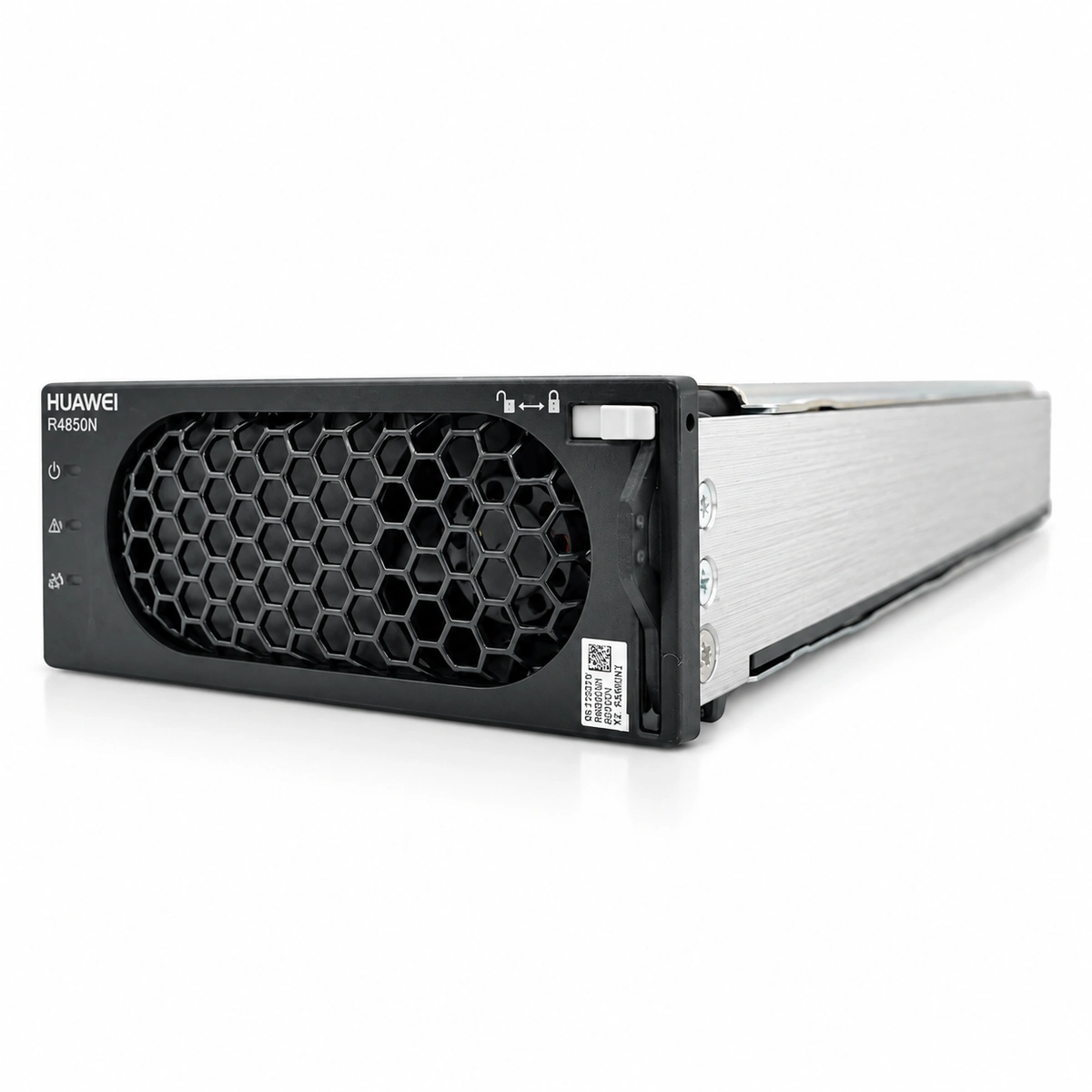
The Huawei S4875G1 establishes a technological milestone in carrier-grade renewable energy integration by packaging a full 4000W Maximum Power Point Tracking (MPPT) DC-DC conversion engine into a standardized 1U form factor measuring 40.8 mm (H) x 105 mm (W) x 281 mm (D), with an operational weight of approximately 2.0 kg. Unlike legacy solar charge controllers that rely on bulky standalone wall-mount enclosures with external wiring harnesses, the S4875G1 utilizes an ultra-compact slide-in cassette architecture. Its outer dimensions and rear high-power blind-mate edge connectors are identical to Huawei R4850G2 and R4875G1 AC rectifiers. This mechanical identity allows direct slot-level interchangeability within standard Huawei power subracks, including the ETP48400, ETP48200, MTS9000A, and TP48600 power platforms, enabling telecom operators to convert existing AC-only rectifier bays into hybrid solar-grid systems without mechanical modification.
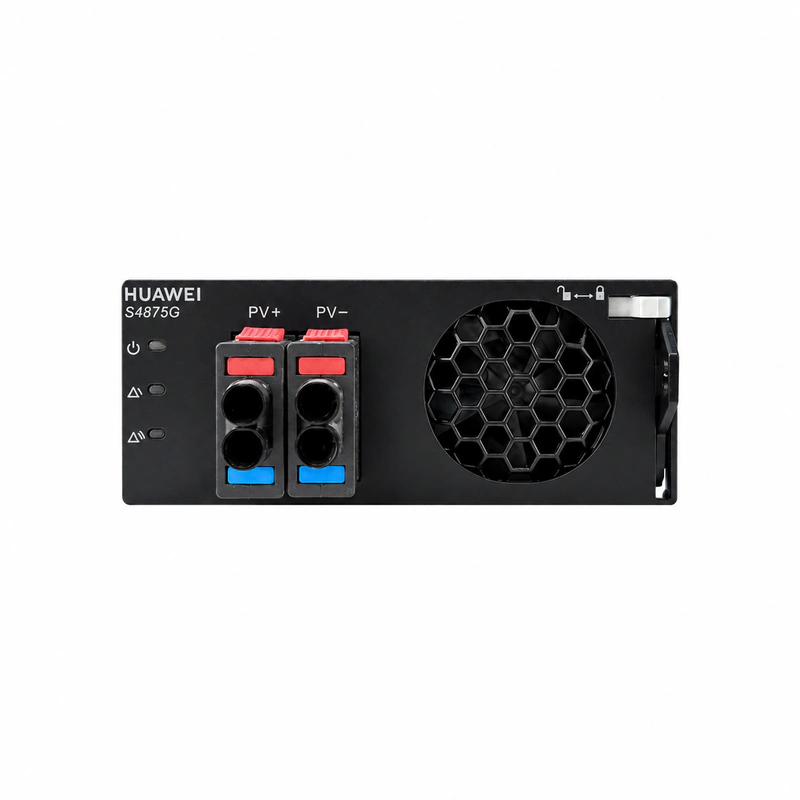
The front fascia of the S4875G1 is optimized for high-current, tool-less field deployment. It integrates heavy-duty dedicated photovoltaic DC quick-connect terminals clearly labeled PV+ and PV-, capable of handling sustained continuous input currents up to 58A. These robust front terminals isolate high-voltage DC solar array cabling from internal cabinet backplanes, streamlining field wiring and eliminating cable clutter. Adjacent to the input terminals, the front plate features a high-transmissivity honeycomb ventilation grill designed to minimize aerodynamic resistance while blocking large particulate ingress. A hardened mechanical extraction latch mechanism ensures positive structural locking into the chassis subrack, maintaining precise engagement with the blind-mate backplane connectors even in high-vibration seismic zone 4 environments.
Thermal management within this ultra-dense 1U envelope is governed by a forward-forced air cooling scheme driven by an internal, intelligent pulse-width modulation (PWM) variable-speed brushless DC fan. The cooling airflow path travels strictly from front to back, isolating the module from adjacent AC rectifiers and ensuring uniform thermal dissipation across the internal planar magnetics, silicon carbide (SiC) MOSFET switching stages, and high-ripple electrolytic capacitor banks. Three multi-state LED status indicators on the front panel (Power/Normal in green, Protection/Alarm in yellow, and Module Fault in red) provide immediate, at-a-glance diagnostic feedback for on-site operations and maintenance personnel.
Section 2: Advanced MPPT Tracking Dynamics & Wide Photovoltaic Voltage Window
At the core of the S4875G1 is an advanced multi-phase interleaved DC-DC buck-boost conversion topology governed by an ultra-fast digital signal processor (DSP). The DSP executes high-frequency perturb-and-observe and incremental conductance tracking algorithms, achieving an exceptional static and dynamic MPPT tracking accuracy of >= 99.8%. This dynamic tracking capability ensures that during volatile meteorological events, such as fast-moving cloud edges that cause solar irradiance to swing rapidly between 200 W/m2 and 1100 W/m2 within sub-second intervals, the module adjusts its operational impedance instantaneously. By constantly operating precisely at the knee of the solar array P-V curve, the S4875G1 eliminates power capture loss that compromises conventional telecom solar regulators.
The module features an optimized MPPT voltage operating envelope tailored to industry-standard photovoltaic string configurations. Its full-power operational window spans 72V DC to 125V DC, over which the internal power train accepts up to 58A of solar input current to continuously deliver the full 4000W output. To maximize energy harvesting during shoulder hours (dawn and dusk) and under extreme thermal conditions, the module supports an extended tracking range: between 60V DC and 72V DC, the module operates at up to 52A input current with derated output power (approximately 3000W), while between 125V DC and 150V DC, the module tracks down to 25A input current to sustain high-voltage solar array generation. The absolute maximum DC open-circuit voltage (Voc) rating is 160V DC, providing critical safety margin against cold-weather array overvoltage spikes.
Input electrical survivability is reinforced through a multi-tier protection architecture. The S4875G1 incorporates an autonomous input reverse polarity protection circuit that prevents internal semiconductor destruction if field contractors reverse the positive and negative PV string leads during commissioning. Furthermore, the unit features precise DC input overvoltage and undervoltage shutdown thresholds that automatically disconnect the internal switching stages when input levels drift outside the safe operating envelope, coupled with high-energy metal oxide varistors (MOVs) and gas discharge suppression devices that protect the DC bus from indirect lightning surges and solar field induction spikes.
Section 3: Telecom-Grade -48VDC Power Quality & High-Efficiency Conversion
The S4875G1 delivers a peak solar-to-DC conversion efficiency exceeding 96.5%, significantly outperforming conventional solar charge controllers that typically hover between 91% and 94%. By slashing internal conversion losses by more than 40% compared to legacy architectures, the S4875G1 drastically reduces parasitic heat generation inside outdoor telecom enclosures. This efficiency reduces cabinet cooling energy demands, mitigating internal hotspot formation and directly extending the operational lifespan of co-located telecommunication electronics, fiber termination equipment, and energy storage batteries.
Designed to power sensitive carrier-class radio access network (RAN) hardware, the module delivers an adjustable DC output voltage range from -42V DC to -58V DC, dynamically regulated via the central Huawei SMU supervisory controller. In its primary operating window (72V to 125V PV input), it delivers rated currents of 75A at 53.5V DC (4012W) and 70.4A at 57V DC (4000W). Even under marginal PV string voltages (60V to 72V DC), the module sustains stable outputs of 56A at 53.5V DC and 52.6A at 57V DC (approximately 3000W). Voltage regulation accuracy is held tightly within <= +/- 0.5% across entire zero-to-full load transitions, ensuring rock-solid DC bus stability even during sudden transitions between solar harvesting and battery discharge.
Power purity complies with and exceeds strict carrier-grade standards, including ITU-T recommendations for optical transmission and wireless transceiver power inputs. The output peak-to-peak ripple voltage is suppressed to <= 150 mVp-p across a 20 MHz bandwidth, while telephone-weighted psophometric noise is measured at <= 1.0 mV. This ultra-low noise profile guarantees that the module introduces zero high-frequency switching interference into co-located active antenna units (AAUs), remote radio heads (RRHs), baseband units (BBUs), or digital microwave transceivers. Dynamic load response is equally high-performing: when subjected to a 25% to 50% to 25% step load change at a slew rate of 0.1 A/us, the output voltage recovery time is <= 200 microseconds, completely preventing bus sag or overshooting that could trigger low-voltage load disconnect (LVLD) alarms.
Section 4: Hybrid Solar-Grid-Diesel Synergy & Intelligent Telemetry via CAN Bus / SMU02C
True modern telecom site optimization requires holistic, automated control of mixed energy sources. The S4875G1 is designed with native Controller Area Network (CAN) bus digital communication, enabling seamless, high-speed telemetry integration with Huawei SMU02C, SMU02B, and advanced site monitoring controllers. Over this deterministic industrial bus, the S4875G1 transmits real-time operational telemetry at millisecond intervals, including instantaneous PV array voltage, PV array current, cumulative kilowatt-hour (kWh) solar yield statistics, actual output DC voltage, delivered load current, internal heatsink thermal sensor readings, and granular hardware alarm states. This data is aggregated and backhauled natively to the Huawei NetEco Operations Support System (OSS) or third-party SNMP network management platforms.
When installed alongside Huawei R4850G2 or R4875G1 AC rectifiers inside a unified subrack, the system leverages Huawei intelligent Solar-First Energy Scheduling algorithms. Under this control topology, the supervisory unit continuously prioritizes solar DC generation from the S4875G1 modules to satisfy primary load consumption and battery float charging. The controller automatically throttles down or places co-located AC rectifiers into an active standby sleep mode whenever solar irradiance is sufficient. On hybrid sites integrated with automated diesel generators (DGs), this solar prioritization reduces generator runtimes by 60% to 85%, cutting logistical fuel supply overhead, slashing diesel particulate emissions, and radically extending generator maintenance intervals.
The S4875G1 integrates dynamically with site energy storage infrastructure, maintaining optimized charging regimes for both traditional Valve Regulated Lead-Acid (VRLA) batteries and advanced Lithium Iron Phosphate (LiFePO4) energy storage, such as Huawei BoostLi smart lithium modules. The SMU supervisor coordinates autonomous three-stage charging (constant-current bulk charge, constant-voltage boost charge, and trickle float charge) with software-driven equalize cycles and dynamic temperature compensation. When paired with BoostLi batteries over RS485/CAN interfaces, the S4875G1 intelligently adjusts charge voltage and current limits based on the battery internal Battery Management System (BMS) health metrics, temperature distribution, and state-of-charge (SOC) parameters, preventing cell over-stress and unlocking full 10-year battery operational lifespans.
Section 5: Mission-Critical Applications & Extreme Thermal Envelope
Modern telecommunication infrastructure is increasingly deployed in harsh environments, from sub-zero mountain peaks to arid desert environments where ambient shelter temperatures routinely exceed +50 deg C. The S4875G1 is engineered with an industrial operating temperature range spanning -40 deg C to +75 deg C (-40 deg F to +167 deg F). The module delivers its complete, un-derated 4000W output capacity continuously in ambient environments up to +55 deg C (+131 deg F). Above +55 deg C, an intelligent DSP-governed thermal derating curve manages power output linearly up to +75 deg C, ensuring that the module maintains continuous DC bus support without sudden protective thermal shutdowns, even under worst-case cabinet heat-soak scenarios.
Acoustic emissions and environmental sealing are engineered to carrier specifications. The PWM-controlled brushless cooling fan adjusts its rotational velocity dynamically based on ambient temperature and load demand, keeping acoustic noise <= 55 dBA at normal 25 deg C ambient operating conditions, conforming to municipal environmental noise regulations for urban micro-sites. The chassis incorporates an IP20 internal rating while utilizing heavy-duty conformal coating across all internal printed circuit board assemblies (PCBAs) to protect sensitive SMD components, logic gates, and gate drivers from atmospheric condensation, salt mist corrosion, industrial sulfur contamination, and airborne conductive dust typically found in roadside telecom cabinets.
These environmental capabilities make the S4875G1 the preferred conversion engine across four mission-critical application classes: remote off-grid 4G/5G macro base stations running zero-emission solar-plus-storage topologies; high-altitude microwave relay towers and optical amplifier huts where grid utility drop costs are economically prohibitive; Smart City surveillance, environmental sensing, and edge-compute cabinets deployed in municipal and highway corridors; and mission-critical industrial SCADA monitoring systems for long-distance oil and gas pipelines, high-voltage electrical transmission rights-of-way, and border perimeter security communications.
Section 6: Procurement Verification, Genuine Module Inspection & 10-Year Lifecycle TCO Analysis
Due to the widespread adoption and high commercial value of Huawei telecom power modules, the global supply chain faces risks from counterfeit, modified, or poorly refurbished units that pose catastrophic fire and downtime hazards. Enterprise procurement and network engineering teams must enforce rigorous incoming verification protocols. Genuine factory-original Huawei S4875G1 modules feature laser-etched matrix barcodes, tamper-evident corporate serial number tags with matching manufacturing lot IDs, precision-molded polycarbonate extraction handles, and pristine electrolytic capacitors sourced from tier-one Japanese manufacturers. When inserted into an active subrack, authentic units immediately establish encrypted CAN communication with the Huawei SMU02C controller, auto-reporting genuine firmware signatures, correct hardware revisions, and zero factory error codes.
A critical technical inspection point is the integrity of the internal PCBA conformal coating. Refurbished or unauthorized clones often omit IPC-CC-830-compliant moisture and fungus barriers, resulting in premature dielectric breakdown and internal arcing under high-humidity conditions. With a field-proven Mean Time Between Failures (MTBF) rating of >= 350,000 operational hours (equivalent to approximately 40 years of continuous duty under standard Telcordia SR-332 testing criteria), authentic S4875G1 modules provide the long-term reliability required to safeguard network uptime across a full 10-year site lifecycle.
A comprehensive Total Cost of Ownership (TCO) analysis reveals that the S4875G1 delivers a rapid capital payback period, typically under 14 to 22 months when deployed in solar-hybrid configurations. By capturing up to 4kW of clean solar power per single 1U slot, the module directly displaces thousands of liters of diesel fuel annually, reduces scheduled generator servicing runs, lowers grid electricity bills via peak-shaving algorithms, and maximizes battery cycle life through precise voltage regulation. For certified supply chain fulfillment, genuine inventory verification, bulk project pricing, and global logistics support, contact RICEWIND engineering specialists directly at lee@ricewind.com or via Phone / WhatsApp / WeChat at +86 17621197907.
Engineering Procurement & Technical Desk
For technical datasheets, custom power topology design, or volume export quotations, reach out to HEFENGQI engineers.