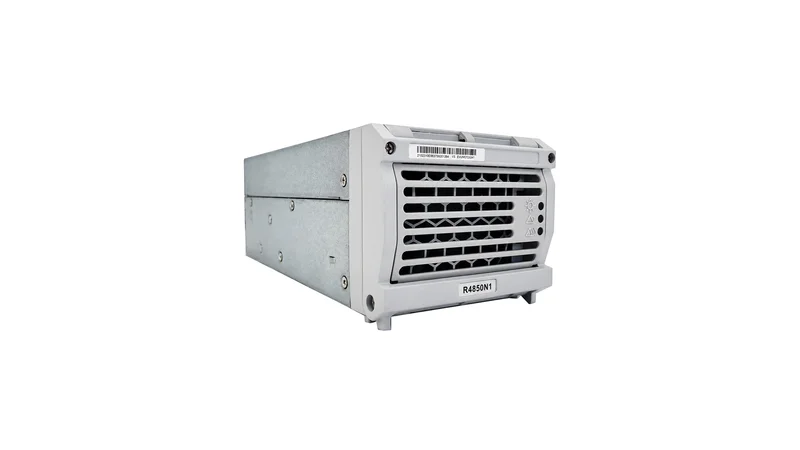
1. Modular Topology and 1U Ultra-Dense Physical Architecture
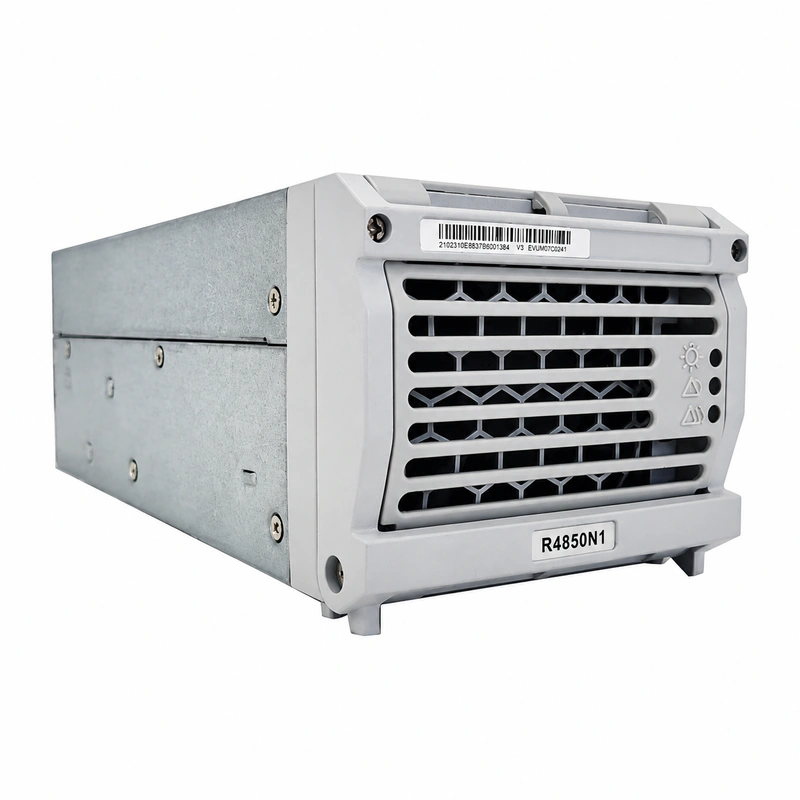
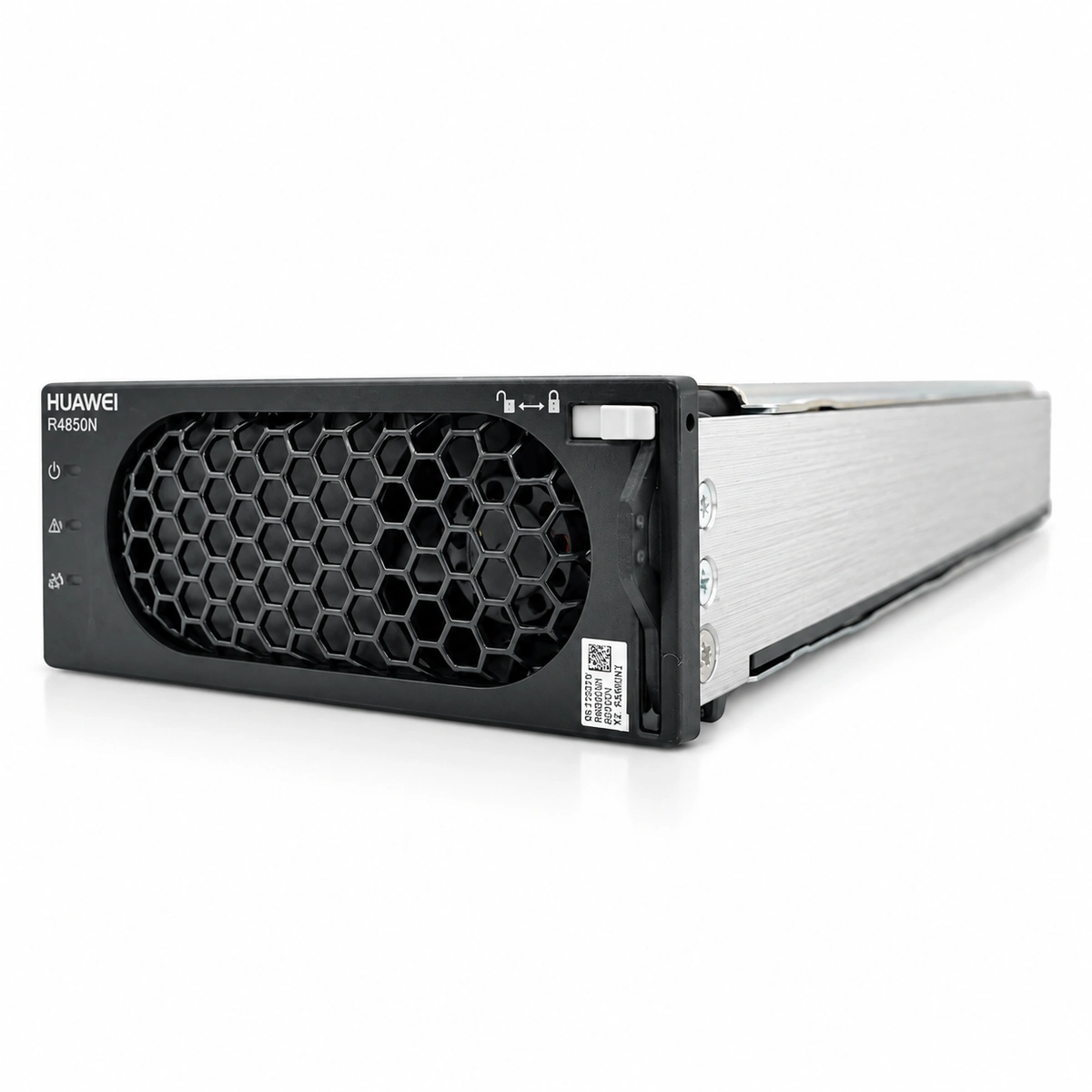
The Huawei R4850N1 establishes an exceptional standard in physical power packaging, condensing a nominal 3000W conversion capacity into a compact 1U form factor measuring 40.8 mm in height, 105 mm in width, and 281 mm in depth, with a gross unit mass not exceeding 2.05 kg. This high volumetric power density enables modern telecommunications infrastructure operators to maximize subrack shelf capacity, integrating up to four modules horizontally into standardized 19-inch subracks (such as the Huawei ETP48200 series) to deliver 200A continuous DC current within a minimal 1U to 3U physical vertical envelope. The chassis construction uses electro-galvanized sheet steel with integral mechanical alignment guides, preventing racking misalignment and shielding internal magnetics from mechanical deformation during insertion.
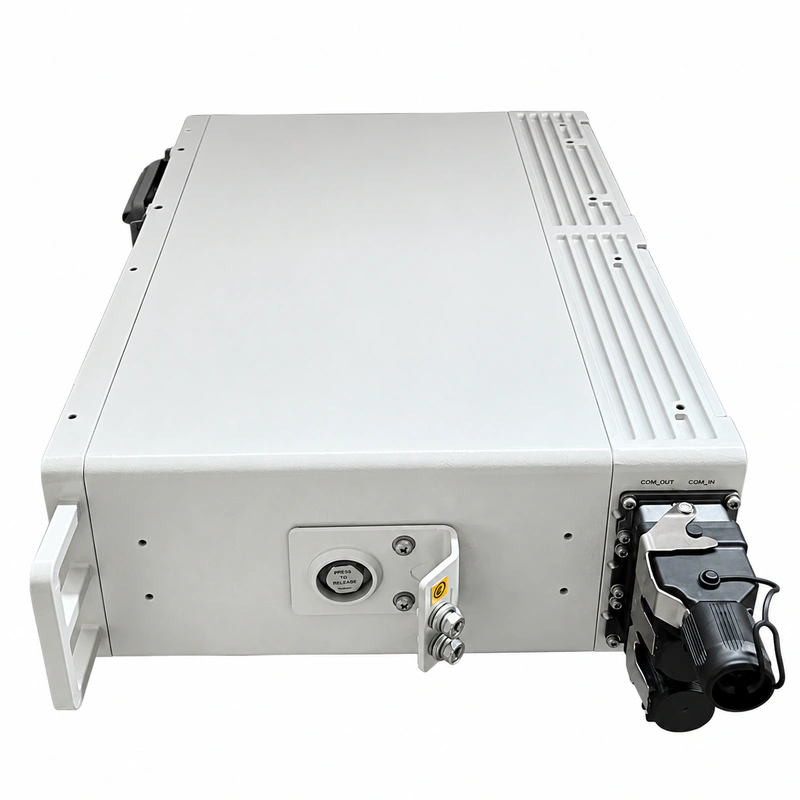
Crucial to zero-downtime maintenance architectures is the rear blind-mate hot-pluggable interface. The module utilizes heavy-duty gold-flashed power blades and staggered pre-charge pin engagement that absorbs electrostatic discharges and limits input inrush currents during live insertion. The mechanical locking latch located on the lower front fascia ensures continuous positive contact pressure while providing tool-less, zero-arc insertion and extraction under full load. Heat generation within the assembly is evacuated through an isolated front-to-back straight-line airflow tunnel, isolating high-voltage resonant inductors and planar power transformers from the side chassis panels, thereby mitigating thermal cross-coupling between adjacent rectifiers inside multi-slot high-density subracks.
Standardized 1U dimensions (40.8 x 105 x 281 mm) enabling up to 12kW per 19-inch horizontal slot row.
Blind-mate connector architecture with mechanical alignment guides and integrated pre-charge pins to eliminate arcing.
Isolated front-to-back ventilation preventing horizontal heat soak into adjacent communication equipment.
2. Grid Compatibility, Brownout Survivability, and Power Quality Metrics
Electrical utility environments in cellular base stations vary from pristine city feeds to unpredictable rural branch lines subject to extreme voltage fluctuations, sags, and prolonged brownouts. The R4850N1 incorporates an ultra-wide input voltage stage capable of continuous operation from 85VAC up to 300VAC (single-phase line-to-neutral or line-to-line derived from three-phase subracks) over a line frequency range of 45Hz to 65Hz. The power stage is rated to deliver the full 3000W output continuously across an input spectrum of 176VAC to 300VAC. When input grid levels degrade below 176VAC, the module does not trip off; instead, it executes an autonomous linear derating curve down to 85VAC, sustaining critical DC telecommunication loads without prematurely discharging site battery strings.
Harmonic suppression and reactive power minimization are handled via an advanced two-phase interleaved continuous conduction mode (CCM) active Power Factor Correction (PFC) stage. The module achieves a power factor (PF) of >= 0.99 between 50% and 100% rated load, dropping input Current Total Harmonic Distortion (THDI) to <= 5% at full load, comfortably exceeding the strict benchmarks of IEC 61000-3-2 and carrier harmonic compliance guidelines. To protect internal silicon against atmospheric disturbances and industrial line transients, the AC front-end is fortified with robust metal oxide varistors (MOVs) and gas discharge tubes, delivering high-level differential and common-mode surge withstand capability without suffering dielectric puncture.
Continuous 85VAC to 300VAC input operating range with sustained 3000W full output down to 176VAC.
Predictable linear derating profile between 176VAC and 85VAC to maximize load uptime without battery depletion.
Active interleaved PFC maintaining PF >= 0.99 and THDI <= 5%, preventing generator overheating and phase unbalance.
3. Soft-Switching Conversion Topology and Thermal Dynamics
At the core of the R4850N1 power conversion section lies an LLC resonant soft-switching bridge converter combined with synchronous secondary rectification. This topology enforces zero-voltage switching (ZVS) on the primary power MOSFETs and zero-current switching (ZCS) across output rectifiers throughout the dynamic operating envelope. By eliminating hard-switching overlap losses, the module achieves an outstanding peak efficiency of >= 94.0%. This reduced thermal loss profile minimizes thermal stress on critical internal components, such as high-temperature electrolytic filtering capacitors and planar transformer windings, significantly extending the operating lifetime of the unit in elevated ambient conditions.
Thermal performance is reinforced by a microprocessor-controlled PWM variable-speed brushless DC fan that samples real-time intake thermistors and internal heatsink thermal sensors. The cooling logic adjusts fan RPM proportionally to internal losses and ambient temperature, which limits acoustic emissions to <= 55 dBA under nominal conditions and lowers parasitic power consumption. The R4850N1 operates continuously across an ambient temperature range of -40°C to +75°C. It supplies un-derated 3000W output power up to +55°C, with controlled linear thermal derating applied between +55°C and +75°C to protect internal semiconductor junctions while maintaining DC bus stability.
LLC resonant soft-switching core delivering >= 94.0% electrical efficiency to mitigate thermal wear.
Continuous full 3000W load capability from -40°C up to +55°C, with graceful thermal derating up to +75°C.
Dynamic PWM closed-loop fan management maintaining low internal thermal delta and acoustic noise <= 55 dBA.
4. Digital Telemetry, Autonomous CAN Bus Sharing, and SMU Controller Integration
Paralleling multiple rectifier modules requires balanced current distribution to prevent individual thermal overloading and premature phase aging. The R4850N1 utilizes a dual-wire differential Controller Area Network (CAN) digital bus interface, operating an autonomous current-sharing algorithm that guarantees current distribution imbalance of <= +/- 5% across modules from 20% to 100% rated capacity. This architecture operates autonomously without depending on a central supervisor; if the main system controller loses communication or experiences a hardware fault, the R4850N1 modules maintain current sharing and retain their default output float voltage (-53.5VDC) autonomously, completely eliminating single points of failure.
When paired with Huawei Site Monitoring Units—including SMU01A, SMU01B, SMU01C, SMU02B, and SMU02C—the R4850N1 unlocks extensive digital telemetry. Network administrators can remotely read real-time AC input voltage, AC frequency, DC output voltage, individual output current, internal heatsink temperatures, and comprehensive operational status flags via NetEco software platforms or third-party SNMP northbound networks. Output DC parameters are fully software-programmable from -42VDC to -58VDC, supporting rapid switching between float charge, boost/equalize charge, and battery-test cycles, with software-configurable current limits adjustable from 10% to 105% (5A to 52.5A).
Autonomous CAN bus current balancing maintaining module imbalance strictly within +/- 5% without central supervisor dependence.
Comprehensive telemetry streaming: AC input monitoring, DC output metrics, heatsink temperatures, and internal fault diagnostics.
Seamless integration with SMU01 and SMU02 series controllers for dynamic battery float/boost control and energy saving sleep modes.
5. Field Deployment Architectures: Macro Sites, Data Transmission, and Weak Grids
Modern telecom engineering demands power hardware that adapts across diverse deployment topologies. In 4G and 5G cellular macro sites, the R4850N1 serves as the primary DC conversion engine within Huawei ETP48100, ETP48200, and TP48600B power shelves, directly powering high-draw Remote Radio Units (RRUs), Active Antenna Units (AAUs), and Baseband Units (BBUs). With ripple and noise suppressed to <= 200mVp-p across a 20MHz bandwidth and weighted psophometric noise kept below <= 2mV, the module delivers clean DC power that shields sensitive radio frequency stages and optical transceivers from carrier-induced phase jitter and baseband transmission errors.
In off-grid and weak-grid environments, such as rural remote installations powered by cyclic diesel generators or hybrid solar-photovoltaic DC microgrids, the R4850N1 provides reliable brownout tolerance and wide frequency tracking (45Hz to 65Hz). When paired with generator sets producing voltage instability and wave clipping, the rectifier's low THDI and robust input filter prevent generator hunting and premature alternator winding burnouts. In large metro optical distribution nodes, DWDM repeater shelters, and GPON OLT central offices, the fast dynamic response time of the R4850N1 stabilizes bus transients during load surges, keeping the critical -48VDC distribution bus within a strict +/- 0.5% regulation tolerance.
Psophometric noise <= 2mV and ripple <= 200mVp-p, protecting RF front-ends and high-speed fiber transceivers.
Robust frequency compliance (45Hz-65Hz) matching off-grid diesel gen-set and hybrid PV microgrid dynamics.
Voltage regulation accuracy within +/- 0.5% across 0% to 100% dynamic step loads, securing core optical transport gear.
6. Carrier-Grade Procurement, Quality Verification, and Lifecycle TCO
When planning large-scale infrastructure rollouts, telecom procurement directors face risks from unauthorized supply chains, including counterfeit units, re-labeled lower-capacity modules, and poorly refurbished components with uncalibrated internal protections. The carrier-grade Huawei R4850N1 delivers an audited Mean Time Between Failures (MTBF) exceeding 500,000 hours at 25°C, providing decades of field reliability when sourced through authenticated, professional technical channels. Maintaining strict supply chain verification protocols ensures high field performance, lower warranty return rates, and sustained site availability.
RICEWIND is an international provider of critical telecommunication power equipment, maintaining certified original stock, comprehensive load-testing protocols, and full lifecycle engineering support for the Huawei R4850N1. Before international dispatch, RICEWIND engineers subject every module to rigorous multi-point testing: full 50A/3000W load-bank testing across 120VAC, 220VAC, and 290VAC, CAN telemetry handshake verification against native SMU controllers, high-potential dielectric breakdown validation, and digital current-sharing calibration. Global technical teams, system integrators, and infrastructure procurement managers can source guaranteed original new and factory-certified units by contacting RICEWIND engineering specialists directly at lee@ricewind.com or via telephone/WhatsApp at +86 17621197907.
Verified field MTBF exceeding 500,000 hours per Bellcore/Telcordia SR-332 reliability standards.
Comprehensive RICEWIND pre-dispatch load-bank testing covering full power, thermal burn-in, and CAN telemetry.
Direct engineering procurement and inventory support available via RICEWIND: lee@ricewind.com / +86 17621197907.
Engineering Procurement & Technical Desk
For technical datasheets, custom power topology design, or volume export quotations, reach out to HEFENGQI engineers.