Subrack Architecture & Space Optimization in High-Density Telecom Enclosures
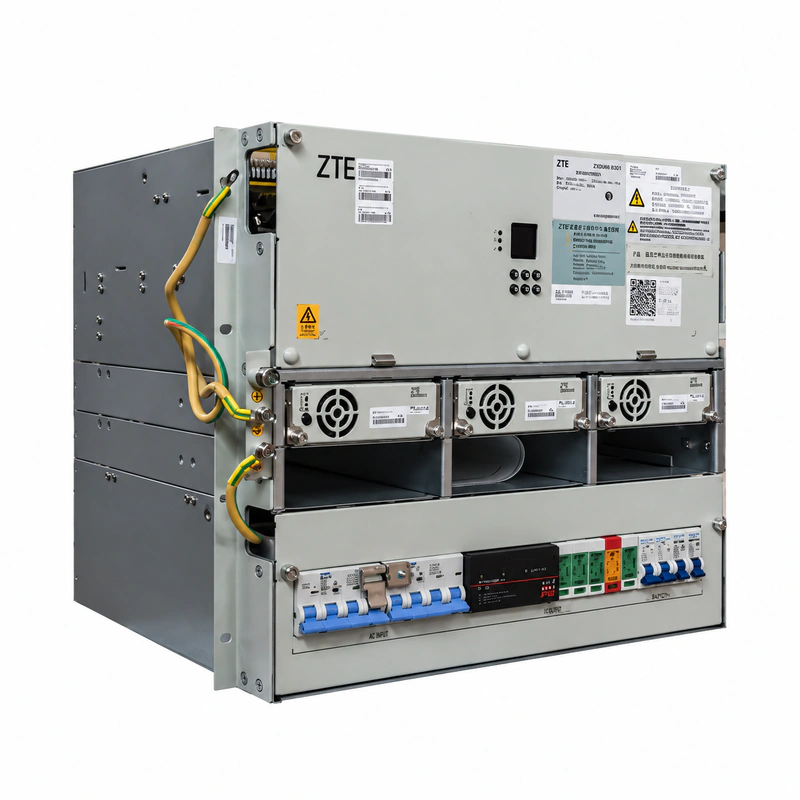
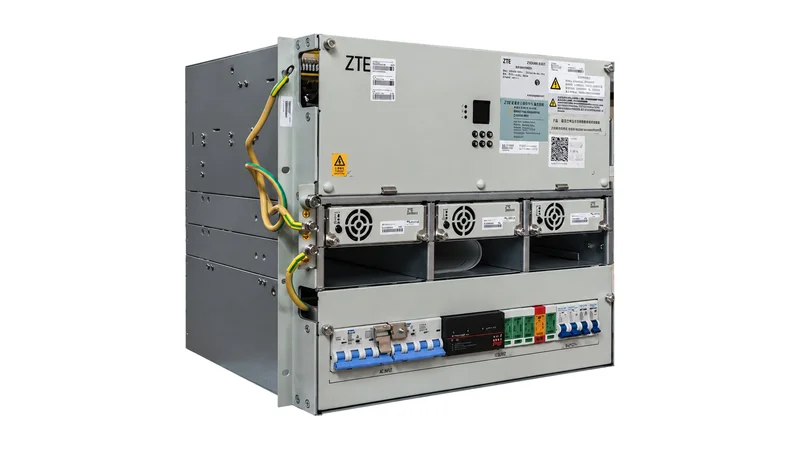
The ZTE ZXDU68 B301 is engineered as an ultra-compact, 6U standard 19-inch rack-mount embedded DC power shelf measuring 264 mm in height, 482 mm in width, and 360 mm in depth. Modern telecommunications shelters, outdoor cabinet enclosures, and C-RAN baseband pooling stations face severe structural volumetric constraints. The ZXDU68 B301 addresses this by integrating AC power distribution, DC load management, multi-string battery connectivity, centralized digital supervision, and up to six hot-pluggable rectifier slots into a unified, high-density mechanical envelope that delivers up to 300A continuous output at nominal -48V DC (18kW total operational capacity).
A critical mechanical design highlight of the ZXDU68 B301 subrack is its comprehensive 100% front-access installation and maintenance topology. Field engineers execute all AC grid connections, DC feeder cabling, battery landing terminations, breaker actuations, and module replacements strictly from the front panel. This eliminates the necessity of rear or side cabinet clearances, allowing the shelf to be deployed against rear enclosure walls or within shallow 600 mm telecom equipment racks. The internal busbar layout optimizes thermal dissipation while isolating high-voltage AC input lines from sensitive low-voltage DC distribution and supervisory signaling conduits, conforming to strict IP20 mechanical protection standards.
Verify 6U physical envelope dimensions (264 mm H x 482 mm W x 360 mm D) against existing cabinet depth and thermal clearance constraints.
Confirm total current requirements do not exceed 300A across N+1 or N+2 redundancy models using up to six ZXD3000 rectifier modules.
Ensure all planned DC branch terminations and battery feeder lugs conform to front-access terminal pitch and torque specifications.
Rectifier Conversion Dynamics, Grid Resilience & Energy Conservation
At the core of the ZXDU68 B301 power conversion plane are the field-proven ZTE ZXD3000 high-efficiency switch-mode rectifier modules (compatible with hardware revisions V5.0, V5.1, and V5.5). Operating at a continuous rated output of 50A (3000W) per module, the ZXD3000 leverages advanced digital signal processing (DSP) control and soft-switching resonant topologies to achieve an industry-leading peak conversion efficiency exceeding 96.0%. The rectifier platform maintains an active Power Factor Correction (PFC) profile yielding PF > 0.99 and Total Harmonic Distortion (THD) < 3%, significantly mitigating harmonic pollution on upstream diesel generators and transformer feeds.
Grid vulnerability and wide voltage swings present severe operational hazards in emerging markets and edge environments. The ZXD3000 rectifier exhibits an ultra-wide AC input tolerance ranging from 80V AC to 300V AC at 45Hz to 65Hz. The module delivers full 3000W rated output within an input window of 176V AC to 300V AC, dynamically executing linear power derating between 80V AC and 175V AC to maintain uninterrupted DC rail energization without dropping offline. Furthermore, the integrated supervisory system executes intelligent module hibernation: during off-peak load periods, redundant rectifiers are transitioned into low-power sleep modes while active units operate at their optimal 50% to 80% efficiency sweet spot, incorporating automated cycling wear-leveling to equalize operating hours across all units.
Audit site AC input parameters against the ZXD3000 input envelope (176V-300V AC for full 3000W capacity; 80V-175V AC linear derating mode).
Enable dynamic module sleep cycling within supervisory firmware to sustain >95% system efficiency during low traffic periods.
Validate input PFC (>0.99) and current THD (<3%) metrics to ensure complete compliance with site generator transfer switches.
Power Distribution Architecture, Selective Redundancy & Battery Safeguards
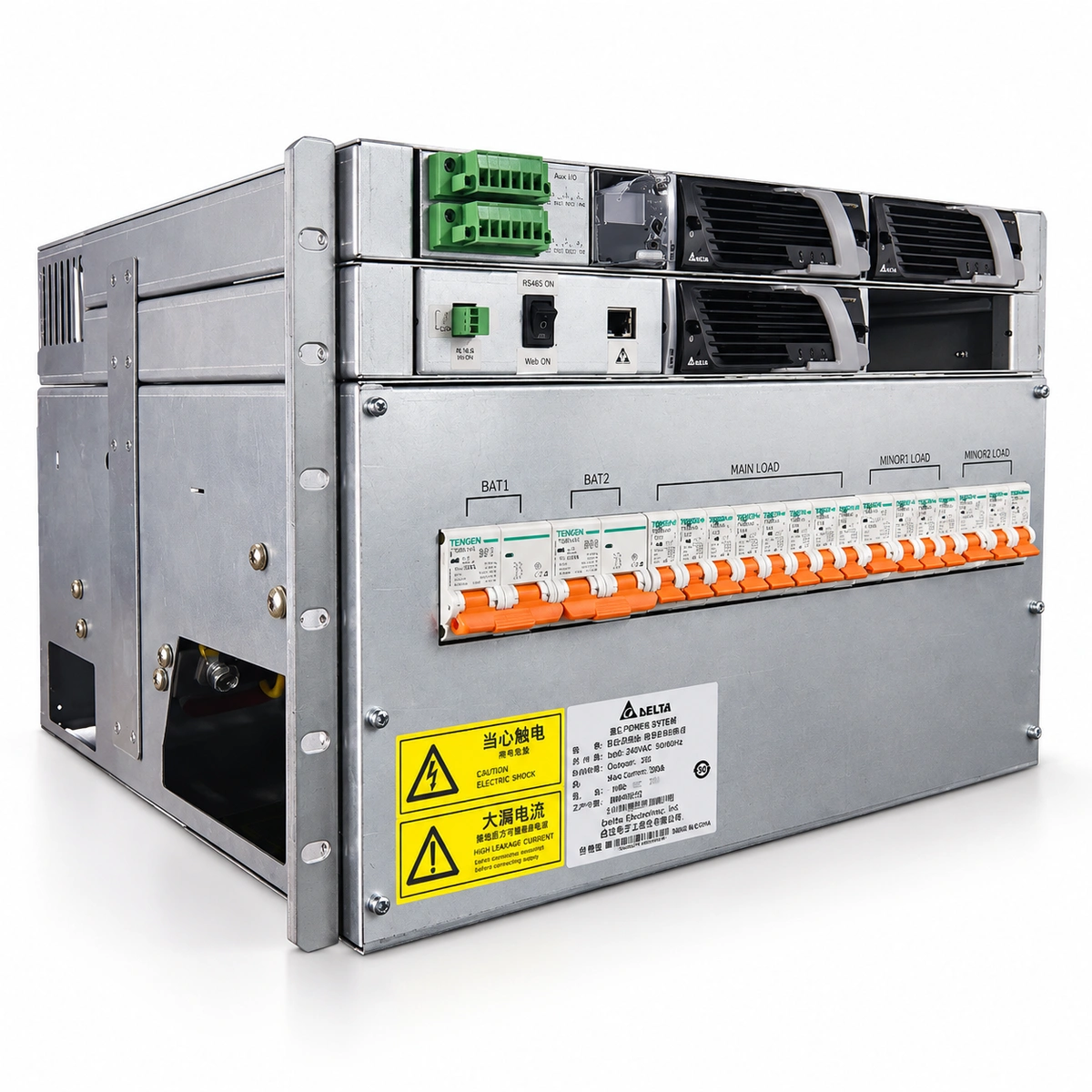
The internal power distribution unit (PDU) of the ZTE ZXDU68 B301 is engineered for mission-critical selectivity, eliminating common-cause electrical failures. The AC input stage features an integrated 63A/3P circuit breaker (configurable for three-phase 380V/400V/415V five-wire or single-phase 220V/230V feeds) fortified with an integrated Class C surge protective device (SPD) rated at 20kA nominal and 40kA maximum discharge capacity (8/20 μs waveform). This multi-stage transient suppression protects downstream power electronics from lightning strikes and industrial switching transients.
The DC distribution plane provides dual-bus tiered survivability through integrated Low Voltage Disconnect contactors: Load Low Voltage Disconnect (LLVD) and Battery Low Voltage Disconnect (BLVD). Under mains failure scenarios, LLVD automatically sheds non-critical auxiliary and cooling loads at a user-defined threshold (default -43.2V DC), conserving remaining battery reserve exclusively for core 4G/5G radio basebands and optical transmission nodes. If grid outage persists to deep discharge levels, BLVD isolates the battery strings at -42.0V DC to permanently eliminate cell polarity reversal and plate sulfation. The system natively interfaces with both conventional VRLA (AGM/Gel) battery banks and modern Smart Lithium (LiFePO4) battery packs, deploying precise programmable temperature-compensated float/boost voltage regulation.
Configure distinct branch assignments for critical communication loads on BLVD and non-critical services on LLVD disconnect buses.
Calibrate temperature compensation charging coefficients according to battery manufacturer datasheets (typically -3mV to -5mV/°C/cell for VRLA).
Confirm Class C AC SPD auxiliary alarm contacts are mapped directly into the supervisory telemetry bus for immediate failure notification.
CSU502A Digital Supervision, Telemetry & NetEco Network Integration
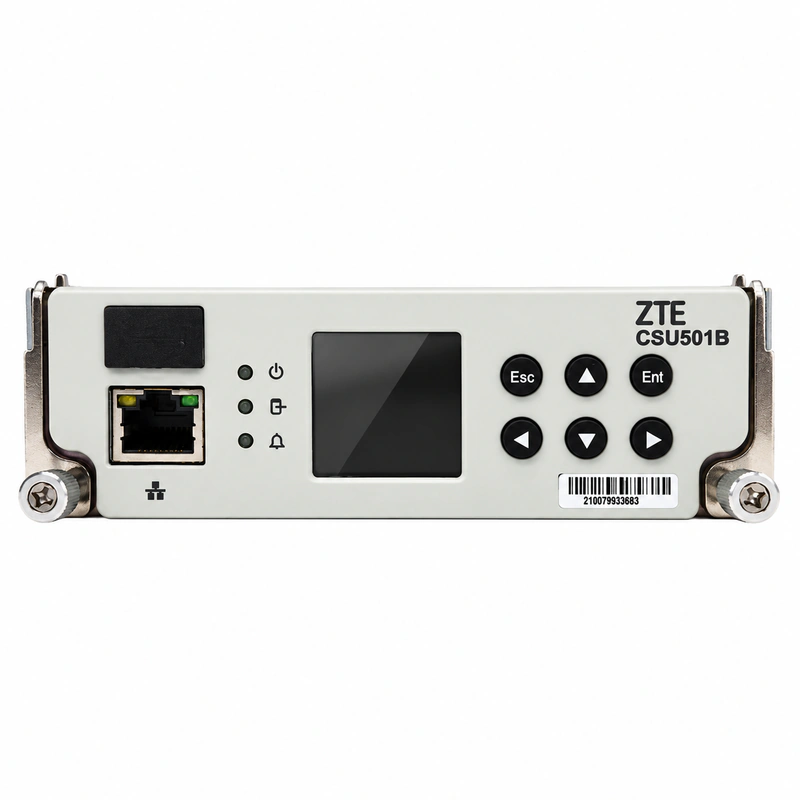
Centralized control and operational transparency of the ZXDU68 B301 are governed by the ZTE CSU502A (or CSU500B) intelligent monitoring unit. Equipped with a high-contrast multi-language LCD interface and intuitive navigational keypad, the controller grants field technicians real-time instrumentation oversight without requiring external diagnostic laptops. Internally, the CSU502A utilizes an isolated industrial CAN bus architecture for sub-millisecond telemetry and voltage trimming across all installed ZXD3000 rectifiers, alongside RS485 communication ports for intelligent battery management systems (BMS) and environmental sensor aggregation.
For northbound Network Operations Center (NOC) and energy management platform integration, the CSU502A provides native 10/100M Fast Ethernet connectivity supporting SNMP v1, v2c, and cryptographically secure SNMP v3, as well as HTTPS Web GUI and Telnet protocols. The supervisory system runs predictive health diagnostics, calculating real-time State of Charge (SOC), State of Health (SOH), and automated discharge reserve run-time projections based on actual site load curves. A comprehensive array of dry-contact output relays permits hardware-level alarm broadcasting to legacy supervisory and third-party remote terminal units (RTUs).
Mandate SNMP v3 encryption protocols for all northbound NOC integrations to prevent unauthorized remote configuration manipulation.
Interface intelligent BMS over RS485 to feed cell-level voltage and thermal telemetry into the central CSU502A controller.
Conduct periodic automated battery conductance and online capacity discharge tests via the supervisory scheduling engine.
Mission-Critical Telecom Deployment Topologies & Environmental Hardening
The ZTE ZXDU68 B301 is engineered to maintain uninterrupted continuity across diverse mission-critical operational envelopes. In 4G/5G macro cellular base station sites, the 300A DC delivery smoothly handles the rapid transient load swings inherent in massive MIMO active antenna units (AAUs) and baseband units (BBUs). In metro optical aggregation hubs, DWDM transmission points, and central office OLT frames, the system's ultra-low electrical ripple and noise (<200mV peak-to-peak, <2mV psophometrically weighted) guarantee signal integrity across high-speed optical transceivers.
Environmental survivability is validated across an operating temperature range of -25°C to +65°C, providing un-derated 300A full-load delivery up to +55°C. Cooling within the rectifier modules is driven by micro-controlled variable-speed brushless DC fans that match airflow dynamically to thermal dissipation requirements, keeping acoustic noise below 55 dBA. This low noise footprint qualifies the ZXDU68 B301 for deployment in urban micro-data centers, modular edge enclosures, and shared commercial real estate telecom rooms subject to strict municipal noise ordinances.
Verify thermal envelope suitability: confirm zero power derating up to +55°C for high-ambient desert or unconditioned shelter installations.
Audit psophometric noise limits on -48V DC bus to safeguard optical and radio transmission gear from DC bus ripple.
Confirm physical acoustic emission levels (≤55 dBA) satisfy local noise constraints for urban and co-located telecom facilities.
Carrier-Grade Procurement, Testing Verification & Lifecycle TCO Strategy
Procuring carrier-grade DC power infrastructure requires comprehensive verification protocols to eliminate unauthorized refurbishments, counterfeit modules, and latent manufacturing defects. Telecom operators establish a benchmark Mean Time Between Failures (MTBF) exceeding 500,000 hours for the ZXDU68 B301 architecture. Procurement specifications must mandate 100% full-load burn-in load bank test certification for every rectifier and subrack assembly prior to site commissioning. Verifying original firmware compatibility across all ZXD3000 rectifiers and CSU502A supervisors prevents operational anomalies and bus-locking incidents.
RICEWIND operates as a premier global telecommunications power systems partner, maintaining verified, certified genuine inventory of original ZTE ZXDU68 B301 subracks, ZXD3000 rectifiers, and CSU502A controllers ready for immediate global logistics dispatch. By pairing genuine factory hardware with rigorous pre-dispatch electrical load testing, RICEWIND minimizes deployment lead times, eliminates field failure risks, and secures lowest Total Cost of Ownership (TCO) across decade-long lifecycle deployments. Direct technical consultation and procurement inquiries: Contact RICEWIND Engineering via Email at lee@ricewind.com or Phone/WhatsApp at +86 17621197907.
Require pre-shipment 100% full-load burn-in test reports and individual serial number traceability from suppliers.
Standardize on verified genuine ZTE hardware via RICEWIND to guarantee component authenticity, MTBF compliance, and spare part availability.
Contact RICEWIND engineering specialists (lee@ricewind.com | +86 17621197907) for tailored system dimensioning, custom breaker configurations, and rapid global delivery.
Engineering Procurement & Technical Desk
For technical datasheets, custom power topology design, or volume export quotations, reach out to HEFENGQI engineers.