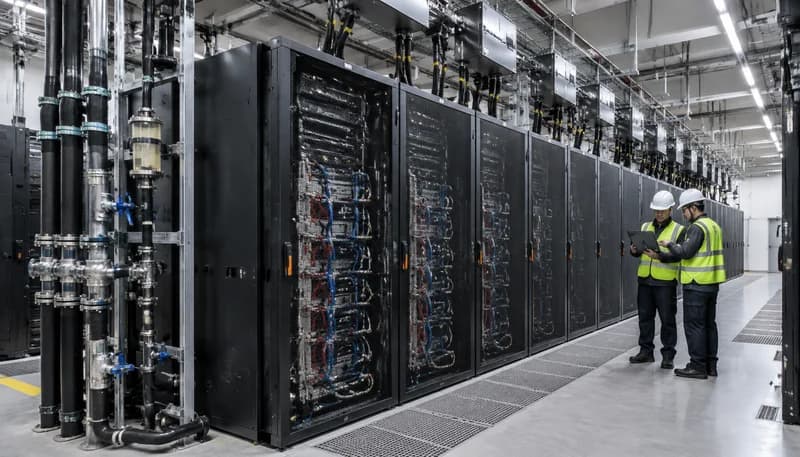
1. Reported Rack-Density Growth and AI Deployment Pressure
The supplied Data Center Knowledge article reports that rack power density has been steadily increasing as AI workloads, space constraints and improved thermal solutions change facility requirements. According to the article, average rack load increased from about 6.1 kW in 2016 to 12 kW in 2024 and 26 kW in 2026. These figures are source-reported values and should be treated as indicators of market direction rather than universal design assumptions for every facility.
The source also reports that while loads around 10 kW or lower remain common in some smaller-scale data centers, AI-focused environments are pushing practical rack capacities toward much higher levels. It states that designs approaching, and in some cases targeting, 1 MW per rack exist, but such racks are described as outliers rather than a standard deployment condition.
Engineering planning should separate reported industry trends from project-specific requirements. Rack density decisions should begin with actual IT equipment specifications, expected utilization, growth plans and available facility infrastructure rather than assuming a fixed future rack power value.
Confirm projected rack power profile by workload type
Separate current deployment data from future density scenarios
Validate assumptions with IT and facility teams
2. Electrical Distribution Consequences: Current, Conductors, Busway, PDU and Protection
Higher rack power changes the design of electrical distribution paths from the source transformer and switchgear through branch circuits, busway systems, rack power distribution units and final connections. The supplied source notes that traditional distribution architectures may struggle to deliver hundreds of amps to a single rack with appropriate redundancy, but the actual current requirement depends on electrical parameters.
Current cannot be assigned from rack power alone. The relationship depends on voltage, single-phase or three-phase configuration, power factor and system efficiency. For example, a higher voltage supply can deliver the same power at lower current than a lower voltage arrangement, while power factor affects the real current required for a given load. Conductors, busway ratings, PDU selection and protective device coordination must therefore be calculated from the complete electrical design.
Engineering recommendations include reviewing conductor sizing, thermal limits, voltage drop, selective coordination, fault protection and maintainability before increasing rack density. Higher density may require revised distribution zones so that capacity expansion does not compromise redundancy domains or service access.
Calculate current from voltage, phase and power factor
Review busway, PDU and protection coordination
Map redundancy paths before increasing rack loads
3. Direct-to-Chip Liquid Cooling and Heat-Rejection Integration
The source identifies direct-to-chip liquid cooling, rear-door heat exchangers and immersion cooling as technologies that can enable higher rack densities by improving thermal management. Direct-to-chip cooling changes the facility design interface because heat removal becomes connected to liquid distribution systems, pumps, controls and monitoring infrastructure.
Liquid cooling introduces additional engineering requirements, including coolant distribution unit electrical loads, pump power, control panels, leak detection and maintenance procedures. The source specifically notes that liquid cooling requires new capital investment, monitoring and maintenance needs, water management and leak detection capabilities, as well as new operational skills.
A coordinated design approach should connect rack heat generation, CDU capacity, facility cooling loops and heat rejection equipment. Operators should evaluate not only cooling capacity but also electrical consumption of cooling support equipment and the operational response required if a cooling component becomes unavailable.
Include CDU and pump loads in power planning
Design leak detection and response procedures
Coordinate rack cooling with heat rejection systems
4. Structural Planning, Cabinet Geometry and Deployment Logistics
The supplied source reports that heavier and denser racks increase floor loading and handling complexity. Facilities originally designed around lighter equipment may require structural reinforcement, alternative floor systems or revised installation pathways. These changes affect both new construction and retrofit projects.
Cabinet geometry also influences deployment. Taller or deeper cabinets can increase compute density but may affect aisle dimensions, service clearances, transport routes and maintenance access. The source notes that improved room layout approaches and equipment movement methods, including ceiling hoists for constrained rooms, can assist with handling challenges.
Engineering recommendations should consider floor loading, cabinet weight distribution, pipe support locations, overhead pathways and installation sequencing before equipment arrives. A high-density deployment is a construction and logistics project as much as an IT hardware installation.
Verify floor capacity and cabinet loading zones
Reserve service clearances and transport pathways
Plan pipe supports and installation sequence early
5. Metering, Commissioning and Reliability Validation
Rising rack density increases the importance of accurate measurement and controlled deployment. Metering should provide visibility from facility-level power systems through distribution equipment and down to rack-level consumption where practical. This allows operators to compare planned loads with actual operating conditions.
Staged commissioning is recommended when introducing high-density AI infrastructure. Electrical systems, liquid cooling equipment, controls, leak detection, monitoring systems and heat rejection interfaces should be tested in defined stages before full workload deployment. Redundancy-domain boundaries should be documented so operators understand which failures affect which equipment groups.
Failure-mode testing should examine realistic operational events, including loss of power paths, cooling component failures, control communication issues and maintenance scenarios. Testing should verify that protection systems, alarms and recovery procedures operate as intended.
Install measurement points across critical power paths
Commission systems in controlled stages
Test failure scenarios before production workloads
6. Operator Decision Framework and RICEWIND Contact
Operators evaluating higher AI rack density should use a coordinated decision framework that begins with workload requirements, then evaluates electrical capacity, thermal strategy, structural readiness and operational capability. The source recommends planning power architectures for higher rack power draw, aligning cooling strategies with future density roadmaps and validating floor loading, pathways and handling equipment.
The recommended approach is to avoid treating power, cooling and structural upgrades as separate projects. A rack-density increase affects electrical distribution, liquid cooling infrastructure, building systems, maintenance procedures and commissioning practices. Engineering decisions should be based on measured requirements, documented assumptions and tested operating limits.
For coordinated power distribution, liquid cooling integration and structural planning discussions, contact RICEWIND at ricewind.com, Email: lee@ricewind.com, WhatsApp: +86 17621197907. RICEWIND supports engineering conversations around infrastructure planning for evolving data center requirements.
Build a cross-discipline rack density roadmap
Document assumptions and operating limits
Coordinate electrical, cooling and structural teams
Engineering Procurement & Technical Desk
For technical datasheets, custom power topology design, or volume export quotations, reach out to HEFENGQI engineers.