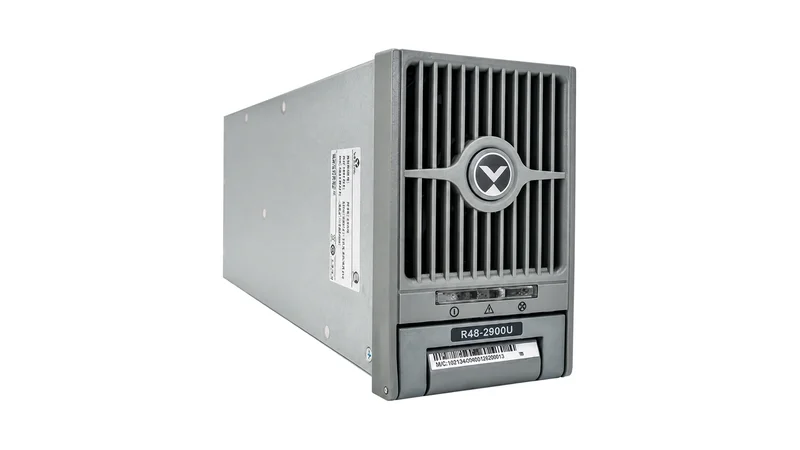
1. Modular Topology & 1U High-Density Power Architecture
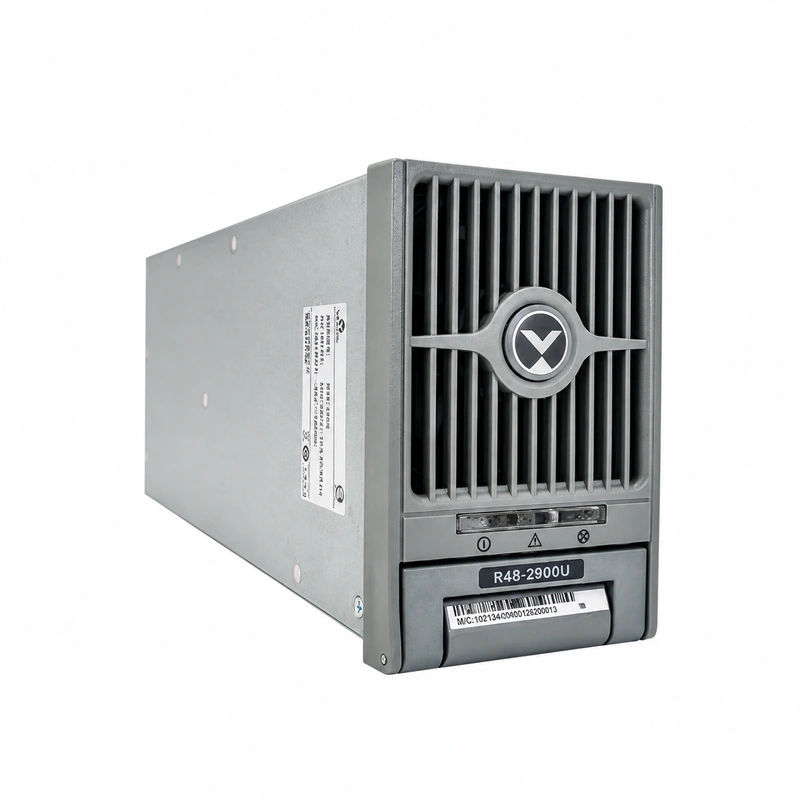
The Vertiv Emerson R48-2900U represents a benchmark in telecommunications switch-mode rectifier design, packaging a nominal 2900W (-48VDC, 50A) continuous power capability into an ultra-compact 1U form factor measuring 85.3mm (H) x 40.8mm (W) x 272mm (D). Weighing no more than 1.7 kg, the module optimizes rack real estate within high-density telecom power shelves such as the NetSure 531 and NetSure 731 series. The internal layout utilizes an optimized two-stage power conversion topology that minimizes thermal footprint while eliminating redundant structural chassis mass, allowing operators to deploy high-capacity N+1 or N+2 redundant configurations inside compact outdoor cabinets.
Crucial to uninterrupted 24/7/365 telecommunication uptime is the module's hot-swappable blind-mate mechanical interface. Designed with heavy-duty gold-plated multi-pin connectors on the rear backplane and an anti-arc leading ground pin, the R48-2900U guarantees safe live-insertion and extraction under active busbar voltages without disturbing adjacent rectifier units or inducing bus transients. The structural guide rail mechanism ensures precise physical alignment during insertion, isolating sensitive internal electronics from mechanical stress, while straight front-to-back forced-air ventilation isolates the intake and exhaust paths to prevent thermal recirculation inside high-density subracks.
Physical dimensions: 85.3mm (H) x 40.8mm (W) x 272mm (D) at <= 1.7 kg total weight
Blind-mate rear multi-pin gold-plated power and signaling interface with mechanical anti-arc insertion guides
True live hot-swappability facilitating zero-downtime maintenance and incremental capacity expansion
2. Grid Compatibility, Brownout Survivability & Power Quality
Modern telecom networks increasingly interface with volatile AC distribution networks, especially across suburban, rural, and industrial edge installations. The R48-2900U addresses this through an ultra-wide single-phase operating input window ranging from 85VAC to 290VAC (nominal 200VAC to 250VAC, 45Hz to 65Hz). Full 2900W rated output is maintained across 176VAC to 290VAC. Below 176VAC down to 85VAC, the module does not drop offline; instead, it executes an autonomous, linear output power derating strategy, keeping DC-powered transmission nodes alive during severe grid sags and extended brownouts without prematurely draining backup battery banks.
From a power quality perspective, the unit features an active Power Factor Correction (PFC) boost stage that achieves a power factor of >= 0.99 from 50% to 100% rated load. Total Harmonic Distortion of the input current (THDI) is strictly maintained at <= 5% at full load, exceeding the stringent requirements of EN 61000-3-2 and IEEE 519 standards. Built-in input overvoltage protection automatically disconnects the conversion stage above 290VAC and self-recovers once voltage normalizes, while robust internal metal oxide varistor (MOV) arrays suppress severe grid transients and lightning surge spikes common to remote tower deployments.
Wide AC input range of 85VAC to 290VAC with linear power derating between 176VAC and 85VAC
Active PFC performance with PF >= 0.99 and THDI <= 5% under typical operating loads
Automatic overvoltage trip above 290VAC and undervoltage cutoff below 80VAC with autonomous recovery
3. High-Reliability Power Conversion & Thermal Performance
The R48-2900U utilizes a field-proven high-frequency soft-switching resonant topology delivering peak conversion efficiencies between 92.5% and 93.0%. While ultra-high-efficiency platforms trade off component tolerance for marginal percentage gains, the R48-2900U architecture is deliberately engineered for industrial resilience, utilizing conservatively rated power semiconductors that experience significantly lower thermal and voltage stress. This translates directly to enhanced operational longevity and exceptional immunity to ambient temperature swings ranging from -40 deg C to +70 deg C.
Thermal management is handled by an internal intelligent variable-speed brushless DC fan governed by a digital PWM controller. The fan adjusts dynamic airflow according to internal heatsink thermistors and instantaneous load demand, keeping acoustic noise below 55 dBA under typical operational loads. The module outputs full 2900W power without thermal derating up to +45 deg C ambient, providing a linear power derating window up to +70 deg C. Output DC voltage stabilization is maintained within <= +/- 0.5%, with peak-to-peak ripple noise suppressed below 150mVp-p (0-20MHz) and psophometric noise kept below 1.0mV, safeguarding sensitive microwave and baseband transceivers.
Robust industrial conversion efficiency of >= 93.0% with minimal thermal stress on switching semiconductors
Full 2900W output operation up to +45 deg C with continuous operational tolerance up to +70 deg C
Intelligent PWM fan cooling with acoustic noise <= 55 dBA, ripple <= 150mVp-p, and psophometric noise <= 1.0mV
4. Digital Telemetry, Autonomous CAN Bus Sharing & Vertiv Controller Integration
Parallel operation in multi-rectifier power plants demands strict current distribution to prevent individual unit overload and thermal runaway. The R48-2900U integrates an autonomous Controller Area Network (CAN) bus interface providing fully digital active current sharing. The dynamic load sharing imbalance among parallel modules is strictly constrained to <= +/- 3% of rated current. Crucially, the current-sharing logic operates autonomously at the hardware and DSP level; in the event of an external monitoring controller failure, the rectifiers continue to balance current seamlessly without a single point of failure.
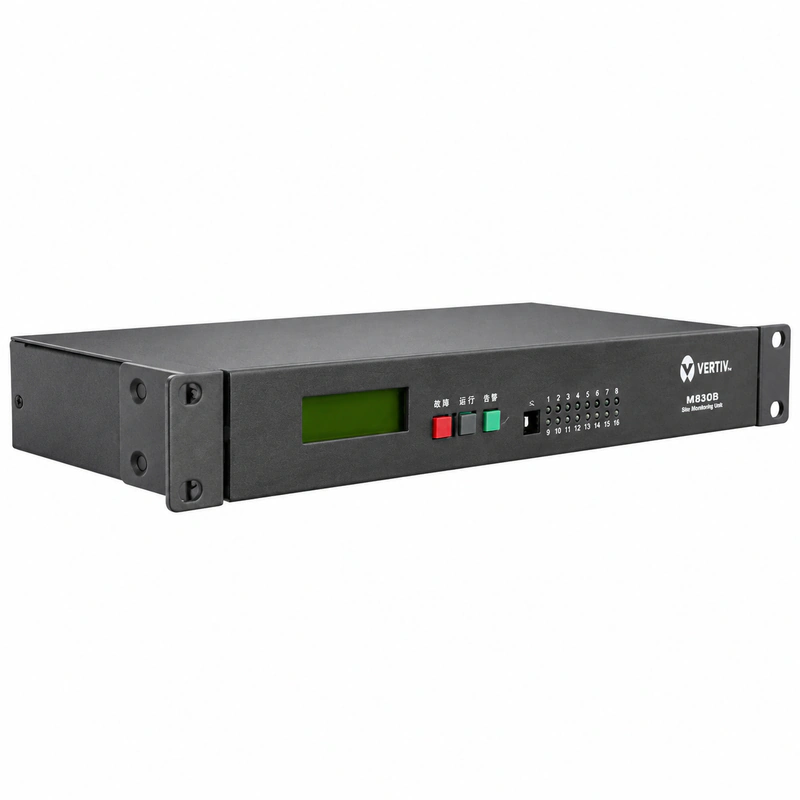
The module provides seamless plug-and-play integration with the entire ecosystem of Vertiv supervision units, including the M221S, M222S, M522B, M830B, and the advanced NCU controller. Through the digital communications bus, the supervisory controller extracts real-time telemetry parameters including AC input voltage, DC output voltage (-42VDC to -58VDC adjustable), output current, heatsink temperature, fan RPM, and alarm codes. Controllers can remotely configure output current limits (adjustable from 10% to 105%), initiate battery equalizing charges, or place specific rectifiers into energy-saving sleep modes during low site traffic.
Digital autonomous CAN bus current sharing ensuring dynamic load imbalance <= +/- 3%
Fully validated telemetry compatibility with Vertiv M221S, M222S, M522B, M830B, and NCU controllers
Comprehensive real-time telemetry reporting: AC voltage, DC voltage/current, temperature, and fan health
5. Real-World Telecom & Harsh Grid Field Deployment Architectures
The R48-2900U is engineered for high-availability mission-critical telecom environments. In 4G LTE and 5G New Radio (NR) distributed base stations, it is frequently populated in multi-slot 19-inch or 23-inch NetSure subracks (such as the NetSure 531 and NetSure 731) to feed Remote Radio Units (RRUs) and Baseband Units (BBUs). Its low acoustic footprint and tight electromagnetic compatibility (EMC) compliance make it equally suitable for indoor transmission rooms, optical GPON OLT central offices, and DWDM repeater shelters where clean, stable -48VDC power is non-negotiable.
Furthermore, the module serves as the primary upgrade and replacement engine for legacy Emerson installations, offering backward compatibility with legacy PS48120, PS48300, and PS48600 power systems. In harsh fringe environments—such as utility electrical substations, railway signaling communication shelters, and isolated rural sites running on intermittent diesel generator sets—the R48-2900U withstands high generator frequency drift (45Hz-65Hz) and sudden load step-changes, preventing nuisance tripping and maintaining plant integrity.
Seamless integration with Vertiv NetSure 531, 731, 701, and legacy Emerson PS48120/PS48300/PS48600 shelves
Carrier-grade deployment suitability: 4G/5G macro BTS, optical aggregation nodes, and DWDM transport sites
High tolerance for unstable diesel generator AC inputs and frequency shifts across remote off-grid shelters
6. Carrier-Grade Procurement, Testing Verification & Lifecycle TCO
Deploying power conversion infrastructure demands rigorous quality assurance to minimize the total cost of ownership (TCO) across 10-to-15-year telecom lifecycle windows. The Vertiv Emerson R48-2900U boasts a calculated Mean Time Between Failures (MTBF) exceeding 450,000 operational hours. However, the prevalence of counterfeit and poorly refurbished rectifiers in the secondary supply chain presents significant operational risks. Sourcing authentic modules verified by high-standard testing protocols is vital to avoid catastrophic cabinet fires or unplanned site outages.
RICEWIND is a premier global supplier of telecom energy hardware, maintaining stringent engineering intake and outbound testing protocols. Every R48-2900U module supplied by RICEWIND undergoes 100% full-load load-bank burn-in testing, verification of active PFC parameters, calibration of the CAN communication interface with Vertiv controllers, and thermal imaging inspection before dispatch. RICEWIND maintains extensive inventory for rapid global deployment, supporting both urgent site repairs and nationwide network expansions. For direct engineering consultations, inventory inquiries, and technical procurement support, contact RICEWIND via email at lee@ricewind.com or by telephone at +86 17621197907.
Demonstrated carrier-grade reliability with calculated MTBF exceeding 450,000 hours
Mandatory 100% full-load burn-in testing and CAN bus calibration performed prior to shipment by RICEWIND
Global inventory availability with verified supply chains; technical support via lee@ricewind.com / +86 17621197907
Engineering Procurement & Technical Desk
For technical datasheets, custom power topology design, or volume export quotations, reach out to HEFENGQI engineers.