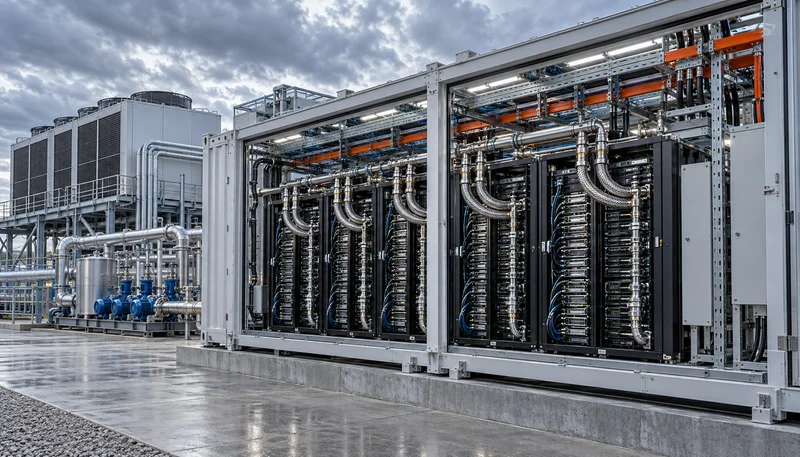
The Factory-Built AI Data Center: Compressing Civil Lead Times from Months to Days
Conventional stick-built civil engineering frameworks are fundamentally misaligned with the exponential velocity of frontier artificial intelligence hardware lifecycles. Standard data center construction typically demands eighteen to twenty-four months of greenfield civil development, followed by four to six months of highly volatile, on-site mechanical, electrical, and plumbing (MEP) fit-out. This paradigm is chronically vulnerable to regional labor shortages, variable quality control during manual field-terminated optical cabling, and erratic hydraulic pipe fitting. The Nvidia DSX Pod supersedes this fragmented methodology by treating the data center envelope not as a piece of stationary real estate, but as an integrated, precision-manufactured compute module. Built entirely within controlled factory environments, the containerized architecture enforces rigorous Factory Acceptance Testing (FAT), encompassing full-load stress screening, hydrostatic pressure validation, and integrated optical loopback verification before structural dispatch.
The primary operational achievement of this containerized paradigm is the aggressive compression of on-site physical commissioning timelines: dropping from a standard six-month MEP integration schedule down to fourteen calendar days at any pre-engineered pad site. Achieving this order-of-magnitude reduction requires standardized physical and operational interfaces. Foundation pads are cast with pre-aligned locating pins, dry-break utility terminations, and modular disconnect chambers. Once the ruggedized container is craned into position, infrastructure technicians only need to dock dual-feed medium-voltage electrical conduits, bolt secondary fluid distribution manifolds via standardized dry-break flanges, and splice high-radix single-mode optical backbones. This deterministic workflow isolates site construction risks to basic civil earthworks and foundation pouring, allowing compute infrastructure delivery to parallel, rather than follow, bulk grid interconnect provisioning.
Standardized ISO 40-foot structural envelope with ISO 1496-1 twist-lock structural corner castings for rapid crane positioning
Factory-completed hydrostatic pressure testing of fluid circuits at 1.5x nominal operating pressure prior to factory dispatch
Pre-engineered structural foundation pad specifications including integrated seismic hold-down points and pre-trench utility stubs
Megawatt Volumetric Density: Architectural Packaging of Vera Rubin NVL72 Racks
Inside the 40-foot containerized envelope, the DSX Pod achieves an unprecedented volumetric and thermal compute density by packing exactly seven Vera Rubin NVL72 liquid-cooled racks. Each individual NVL72 frame draws between 120 kW and 132 kW of continuous electrical power, establishing an aggregate IT operational load between 840 kW and 924 kW, with ancillary cooling, telemetry, and power conversion elevating the total module demand to nearly 1 MW. Packaging this magnitude of thermal and electrical density into a mobile, road-transportable envelope mandates an uncompromising mechanical layout. Compute trays are arranged along a central aisle optimized for rapid extraction, utilizing blind-mate structural slide rails that simultaneously engage electrical busway stubs and hydraulic fluid ports without manual hose or harness manipulation during maintenance cycles.
To preserve the integrity of the ultra-dense NVLink-6 optical backplane across adjacent NVL72 frames, the container's structural chassis is engineered with high-rigidity torsional framing to prevent chassis deflection during transit and thermal cycling. Dedicated, overhead optical fiber raceways are physically isolated from electromagnetic interference generated by internal rectifiers and HVDC busbars. These raceways accommodate thousands of factory-dressed, bend-insensitive MPO-32 and MPO-16 single-mode fiber trunks with strict minimum bend-radius compliance. Hot-aisle and cold-aisle spatial geometries are tightly budgeted, providing sufficient service clearance for hot-swappable power supply units, telemetry controllers, and blind-mate compute trays while dedicating remaining envelope volume to hydraulic distribution headers and primary power rectification cabinets.
Seven-rack structural framing optimized for NVL72 dynamic floor-load distribution exceeding 2,400 kg per rack footprint
Blind-mate slide-rail integration with integrated dynamic mechanical alignment pins (±1.5 mm tolerance window)
Overhead low-loss fiber routing troughs isolated from DC electromagnetic fields with dedicated 40mm bend-radius management
Closed-Loop Direct-to-Chip Thermal Management & Chillerless Heat Rejection
The DSX Pod's thermal architecture completely eliminates dependency on energy-intensive mechanical facility chillers, which historically degrade system-level Power Usage Effectiveness (PUE) and introduce massive single-point mechanical failure domains. Heat removal is handled entirely via closed-loop direct-to-chip (D2C) liquid cooling, driven by an integrated internal Coolant Distribution Unit (CDU) housing dual redundant, variable-speed centrifugal pumps. Treated deionized water mixed with corrosion inhibitors and biocide formulations is circulated through industrial stainless-steel distribution headers directly into microchannel copper cold plates mechanically clamped to the Vera Rubin GPUs, high-bandwidth memory (HBM4) stacks, and host CPU packages. The internal secondary fluid circuit guarantees turbulent flow regimes across microfins, maintaining core junction temperatures well below silicon threshold limits under sustained matrix-multiplication workloads.
Operating within the ASHRAE W3/W4 liquid temperature classification, the primary thermal loop functions with supply fluid temperatures ranging from 32°C to 45°C, yielding high-grade return water temperatures exceeding 55°C. This elevated delta-T enables 100% dry-cooling heat rejection using modular, external adiabatic dry coolers across nearly all terrestrial climatic zones. During extreme peak ambient thermal conditions, minimal adiabatic water misting is pulsed to lower approach temperatures, entirely avoiding continuous evaporative water consumption. By discarding traditional chilled-water plants, variable refrigerant volume compressors, and large-scale cooling towers, the DSX Pod achieves a mechanical PUE below 1.08, while completely insulating the facility operator from municipal water supply constraints and complex regional environmental discharge regulations.
Dual-inverter redundant N+1 primary-to-secondary CDU with dynamic flow modulation up to 1,200 liters per minute
ASHRAE W3/W4 compliant secondary loop operating envelope supporting 32°C to 45°C inlet fluid conditions
Closed-circuit stainless-steel AISI 316L hydraulic distribution headers equipped with dripless quick-disconnect (QDC) couplings
Power Distribution Topologies: 380V HVDC Busways and Transient Delta-P Buffering
Routing nearly 1 MW of power within the confined envelope of a single shipping container makes standard low-voltage 208V or 415V AC distribution internally unviable due to extreme cable bulk, severe I²R resistive thermal losses, and excessive conductor weight. The DSX Pod solves this physical boundary by ingesting dual-feed 415V/480V 3-phase AC utility lines into centralized, solid-state modular rectification bays located at the container's service head. These high-efficiency rectifiers convert bulk AC power into a regulated 380V High Voltage Direct Current (HVDC) busway system spanning the length of the container ceiling. Step-down power shelves within the NVL72 racks subsequently convert 380V HVDC directly down to 48V/12V intermediate point-of-load planes, slashing internal copper conductor volume by over 65% and reducing system-level electrical distribution losses to under 2.5%.
A critical engineering hurdle in frontier AI infrastructure is the destructive transient delta-P load step: when massive transformer model training runs transition from communication phases to 100% all-to-all tensor compute in fractions of a millisecond, the instantaneous current draw spikes exponentially. Left unmitigated, these sharp di/dt transients cause busway voltage sag, trigger breaker trips, and inject harmonic distortion into upstream utility substations. The DSX Pod incorporates an integrated transient power buffering system consisting of high-power density supercapacitor banks paired with localized Lithium-Titanate (LTO) Battery Energy Storage System (BESS) modules. This hybrid energy storage reservoir acts as an ultra-fast electrical flywheel, sourcing up to 300 kW of auxiliary current within 2 milliseconds, effectively smoothing the utility-facing ramp rate to ensure grid compliance.
Solid-state 380V HVDC centralized rectification shelf boasting >97.5% conversion efficiency with active power factor correction
Fast-transient supercapacitor buffering bank delivering sub-2ms response to dynamic load steps exceeding 500 kW/sec
Coordinated transient arc-flash optical detection and solid-state circuit breaking clearing localized faults under 5 microseconds
Sovereign Enclaves and OpenShell Security Controls for Modular Edge Infrastructure
As computational sovereignty moves from a regulatory aspiration to an enforceable operational mandate, the DSX Pod provides the physical and cryptographic vehicle for sovereign AI factories. The architecture addresses the legal and geopolitical need to confine foundational model training, localized fine-tuning, and national datasets within strictly delineated physical jurisdictions. Rather than leasing multi-tenant infrastructure inside commercially shared hyperscale facilities where cross-tenant virtualization attacks remain a structural risk, government, defense, and sovereign industrial operators can drop autonomous DSX Pod modules directly onto secured government compounds, private energy generation nodes, or enterprise facilities, ensuring absolute custody of the compute pipeline.
Logical security is governed by the OpenShell Reference Architecture, which establishes a zero-trust cryptographic perimeter across all hardware components. Each Vera Rubin compute tray features a hardware Root of Trust (RoT) integrated directly with secure cryptoprocessors that execute authenticated firmware verification, runtime memory attestation, and cryptographically signed platform telemetry reporting. Optical interconnects traversing between containers are secured with hardware-accelerated inline MACsec encryption, neutralizing physical fiber-tapping vectors. Combined with comprehensive perimeter tamper sensors, automated chassis intrusion interlocks, and cryptographic zeroization triggers that scrub local volatile key stores upon physical chassis breach, the DSX Pod operates as a fortified computing enclave suited for hostile or zero-trust deployment environments.
OpenShell-compliant Hardware Root of Trust (RoT) with SPDM 1.2 microcode verification and continuous runtime attestation
Inline hardware MACsec encryption across all external inter-pod optical transceivers operating at line-rate bandwidth
Autonomous physical anti-tamper sensing matrix featuring chassis intrusion interlocks and cryptographic volatile zeroization
Lifecycle Capital Allocation, Forklift Upgrades, and Multi-Pod Gigawatt Clustering
The economic justification for modular containerized infrastructure is governed by Net Present Value (NPV) dynamics centered around revenue realization schedules. In frontier AI training, where the market value of training an advanced frontier model is highly time-sensitive, bringing 15,000+ liquid-cooled GPUs online 5.5 months ahead of a traditional 24-month stick-built schedule generates hundreds of millions in operational value. This temporal arbitrage completely offsets the modest CapEx premium of pre-integrated modular container hardware. By converting complex field construction into a streamlined, repeatable capital procurement program, enterprise infrastructure operators convert high-risk, variable civil expenses into fixed, predictable capital asset blocks that scale concurrently with operational cash flow.
Horizontal scaling toward gigawatt AI factory complexes is achieved by clustering DSX Pods in parallel, modular block arrays linked by standardized pre-cast utility trenches carrying medium-voltage electricity, secondary fluid loops, and dense optical fiber raceways. Most critically, the DSX Pod architecture fundamentally solves the data center obsolescence cycle. Historically, migrating facilities from one compute generation to the next required complex, multi-month gut-and-replace MEP overhauls. With the DSX Pod, generational evolution is managed through simple forklift replacements: a fully amortized container module is detached at its dry-break couplings and electrical disconnects, hoisted off its pad, and replaced with next-generation silicon packaging in hours, achieving zero downtime for adjacent operational clusters.
Modular campus master plan using standardized pre-cast sub-grade utility trenching for 13.8kV/34.5kV distribution and optical loops
Hitless forklift operational procedures enabling container swap, fluid purge, and cluster re-registration within a 48-hour service window
Standardized multi-pod optical orchestration topologies supporting non-blocking full-mesh fabrics across gigawatt-scale clusters
Engineering Procurement & Technical Desk
For technical datasheets, custom power topology design, or volume export quotations, reach out to RICEWIND engineers.