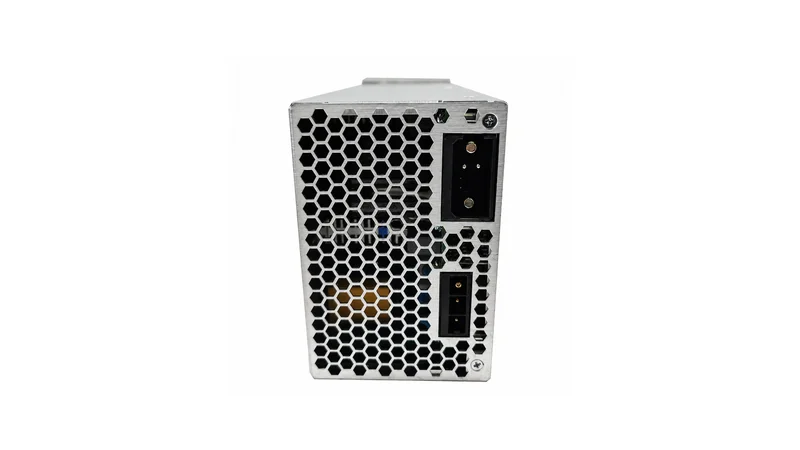
Architectural Topology & Power Density Engineering
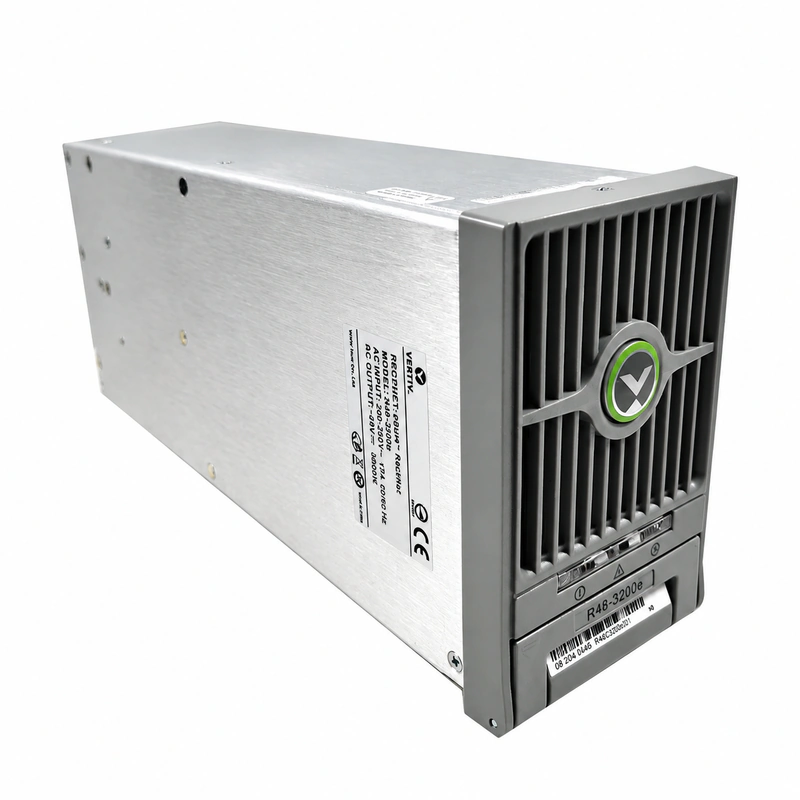
The Vertiv R48-3200e represents a benchmark in telecommunications switch-mode power supply (SMPS) design, packaging 3200W of continuous output power into an ultra-compact envelope measuring 84.5mm in width, 272mm in depth, and 132mm in height (standard 1U/3U subrack shelf plug-in format) with an approximate mass of 2.8 kg. The internal power conversion stage utilizes a high-frequency interleaved power factor correction (PFC) topology coupled with an isolated resonant DC-DC converter. By combining planar magnetics with high-speed power MOSFETs, the module achieves exceptional volumetric power density, minimizing subrack physical space while maximizing power delivery per rack unit in high-load telecom environments.
Mechanical and electrical reliability during field servicing is governed by a precision blind-mate rear connector assembly. This interface supports hot-swapping under live DC bus conditions without risking transient dropouts or upstream supervisory interruption. The mechanical connector layout enforces a staged pin engagement protocol: safety protective earth (PE) engages first to guarantee ground potential equalization, followed by high-current DC bus and AC power conductors, and finally low-voltage CAN communication and sensing pins. This sequential engagement prevents contact arcing, suppresses capacitive inrush currents, and shields the internal digital signal processor (DSP) from electrostatic discharge and ground bounce during insertion.
Form Factor Verification: 84.5mm (W) × 272mm (D) × 132mm (H) footprint with standardized 1U/3U subrack slide rail alignment.
Blind-Mate Mechanical Interlocking: Ensure staged ground-first mating to prevent inductive arcing and floating ground latch-up.
Weight & Handling Compliance: Nominal 2.8 kg unit weight allows single-technician zero-downtime hot extraction and insertion.
Electrical Conversion Efficiency & Grid Adaptation
Operating at a peak conversion efficiency exceeding 95.4%, the R48-3200e significantly suppresses internal power dissipation and lowers site-level thermal loads. In massive multi-kilowatt central offices and edge data centers, this efficiency directly translates into lowered cooling operational expenditure and reduced total electrical draw. The module incorporates an active Power Factor Correction stage maintaining a power factor (PF) of ≥ 0.99 from 50% to 100% of rated capacity, while limiting Total Harmonic Distortion (THD) to ≤ 5%. This low harmonic profile prevents phase imbalance on local diesel generator sets and eliminates upstream transformer overheating caused by non-linear loading.
The unit is engineered to withstand extreme utility voltage instability, featuring an operating input range spanning 85V AC to 300V AC (nominal 200V AC to 250V AC single-phase). At inputs between 176V AC and 290V AC, the module delivers its full 3200W rated capacity. When utility anomalies cause severe brownouts down to the 85V to 176V AC window, the internal DSP implements an intelligent, non-disruptive power de-rating curve down to 1000W–1500W, maintaining DC bus integrity rather than tripping offline. Furthermore, the rectifier withstands sustained input overvoltages up to 415V AC without semiconductor failure, rendering it exceptionally resilient in regions prone to phase-loss neutral shifts or severe industrial inductive switching transients.
Efficiency Benchmarking: Verify >95.4% peak conversion efficiency across the 40% to 80% operational load curve to minimize OPEX.
Grid Input Envelope: Confirm stable 85V AC to 300V AC operation with full 3200W capacity maintained from 176V AC to 290V AC.
Grid Resilience: Verify 415V AC non-destructive sustained overvoltage withstand capability to guard against neutral floating.
Thermal Management & Acoustic Dynamics
Thermal dissipation in the R48-3200e utilizes an optimized front-to-back forced ventilation scheme. Heat-generating power elements—including input rectifiers, PFC chokes, planar transformers, and synchronous rectification MOSFETs—are mounted onto custom-extruded aluminum heatsinks configured parallel to the linear airflow vector. A forward-mounted, variable-speed brushless DC fan is regulated directly by the module DSP via closed-loop pulse-width modulation (PWM). Temperature sensors placed at critical internal junctions adjust fan speed dynamically based on ambient intake temperatures and output current loading, extending fan bearing lifespan and reducing acoustic noise emissions to under 50 dBA at nominal loads.
The module exhibits an extended operational temperature envelope ranging from -40°C to +75°C (-40°F to +167°F). Full 3200W power delivery is sustained without de-rating up to +55°C ambient air intake. Between +55°C and +75°C, the DSP enforces a linear thermal de-rating algorithm, adjusting maximum output current limit to prevent thermal runaway while preserving continuous DC delivery to critical transmission gear. Cold-start profiles are fully supported down to -40°C with internal soft-start logic that mitigates cold-inrush thermal shock on power semiconductors.
Thermal De-rating Thresholds: Validate full 3200W output up to +55°C, with controlled linear derating operating up to +75°C.
Forced Air Velocity: Maintain a clean front-to-rear airflow path; minimum 100mm clearance required in front of subrack intake grilles.
Acoustic & Fan Diagnostics: Monitor DSP-controlled variable fan RPM metrics over CAN bus to preemptively flag bearing friction or dust accumulation.
System Integration & CAN Bus Telemetry
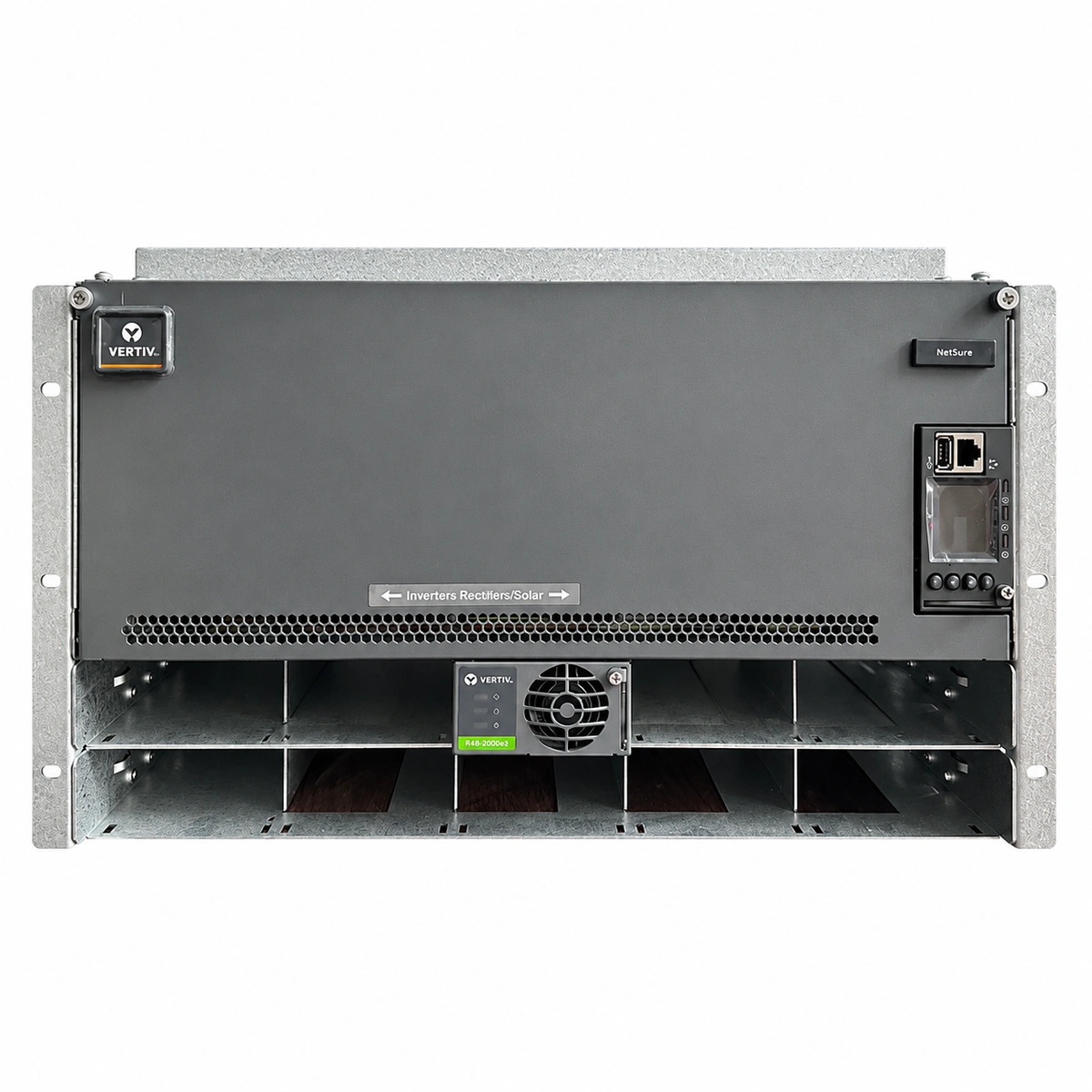
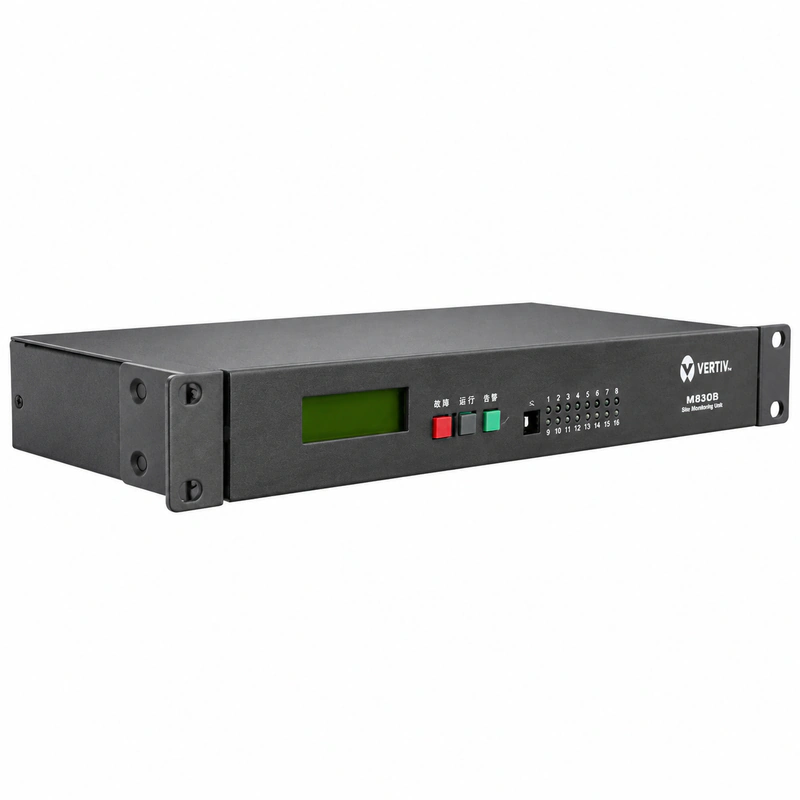
The R48-3200e is engineered for plug-and-play integration into Vertiv NetSure DC power distribution architectures, natively supporting NetSure 501, 531, 701, 721, and 731 series subrack shelves. Communications are managed over an isolated high-speed Controller Area Network (CAN) bus protocol, interfacing directly with supervisory controllers such as the NCU, SCU+, M530B, and M830B. The digital control link provides continuous bidirectional parameter exchange, permitting the central controller to dynamically adjust module output voltage from -42V DC to -58V DC (nominal -48V DC float) to support automated battery equalization, temperature-compensated float charging, and lithium-ion battery management system (BMS) handshakes.
Parallel module deployments utilize an autonomous active load-sharing architecture. Output current sharing among parallel rectifiers within a single subrack is maintained within a strict ±5% tolerance across the 20% to 100% load spectrum, eliminating the risk of individual module over-stressing. The CAN telemetry stream reports granular performance telemetry, including individual phase AC input voltage, frequency, DC output current, internal heatsink thermal points, and diagnostic alarm statuses, allowing central network operations centers (NOC) to execute predictive maintenance and automated capacity planning.
Subrack Mechanical Interfacing: Confirm direct compatibility with Vertiv NetSure 501, 531, 701, 721, and 731 power shelves.
Autonomous Load Sharing: Verify dynamic current balance across parallel units within a ±5% deviation envelope.
Supervisory Controller Handshake: Ensure firmware compatibility with NCU, SCU+, M530B, and M830B controllers over CAN bus.
Mission-Critical Protection Matrix & Industrial Reliability
Designed for unattended mission-critical infrastructure, the R48-3200e integrates a comprehensive hardware- and firmware-governed protection matrix. On the input side, the module features multi-stage metal oxide varistor (MOV) surge suppression coupled with software-defined AC overvoltage and undervoltage trip points featuring automatic hysteresis-driven restart. Output protection incorporates a dual-tier overvoltage clamping mechanism: a primary DSP-controlled software shutdown and an autonomous analog secondary hardware comparator latch. This redundancy ensures that no single-point component failure can impose destructive overvoltages onto connected -48V telecommunications loads.
Output current is precisely managed via dynamic foldback short-circuit protection. Under bolted-fault short-circuit conditions or battery deep-discharge recharge cycles, the module transitions from constant-voltage mode into a constant-current limiting envelope (rated 50A at -58V DC, with peak delivery up to 66.7A at lower float voltages), preventing downstream cable thermal breakdown. Calculated Mean Time Between Failures (MTBF) exceeds 500,000 operational hours in accordance with Telcordia SR-332 standards, reinforced by industrial-grade 105°C-rated long-life electrolytic filtering capacitors and conformal-coated surface mount assemblies.
Dual Overvoltage Architecture: Confirm redundant hardware and firmware DC overvoltage latching mechanisms operate independently.
Short-Circuit Current Limit: Verify output current clamping at 50A to 66.7A during dead-short or low-impedance battery recharge states.
Component Reliability Standards: Require Telcordia SR-332 MTBF validation exceeding 500,000 operating hours under full load.
Carrier-Grade Procurement, Testing & Global TCO Strategy
When procuring the Vertiv R48-3200e for macro base stations, central switching centers, or enterprise data halls, rigorous incoming verification is necessary to guarantee system availability and optimize total cost of ownership (TCO). Procurement teams must inspect unit serial numbering against factory production registers to ensure firmware revision compatibility with existing subrack controllers. Prior to field commissioning, modules should undergo an automated full-load burn-in test encompassing high-pot isolation verification (AC-to-DC dielectric withstand >3000V AC), CAN telemetry handshakes, and a 4-hour thermal soak to eliminate early-life infant mortality risks.
Selecting verified supply channels is critical to prevent the deployment of grey-market components or sub-standard reworked units that compromise site availability. For engineering inquiries, carrier-grade bulk procurement, verified factory-original units, and fully certified warranty-backed modules, consult the official engineering team at RICEWIND. RICEWIND provides global distribution, lifecycle stocking, and direct technical support. Direct technical inquiries and bulk purchase specifications can be routed via Email at lee@ricewind.com or by Phone/WhatsApp at +86 17621197907.
Traceability & Authenticity: Verify genuine Vertiv production serialization and match hardware revision to controller firmware.
Quality Assurance Protocol: Require 100% full-load electrical burn-in and dielectric withstand testing documentation prior to site acceptance.
Direct Engineering Procurement: Connect directly with RICEWIND (lee@ricewind.com / +86 17621197907) for certified supply chain delivery.
Engineering Procurement & Technical Desk
For technical datasheets, custom power topology design, or volume export quotations, reach out to RICEWIND engineers.