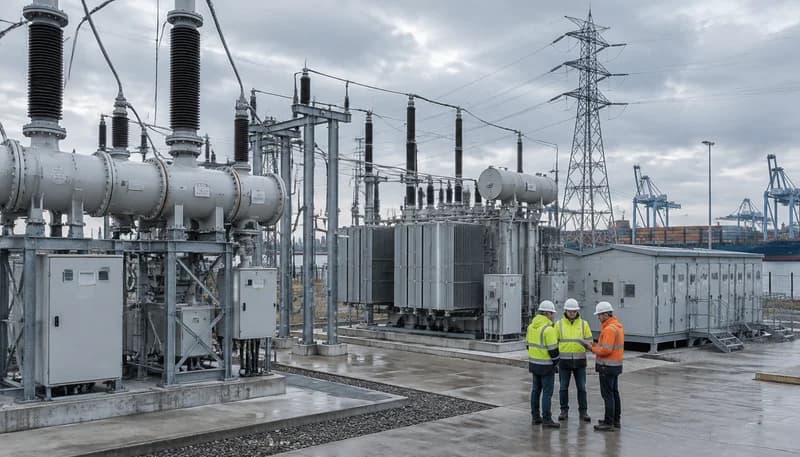
Executive Summary & Grid Reality: The Amsterdam Saturation and Spatial Decentralization
Within Europe's core FLAP-D data center markets (Frankfurt, London, Amsterdam, Paris, and Dublin), the Greater Amsterdam metropolitan area has encountered an unprecedented structural power constraint. Despite an inventory expansion of 11% year-over-year (representing 64.3 MW of new capacity) that compressed vacancy rates to 9.4%, energization timelines have decoupled from digital demand. In the first half of 2026, Amsterdam added just 16.3 MW of commissioned capacity, compared to 72.5 MW energized in Paris. National transmission system operator TenneT and regional distribution system operator Liander have exhausted firm medium- and high-voltage transmission headroom across key nodes including Schiphol-Rijk and Amsterdam-Zuidoost, pushing utility substation interconnection lead times to between 36 and 48 months.
National spatial planning policies restricting hyperscale development to designated industrial clusters—principally Hollands Kroon (Middenmeer) and Het Hogeland (Eemshaven)—combined with municipal moratoriums, have accelerated an outward engineering shift. Developers are transitioning from centralized metro-core builds to regional Dutch hubs, including the Port of Rotterdam, Groningen, Eindhoven, and the eastern corridors of Overijssel and Gelderland. For hyperscale operators and tier-1 colocation providers, this transition requires a fundamental redesign of medium-to-high voltage substation architecture, power transformation sequences, and local grid interconnection agreements to preserve continuous reliability.
Audit TenneT and regional DSO transmission capacity heatmaps for firm versus non-firm (curtailable) interconnection capacity prior to site boundary acquisition.
Verify dual-feed utility redundancy paths from independent 150kV or 380kV substations to ensure N+1 transmission reliability for regional deployments.
Deliverable Power Economics: Overriding Land, Tax, and Latency for 300 MW AI Demands
Site selection criteria across Western Europe have undergone a structural paradigm shift: deterministic energization timelines now fully supersede land acquisition costs, municipal tax incentives, and sub-millisecond fiber network latency. Historically, enterprise colocation facilities operated within predictable 30 MW to 60 MW envelopes. Modern accelerated computing platforms and generative AI model training clusters routinely demand 150 MW to 300 MW of continuous power per campus, saturating entire 150kV/20kV transformation bays at the utility point of common coupling (PCC).
This volumetric escalation coincides with acute global supply-chain bottlenecks for high-voltage and medium-voltage electrical switchgear. Procurement lead times for 380kV/150kV and 150kV/20kV autotransformers now routinely extend from 30 to 36 months, driven by shortages in grain-oriented electrical steel (GOES) cores and specialized high-voltage bushing components. Consequently, executing pre-orders for major substation equipment must now precede site civil groundbreaking by up to three years, transforming electrical infrastructure procurement into the single critical path item for capital expenditure deployment.
Issue long-lead capital commitments for 150kV/20kV 80-100 MVA power transformers 36 months in advance of target commercial operation dates (COD).
Negotiate flexible power purchase agreements (PPAs) with dynamic offtake thresholds to align with volatile North Sea offshore wind feed-in profiles.
Regional Decentralization & Substation Interconnection: Engineering the Outer Nodes
Deploying critical digital infrastructure outside the Amsterdam ring requires specialized civil and electrical engineering adaptations. In Rotterdam's industrial harbor corridor, brownfield developments leverage deep-pile foundations to support vertical, multi-story data center architectures on reclaimed land. Compact, indoor gas-insulated switchgear (GIS) operating at 66kV or 150kV eliminates the extensive physical footprint of conventional air-insulated switchgear (AIS), while the activation of the AMS-IX Rotterdam Point of Presence ensures carrier-grade network density with round-trip latency to Amsterdam maintained below 0.8 milliseconds.
In eastern provinces such as Overijssel and Gelderland, regional campuses interface directly with high-capacity 380kV transmission corridors interconnecting the Dutch grid with the German transmission system (Amprion). These cross-border links offer unique power-wheeling opportunities and enhanced grid resilience. Concurrently, regional Dutch municipalities mandate strict energy efficiency and spatial sustainability metrics: facilities must integrate plate-frame liquid-to-water heat recovery systems capable of exporting 65°C to 75°C low-grade waste thermal energy directly into regional district heating networks.
Deploy SF6-free or low-GWP gas-insulated switchgear (GIS) up to 150kV to satisfy rigorous municipal land-use limits and environmental permitting constraints.
Design secondary closed-loop district heating heat exchangers with supply temperature outputs above 65°C to comply with Dutch municipal heat reuse codes.
Behind-the-Meter Generation, BESS & Microgrid Bridging Strategies
To decouple compute deployment schedules from multi-year utility queue backlogs, operators are deploying behind-the-meter (BTM) microgrids operating in islanded or grid-parallel arrangements. Containerized battery energy storage systems (BESS) based on lithium iron phosphate (LFP) chemistry—configured for 2C to 4C discharge rates with total campus capacities spanning 50 MWh to 200 MWh—provide both synthetic inertia and primary frequency response (FSR). Crucially, BESS installations absorb the dynamic 40 MW to 80 MW step-load swings typical of AI model training cycles, protecting the upstream utility grid from severe voltage sags.
During prolonged grid interconnection delays, temporary prime-power generation assets—such as aeroderivative gas turbines and reciprocating internal combustion engines (RICE) rated for up to 30% hydrogen fuel blending—bridge the operational gap. These microgrids are managed by autonomous controllers executing real-time droop control, peak shaving, and sub-cycle synchronization, allowing the data center to transition smoothly between islanded generation, BESS peak dispatch, and contracted utility import baselines.
Specify liquid-cooled LFP BESS containers with multi-tier deflagration mitigation compliant with NFPA 855 and European industrial fire safety codes.
Configure microgrid control software with fast-frequency response (FFR) subroutines to dampen transient step-loads up to 40% of nominal campus load within 200 milliseconds.
High-Density Power Distribution: Medium-Voltage Transformation for Regional AI Clusters
Within regional hyperscale facilities, delivering 300 MW to rack densities exceeding 80 kW to 120 kW per unit requires replacing legacy 400V low-voltage centralized pathways with medium-voltage (MV) distribution topologies. Facilities step down utility supply voltages (150kV or 66kV) to 20kV or 10kV distribution feeds that enter the white space directly. This architecture eliminates extensive low-voltage copper runs, slashing distribution I²R thermal losses by up to 60% across the transmission-to-hall boundary.
At the white space perimeter, modular cast-resin dry-type transformers convert 20kV power to 415V three-phase alternating current or feed high-voltage direct-current (HVDC, 380V DC) busway systems directly. For ultra-dense AI workloads utilizing liquid cooling (direct-to-chip cold plates and immersion tanks), power distribution units (PDUs) must maintain rigid N+1 or 2N electrical path redundancy across coolant distribution units (CDUs), primary variable-speed circulation pumps, and facility water system manifolds.
Deploy close-coupled 20kV-to-415V cast-resin dry-type transformers situated within 15 meters of compute rows to limit secondary low-voltage resistive losses.
Standardize on 2N redundant dual-corded overhead busway infrastructure engineered to support continuous 120 kW rack densities with zero downtime maintenance paths.
Comprehensive Engineering Deployment Checklist: Pre-Construction Grid Audit
Deploying multi-megawatt computing campuses in the decentralized Dutch market requires an exhaustive pre-construction engineering and grid-readiness audit. Electrical engineering teams must systematically review the legal and physical constraints of the utility point of common coupling, distinguishing between firm delivery allocations, non-firm alternative transport rights (CBC contracts), and seasonal curtailment probabilities influenced by North Sea offshore wind production.
Furthermore, hyperscale facilities must conduct comprehensive harmonic distortion simulations under IEC 61000-3-6 standards. Because the switched-mode power supplies (SMPS) utilized in massive GPU installations generate elevated 3rd, 5th, and 7th harmonic orders, engineers must install active power factor correction (APFC) and active harmonic filters (AHF). This ensures Total Harmonic Voltage Distortion (THDv) remains strictly below 3.0% at the utility interface, preventing upstream resonance within DSO substation capacitor banks.
Execute PSCAD/ETAP harmonic resonance and short-circuit level (kA) analyses at the 150kV PCC to verify compliance with Dutch Grid Code harmonics standards.
Formulate binding utility interconnection terms specifying queue protection, ramp-rate limits, and failure-to-energize liquidated damages before executing land purchase contracts.
Engineering Procurement & Technical Desk
For technical datasheets, custom power topology design, or volume export quotations, reach out to HEFENGQI engineers.