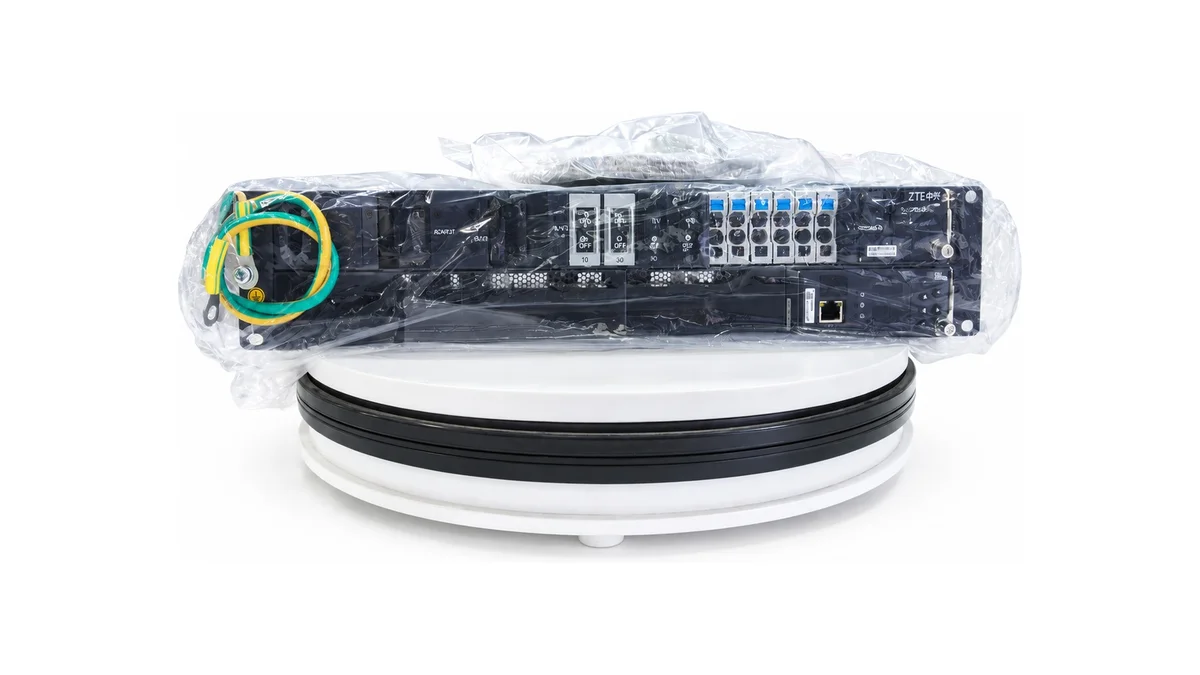
Section 1: Architectural Overview & 3U Compact Subrack Topology
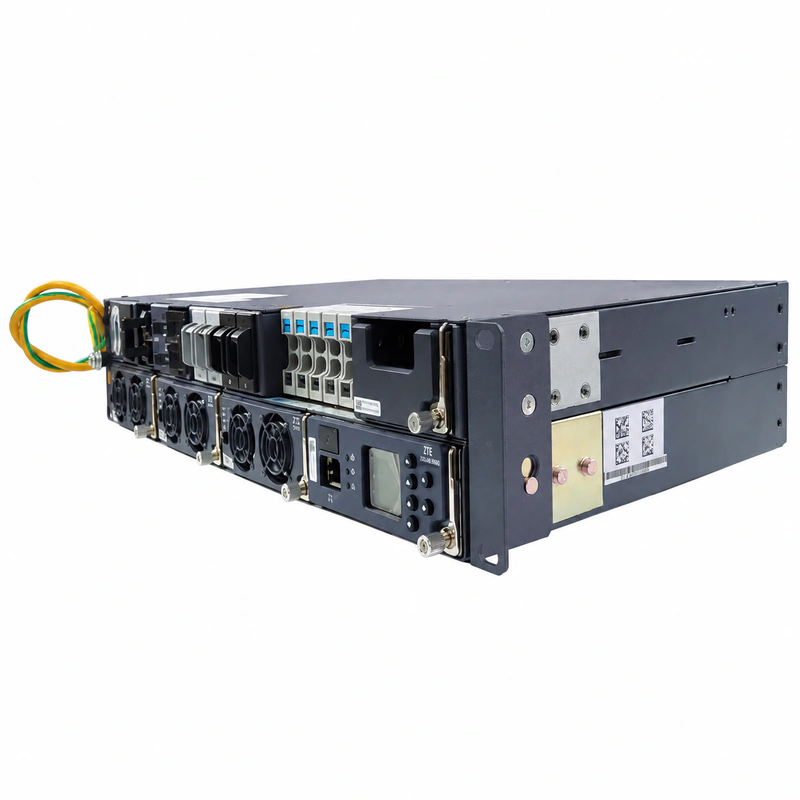
The ZTE ZXDU48 B900 establishes a carrier-grade standard for high-density, space-constrained DC power distribution. Fabricated within a standardized 19-inch rack-mount profile measuring 482mm in width, 290mm in structural depth, and 132mm in height (standard 3U), the chassis is manufactured from high-tensile galvannealed sheet steel to resist structural torsion and environmental corrosion. Its mechanical footprint allows direct integration into standard telecom equipment racks, outdoor integrated macro-site cabinets, and edge micro-shelters where depth envelope restrictions (<300mm) eliminate conventional bulkier power distribution subracks.
At the structural core of the ZXDU48 B900 is a triple-slot, hot-swappable rectifier bay. The system provides universal modular compatibility with both legacy ZTE ZXD800 (15A / 800W) units and high-efficiency ZXD1500 (30A / 1500W) switch-mode rectifier modules. Fully populated with three ZXD1500 modules, the subrack yields a gross busbar capacity of 90A continuous at nominal -48VDC (4.5kW to 5.2kW gross capacity depending on terminal float voltage). This allows telecommunications operators to provision an N+1 resilient 60A protected payload or an uncompromised 90A maximum load profile, utilizing full front-access cabling for power inputs, battery drops, branch distribution, and operational maintenance.
Chassis Dimensions: Standard 19-inch rack-mount, 3U profile (482mm W x 290mm D x 132mm H) with IP20 enclosure protection.
Module Bay Configuration: 3 horizontal/vertical hot-swappable slots accommodating ZXD800 (15A) or ZXD1500 (30A) switch-mode rectifiers.
System Output Scalability: 30A to 90A total continuous capacity; supports N+1 redundancy architectures up to 60A critical load.
Section 2: Electrical Grid Adaptability & Surge Protection
Designed to maintain uninterrupted carrier-grade operation across unstable utility infrastructure and weak rural grids, the ZXDU48 B900 features an ultra-wide AC input operational envelope of 80VAC to 300VAC (nominal single-phase three-wire 220V/230V/240V AC, 50Hz/60Hz). The internal rectification stages deliver 100% rated output power within the 150VAC to 300VAC window, executing a controlled, linear power derating curve between 150VAC down to the low-voltage cutoff of 80VAC. This wide-window topology eliminates continuous switching between grid power and backup battery banks during utility sags, substantially preserving battery chemical life.
Upstream electrical disturbances, lightning transients, and utility switching surges are mitigated by an integrated, coordinated Class C surge protective device (SPD). Rated for a nominal discharge current (In) of 20kA and a maximum discharge current (Imax) of 40kA under an 8/20us waveform, the internal suppression stage shields sensitive internal semiconductors and downstream telecom loads. Each rectifier incorporates active Power Factor Correction (PFC), maintaining an operating power factor greater than or equal to 0.99 at rated load with a Total Harmonic Distortion (THDI) of 5% or less, fully compliant with international electromagnetic compatibility and grid-injection harmonics directives.
Operating AC Input Voltage: 80VAC to 300VAC single-phase (L+N+PE); linear derating from 150VAC down to 80VAC.
Surge Suppression Specification: Integrated Class C lightning protection stage rated at In = 20kA, Imax = 40kA (8/20us waveform).
Power Quality Compliance: Active PFC stage achieving cos phi >= 0.99; input current THDI <= 5% at nominal load.
Section 3: High-Density DC Power Distribution & Dual LVD Protection
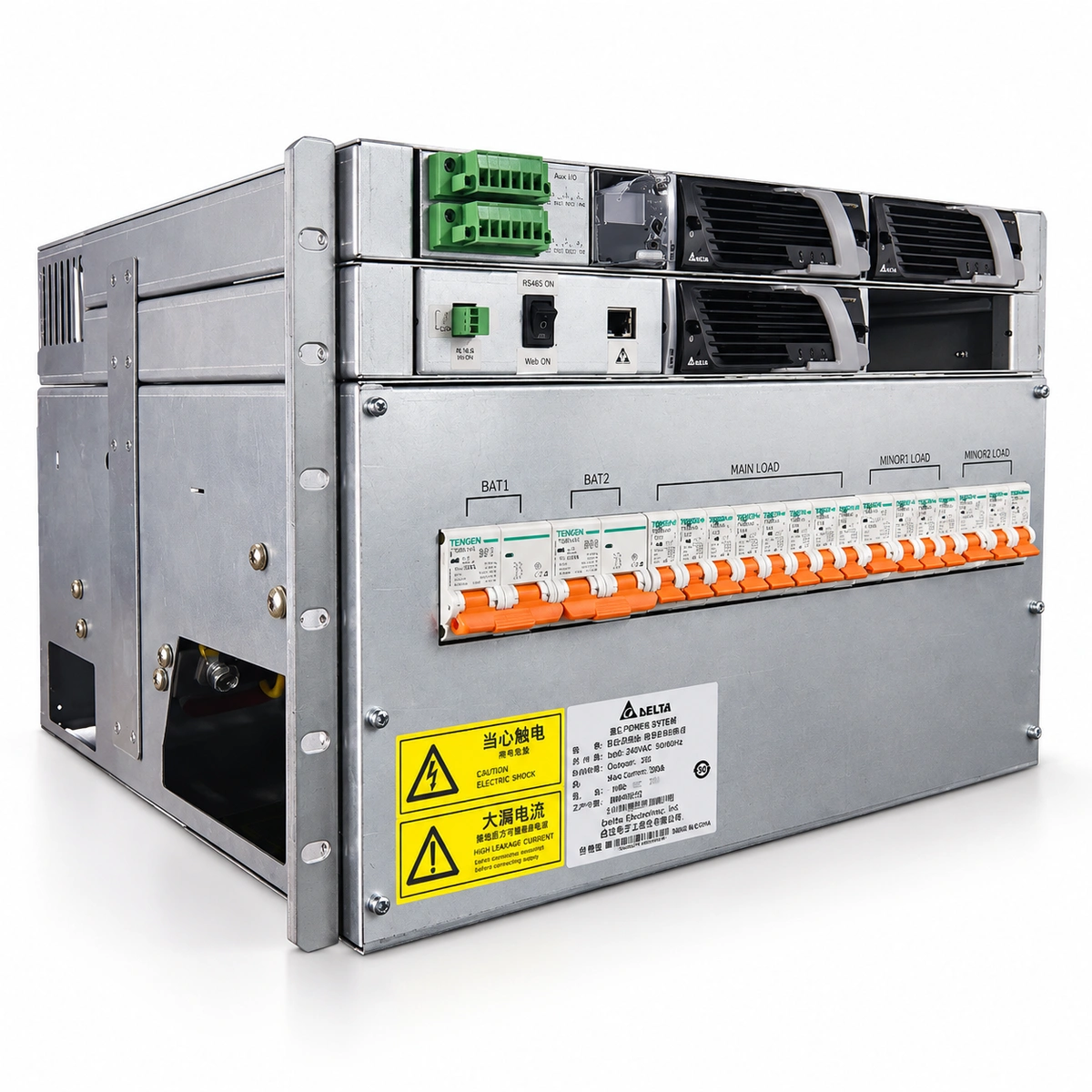
The internal DC power routing architecture of the ZXDU48 B900 is fabricated from high-purity T2 electrolytic copper busbars, specifically engineered to minimize internal resistance, suppress voltage drops across the internal distribution path, and restrict thermal rise under continuous 90A load conditions. The system accommodates up to two independent battery string connections, each protected by high-rupture-capacity miniature circuit breakers (MCBs) rated from 50A to 63A. This enables multi-string redundancy and balanced charging across paired Valve Regulated Lead-Acid (VRLA) or Lithium Iron Phosphate (LiFePO4) battery installations.
To maximize equipment survival during prolonged utility failure while safeguarding energy storage from irreversible cell degradation, the subrack incorporates an automated dual-stage Low Voltage Disconnect (LVD) contactor scheme. The Load Low Voltage Disconnect (LLVD) contactor is programmatically assigned to shed non-essential loads (such as secondary transmission gear or auxiliary environmental cooling) at a user-defined threshold (typically -44.0VDC). The Battery Low Voltage Disconnect (BLVD) contactor executes a definitive disconnect of high-priority transmission and baseband units at the battery safety cutoff (typically -43.2VDC), preventing cell reversal and structural plate degradation.
Busbar Metallurgy: High-conductivity T2 electrolytic copper engineered for minimal thermal rise at 90A continuous current.
Battery Connectivity: Dual battery inputs protected via 2x 50A/63A hydraulic-magnetic or thermal-magnetic MCBs.
Dual-Stage LVD Architecture: Independent LLVD (non-critical load shedding) and BLVD (deep-discharge battery protection) contactors.
Section 4: CSU401S Intelligent Monitoring & Autonomous Battery Management
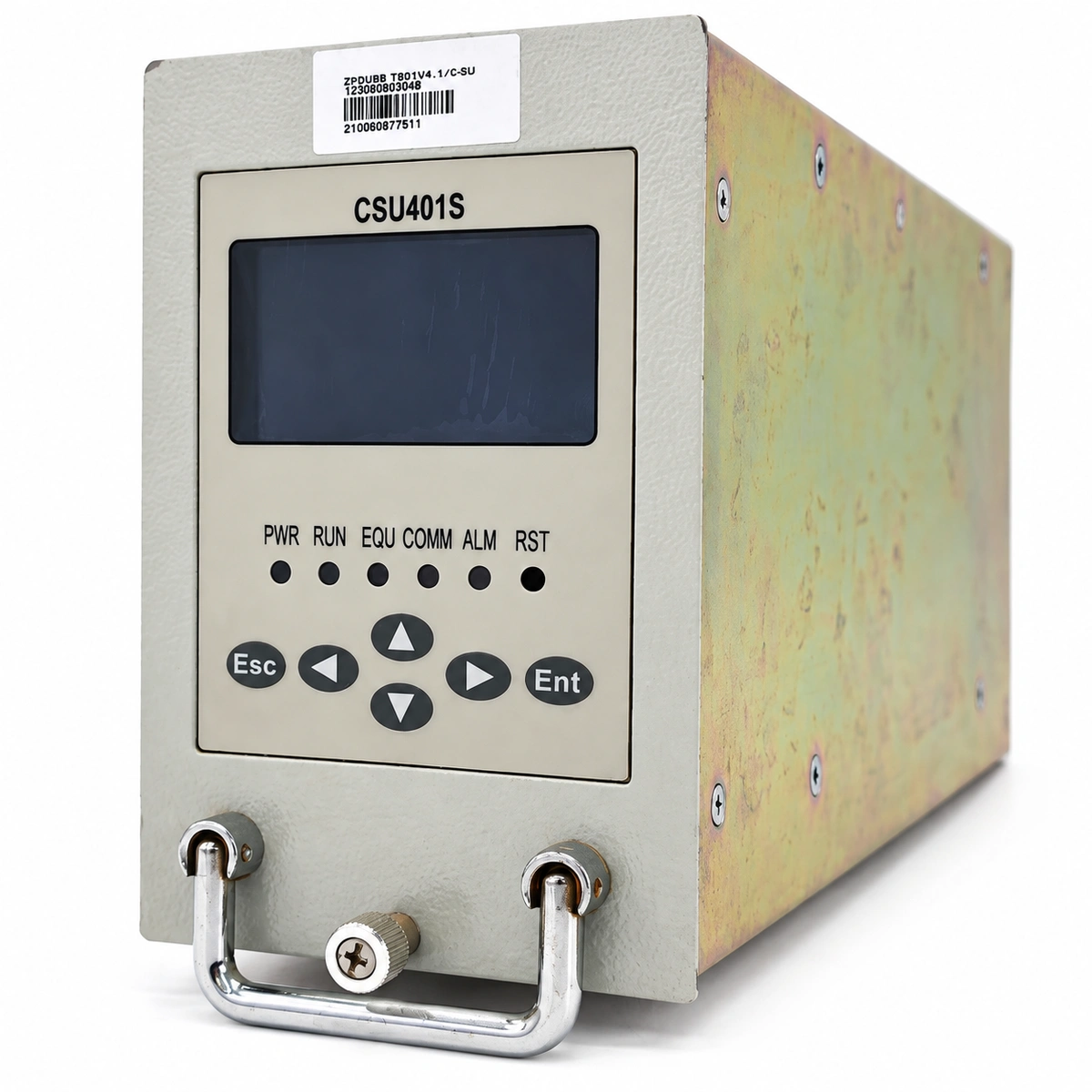
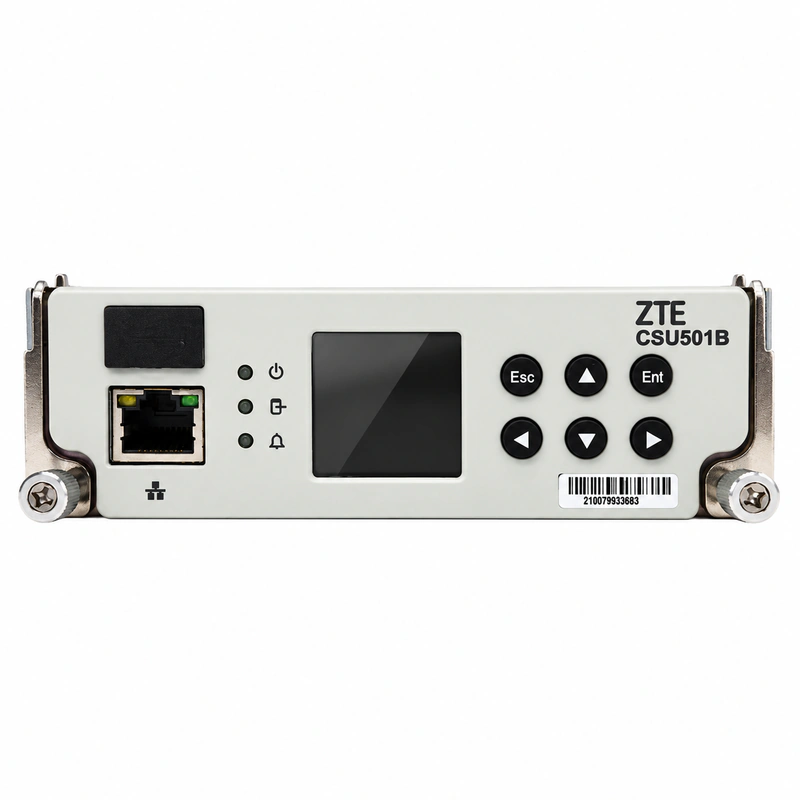
Supervisory intelligence within the subrack is driven by the ZTE CSU401S compact monitoring unit. Equipped with a backlit multi-line LCD display, localized keypad navigation, and intuitive operational status LEDs, the controller provides real-time telemetry over system output voltage (-42VDC to -58VDC adjustable), phase input voltages, aggregate load current, individual rectifier operating parameters, and active alarm statuses. The controller supports multi-tier telemetry acquisition via integrated analog and digital environmental sensor ports, capturing ambient temperature, battery block temperature, relative humidity, and physical door entry alarms.
The CSU401S executes automated battery health management algorithms. It seamlessly commands continuous float charging, automated constant-current boost charging following utility restoration, and dynamic temperature-compensated float regulation based on an external negative temperature coefficient (NTC) thermal probe. The controller also features programmable periodic battery capacity testing, calculating real-world discharge curves against nominal baseline ampere-hour values without risking total site blackouts. Communication interfaces include RS232 and RS485 serial interfaces, with support for SNMPv1/v2c/v3, Modbus industrial automation protocols, and direct integration into ZTE NetNumen U31 centralized OSS frameworks.
Controller Module: Integrated ZTE CSU401S unit with localized LCD, multi-button keypad, and diagnostic LED indicators.
Battery Management Engine: Autonomous boost/float transition, temperature-compensated charging, and scheduled capacity discharge testing.
Northbound Telemetry: RS232, RS485, and Ethernet connectivity supporting SNMPv1/v2c/v3, Modbus, and NetNumen U31 centralized OSS.
Section 5: Wireless Base Station & Edge Infrastructure Deployment Scenarios
The electrical characteristics and compact footprint of the ZXDU48 B900 make it highly suited for modern distributed 4G LTE and 5G wireless base station architectures. In centralized Baseband Unit (BBU) pool deployments, the subrack fits cleanly within standard 19-inch battery-integrated cabinets, delivering high-stability -48VDC bus regulation with an overall output voltage accuracy of <= +/- 0.5%, dynamic response recovery under 200 microseconds, and peak-to-peak ripple noise suppressed below 150mVp-p (weighted psophometric noise <= 2.0mV). This clean DC profile prevents data corruption and RF transmission degradation across Remote Radio Units (RRUs).
Beyond macro cellular sites, the ZXDU48 B900 operates reliably in remote microwave transmission repeaters, railway signaling equipment huts, oil and gas pipeline SCADA monitoring stations, and edge computing micro-data center enclosures. Its broad thermal operating envelope of -25°C to +65°C, supported by internal variable-speed, temperature-controlled forced-air cooling within the rectifiers, guarantees full-load 90A output up to +45°C/+50°C without thermal tripping. Furthermore, the unit operates across an altitude envelope from 0 to 4,000 meters, ensuring consistent performance in high-elevation wireless infrastructure.
Telecom DC Signal Purity: Output ripple and noise <= 150mVp-p; weighted psophometric noise <= 2.0mV for high-sensitivity RF loads.
Thermal Operational Limits: Operational from -25°C to +65°C with variable-speed forced-air ventilation (front-to-back airflow).
Target Deployment Environments: 5G BBU/RRU architectures, microwave transmission links, railway signaling huts, and utility SCADA cabinets.
Section 6: Carrier-Grade Procurement, Testing Verification & TCO Optimization
Procurement verification for mission-critical embedded DC power systems requires rigorous qualification to ensure carrier-grade performance over an expected lifecycle exceeding 10 years. Standard qualification of the ZXDU48 B900 mandates verification of an operational Mean Time Between Failures (MTBF) of greater than 300,000 hours. Buyers must ensure that systems are subjected to 100% full-capacity load-bank burn-in testing across the full 90A operational envelope, accompanied by high-potential (Hi-Pot) dielectric insulation testing between AC/DC stages, DC chassis ground isolation checks, and complete firmware validation of the CSU401S telemetry link prior to field deployment.
To mitigate the risk of unverified clones or degraded warehouse stock, infrastructure procurement teams should engage certified supply partners capable of delivering authentic, quality-verified equipment with documented serial trackability. RICEWIND maintains dedicated inventories of genuine factory-sealed and fully recertified ZTE ZXDU48 B900 systems, supported by engineering integration consulting, rapid global shipping, and comprehensive warranty coverage. Technical procurement teams and project engineers can verify stock configurations, request detailed subrack distribution customizations, and receive direct engineering consultation by contacting RICEWIND at lee@ricewind.com or via telephone at +86 17621197907.
Reliability Metric: Carrier-grade system MTBF >= 300,000 hours with ZXD1500 high-efficiency rectifier modules.
Quality Assurance Testing: Factory load-bank burn-in at 90A, Hi-Pot dielectric insulation validation, and full CSU401S telemetry testing.
Procurement & Technical Support: Direct engineering inquiries and verified equipment sourcing via RICEWIND (lee@ricewind.com / +86 17621197907).
Engineering Procurement & Technical Desk
For technical datasheets, custom power topology design, or volume export quotations, reach out to HEFENGQI engineers.