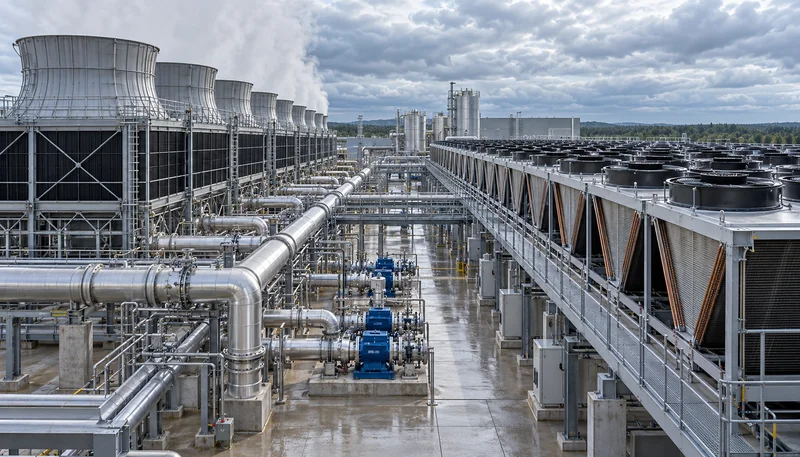
Latent Heat Thermodynamics vs. Hydrological Reality: Quantifying Mega-Gallon Water Consumption
The thermodynamic superiority of open-loop evaporative heat rejection is grounded in phase-change physics, specifically the high latent heat of vaporization of water (approximately 2,260 kJ/kg under standard atmospheric conditions). In an induced-draft open cooling tower, warm condenser water from the central plant is atomized over high-surface-area polyvinyl chloride (PVC) fill media, establishing direct counter-current or cross-flow contact with ambient air. As a fraction of the mass flow evaporates, it absorbs sensible heat directly from the remaining water volume, driving the bulk water temperature down toward the ambient thermodynamic wet-bulb temperature. Because the ambient wet-bulb temperature is typically 6K to 15K lower than the dry-bulb temperature in moderate climates, open towers achieve cold-water supply temperatures impossible with sensible air cooling alone, minimizing chiller compressor lift and enabling extensive economizer hours.
However, this thermodynamic process requires substantial water consumption. Rejecting 1 MW of continuous IT heat load through an open evaporative system consumes between 20,000 and 50,000 gallons (75 to 190 cubic meters) of high-quality potable water per day, accounting for evaporation, drift losses, and mandatory blowdown discharge. Scaled to high-density compute facilities, a 10 MW enterprise facility demands 200,000 to 500,000 gallons daily, while a 100 MW hyperscale campus vaporizes 2 to 5 million gallons per day. At the multi-facility gigawatt scale driven by accelerated computing clusters, daily water withdrawal reaches 20 to 50 million gallons. This intense hydrological footprint stresses municipal water infrastructure and depletes local aquifers, prompting regulatory restrictions, community moratoriums, and severe reputational risks for data center operators in water-stressed basins.
Calculate continuous evaporative mass loss using the formula E = 0.0008 x Range (°F) x Circulating Flow Rate (GPM) x 1.8.
Equip open-loop cooling towers with high-efficiency cellular drift eliminators certified to limit drift losses below 0.0005% of circulating flow rate.
Install continuous electromagnetic flow meters and redundant ultrasonic level sensors on makeup water and blowdown headers to audit site-level WUE.
Capital Allocation & Metallurgy: Why Open-Loop Evaporative Systems Retain a 60-70% CapEx Discount
From an upfront capital expenditure perspective, open-loop evaporative cooling towers maintain a substantial economic advantage over equivalent-capacity closed-loop dry cooler or adiabatic arrays, consistently securing a 60% to 70% equipment CapEx discount. The structural design of an open cooling tower leverages low-cost, corrosion-resistant materials such as pultruded fiberglass-reinforced polyester (FRP), thermoformed PVC fill, and gravity-fed polypropylene distribution nozzles. Heat transfer occurs directly at the air-water interface without requiring intermediate metallic thermal conduction barriers. Consequently, the raw material mass, mechanical component count, and structural deadweight per rejected thermal megawatt remain low, reducing equipment procurement costs and structural support steel expenditures.
In contrast, closed-loop dry coolers and adiabatic systems are constrained by sensible heat transfer mechanics, requiring convective heat exchange through solid metal walls. These configurations demand extensive heat transfer surfaces consisting of copper or aluminum microchannel tubes mechanically bonded to continuous aluminum or epoxy-coated fins. The production, transport, and structural framing of these heavy coil blocks—alongside the inclusion of 304 or 316 stainless steel headers—dramatically escalates initial CapEx. Furthermore, because air exhibits low density and low specific heat capacity (Cp ≈ 1.006 kJ/kg·K), closed-loop dry coolers require expansive arrays of electronically commutated (EC) axial fans and large physical yards. The required mechanical yard footprint can be three to five times larger than an equivalent-capacity open cooling tower farm, driving up real estate acquisition and civil works expenditures.
Perform structural dead-load and wind-shear calculations comparing FRP open cooling towers against large-footprint closed-loop coil assemblies.
Specify hydrophilic or epoxy coatings on aluminum coil fins if deploying closed-loop dry coolers within 10 km of coastal or industrial environments.
Calculate CapEx per thermal megawatt rejected, factoring in civil foundation prep, structural dunnage, acoustic attenuation barriers, and piping manifolding.
The PUE vs. WUE Paradox: Navigating the 25-40% Energy Penalty of Sensible Air-Cooling
The selection between open-loop and closed-loop architectures creates a direct operational trade-off between Power Usage Effectiveness (PUE) and Water Usage Effectiveness (WUE). Water-cooled central chiller plants coupled to open evaporative towers routinely achieve 25% to 40% higher electrical thermodynamic efficiency compared to equivalent air-cooled chiller plants or pure dry-cooler systems. Because open towers reject heat to the wet-bulb temperature, condensing temperatures inside shell-and-tube heat exchangers remain significantly depressed (e.g., 29°C to 32°C). This limited temperature differential minimizes the thermodynamic pressure lift required by centrifugal chiller compressors, lowering specific power consumption to 0.50–0.65 kW/ton, compared to 1.0–1.3 kW/ton for air-cooled scroll or screw packages under equivalent thermal loads.
This thermodynamic divergence becomes critical during extreme ambient summer conditions. When dry-bulb temperatures rise above 40°C, sensible air-cooled heat exchangers experience decreased thermal transfer rates, driving high condensing temperatures, elevated compressor head pressure, and risk of thermal throttling. Open evaporative cooling utilizes ambient wet-bulb depression to reduce peak facility electrical draw by 10% to 35% during high-heat periods. This peak-shaving capability protects utility transformers from over-subscription and safeguards against grid curtailment. Eliminating water consumption entirely through unassisted dry cooling addresses hydrological constraints, but the resulting surge in parasitic fan and compressor energy increases regional electric grid demand and carbon emissions—illustrating the core PUE-versus-WUE engineering paradox.
Model annual plant operating efficiency by cross-referencing regional hourly 8760 weather data with chiller compressor lift curves.
Evaluate substation interconnect capacity against peak summer dry-bulb versus wet-bulb coincident heat rejection electrical draw.
Implement variable-frequency drives (VFDs) and EC fan speed control loops to optimize part-load parasitic fan energy across diurnal temperature swings.
Psychrometric Boundaries: Arid Wet-Bulb Depressions vs. Humid Saturation Limits
The geographic feasibility and thermodynamic performance of open and closed-loop heat rejection systems depend heavily on the local psychrometric envelope. In arid continental climates—such as the American Southwest, the Middle Eastern desert belt, and central Spain—ambient dry-bulb temperatures frequently exceed 42°C, while relative humidity remains below 15%. This divergence generates an expansive wet-bulb depression often exceeding 18K to 22K, with wet-bulb temperatures lingering around 20°C to 24°C. Under these arid conditions, evaporative cooling operates at peak thermodynamic efficacy, allowing cooling towers to generate 27°C condenser supply water without requiring supplemental mechanical refrigeration, despite extreme ambient air temperatures.
Conversely, in humid subtropical and maritime locations such as Singapore, the US Gulf Coast, or coastal Ireland, psychrometric saturation limits evaporative performance. When ambient air reaches 32°C dry-bulb with 85% relative humidity, the wet-bulb temperature climbs to 29.8°C, leaving a narrow wet-bulb depression of barely 2.2K. In this saturated regime, mass transfer between water droplets and the air stream stalls, causing the cooling tower approach temperature to widen and elevating the leaving water temperature. Plant controls are consequently forced to run mechanical vapor-compression chillers continuously at elevated condenser temperatures. Under these conditions, the efficiency gains of open evaporative cooling diminish, while continuous water consumption persists, altering the economic and sustainability profile in humid operating environments.
Extract 20-year ASHRAE 0.4% and 2.0% extreme annual design conditions for both dry-bulb and coincident wet-bulb temperatures at target project coordinates.
Calculate the design wet-bulb approach margin (target 3.5K to 5.0K) under regional peak enthalpy conditions to avoid undersized tower fill selection.
Evaluate local riparian access, municipal water rights, and historical aquifer draw-down trends before committing to an evaporative plant design.
Water Chemistry, Blowdown Dynamics, and the 15-Year Lifecycle TCO Inversion
Although open-loop evaporative cooling towers offer a 60% to 70% upfront CapEx savings, their operational lifecycle involves continuous chemical processing and fluid management requirements. As pure water vaporizes from the tower, dissolved mineral species—including calcium carbonates, magnesium silicates, and chlorides—remain behind, steadily concentrating within the circulating basin water. Facilities must operate continuous automated blowdown cycles to bleed off hyper-saline water, replenishing the system with fresh makeup water to sustain safe Cycles of Concentration (CoC, typically 3 to 6 depending on raw water hardness). Without precise chemical dosing, high CoC leads to rapid mineral precipitation and scale formation on plate-frame or shell-and-tube heat exchangers, where a calcium carbonate layer just 0.1 mm thick reduces the overall heat transfer coefficient (U) by up to 30%.
Operating open cooling towers also introduces biosecurity challenges and ongoing mechanical maintenance expenses. The warm, aerated water volume serves as a prime incubator for *Legionella pneumophila* and aerobic biofilms, necessitating automated injection of oxidizing biocides (e.g., sodium hypochlorite, chlorine dioxide) alongside non-oxidizing bio-dispersants and corrosion inhibitors. When aggregating cumulative water utility rates, municipal sewer discharge surcharges, chemical delivery logistics, filtration maintenance, basin cleaning, and mechanical drift losses, the initial CapEx discount can invert over a 10- to 15-year total cost of ownership (TCO) evaluation. Closed-loop systems, by contrast, utilize sealed, factory-charged fluid circuits containing demineralized water and inhibited glycols that operate for decades with minimal fluid top-up and negligible water treatment expenses.
Calculate facility-specific Cycles of Concentration using the formula CoC = Makeup Water Volume / Blowdown Water Volume = Chloride_basin / Chloride_makeup.
Integrate automated blowdown controllers driven by toroidal conductivity sensors and continuous oxidation-reduction potential (ORP) biocide monitors.
Model 15-year operational TCO incorporating local municipal water tariffs, sewer surcharge penalties, and annual chemical treatment service contracts.
Next-Gen Hybrid Topologies: ASHRAE W3/W4 Liquid Cooling with Trimming Adiabatic Assist
The rapid increase in artificial intelligence hardware density is shifting thermal management strategies away from low-temperature chilled-water plants toward direct-to-chip (DLC) liquid cooling. Modern compute silicon—such as accelerators operating between 1,000W and 1,500W TDP—exhibits elevated junction temperature thresholds that tolerate warm facility supply water. Under the ASHRAE Liquid Cooling guidelines for Class W3 (supply water 2°C to 32°C) and Class W4 (supply water 2°C to 45°C), central plants no longer need to supply traditional 7°C chilled water. By accepting 35°C to 40°C warm-water loops directly to internal microchannel cold plates, the heat rejection plant can run in sensible free-cooling dry mode across most global climate zones without mechanical chiller support.
This architectural shift enables the adoption of hybrid adiabatic dry cooling topologies. In these hybrid configurations, the cooling array operates as a closed-loop dry cooler for 85% to 95% of the operational year, circulating treated water-glycol mixtures through sealed coil blocks with zero water consumption. During peak summer excursions—when dry-bulb temperatures rise above dry-cooling thresholds—the system activates automated adiabatic pre-cooling pads or low-volume atomizing misting rings. This precooling lowers the air temperature entering the coil face toward the ambient wet-bulb temperature, shaving the thermal peak. By deploying water solely as an adiabatic trim assist during extreme ambient peaks, facility operators reduce total annual water consumption by more than 95% compared to open cooling towers, maintain target PUE levels, and avoid electrical transformer over-allocation.
Design direct-to-chip secondary fluid networks (SFNs) to support ASHRAE Class W3/W4 supply water temperatures of 32°C to 45°C.
Implement psychrometrically controlled adiabatic assist setpoints that restrict water spray strictly to ambient dry-bulb conditions exceeding 30°C.
Configure closed-loop fluid circuits with un-evaporated, non-potable, or captured rainwater storage to eliminate municipal potable water dependency for trim cooling.
Engineering Procurement & Technical Desk
For technical datasheets, custom power topology design, or volume export quotations, reach out to RICEWIND engineers.