1. Industry Background and Architectural Foundation
As distributed training of trillion-parameter large language models (LLMs) becomes standard operating procedure, AI computing clusters are scaling into deployments of 10,000 to 100,000+ accelerators. In these ultra-dense Scale-Out network topologies, the operational bottleneck has decisively shifted from raw GPU tensor core execution to inter-node communication latency and bi-directional throughput. 800G and 1.6T optical transceivers—the vital physical bridges between GPU nodes and leaf/spine fabrics—are undergoing their most aggressive architectural transformation to date.
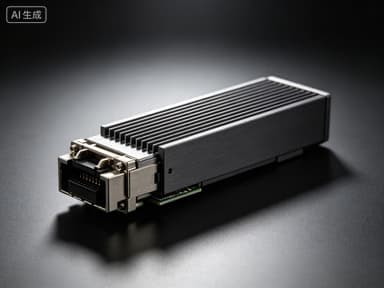
Form-factor standardization has become the primary physical battlefield under single-rack thermal densities exceeding 40kW to 100kW. While QSFP-DD served initial 400G deployments, hyperscale operators are aggressively standardizing on OSFP (Octal Small Form-factor Pluggable) and high-density OSFP-XD packaging. Featuring a marginally broader footprint and integrated top-mount heat fins, OSFP packages dissipate 25W to 35W per module with minimal thermal throttling, enabling dense 32-port deployments on a 1U switch faceplate without restricting airflow.
2. Critical Electrical and Optical Parameter Matrix
Simultaneously, electrical signaling is transitioning from 100G PAM4 to 200G PAM4 per electrical lane. In 800G transceivers, migrating from an 8×100G to a 4×200G optical architecture cuts the required laser and photodiode component count in half, directly increasing mean time between failures (MTBF). At the optical layer, monolithic Silicon Photonics (SiPh) integration is replacing discrete Electro-absorption Modulated Lasers (EMLs), delivering vastly superior thermal stability and higher wafer yields in high-temperature switch compartments.
Power consumption represents the next critical frontier. In massive training fabrics, optical transceivers alone can account for 12% to 15% of total facility energy draw, driven predominantly by power-hungry Digital Signal Processors (DSPs). To dismantle this energy wall, Linear-drive Pluggable Optics (LPO) eliminates internal DSP and CDR circuitry, leveraging the switch ASIC's native SerDes for equalization. This reduces transceiver power consumption by 45% to 50% while slashing latency to sub-microsecond levels.
3. Field Engineering Challenges and Topology Optimization
From an engineering and cabling perspective, 200G/lane optical signals exhibit razor-thin margins for channel insertion loss and optical return loss (requiring return loss better than -45dB). Deploying MPO/MTP-16 and MPO-24 multi-fiber push-on assemblies necessitates carrier-grade Optical Distribution Frames (ODF) and dedicated cable-management troughs to prevent high-density fiber bundles from obstructing exhaust airflow paths.
4. Operational Guidelines and Preventive Standards
HEFENGQI / RICEWIND supplies telecommunications providers, cloud hyperscalers, and AI infrastructure integrators with standardized, thermally optimized 19-inch equipment racks, high-density optical distribution assemblies, and intelligent power distribution units engineered to international CE, UL, and IEC standards.
5. HEFENGQI Engineering Support and Global Supply
Global B2B procurement, custom infrastructure specifications, and technical support: Email: lee@ricewind.com | WhatsApp: +86 17621197907.
Engineering Procurement & Technical Desk
For technical datasheets, custom power topology design, or volume export quotations, reach out to HEFENGQI engineers.