Subrack Architecture & Space Optimization in High-Density Deployments
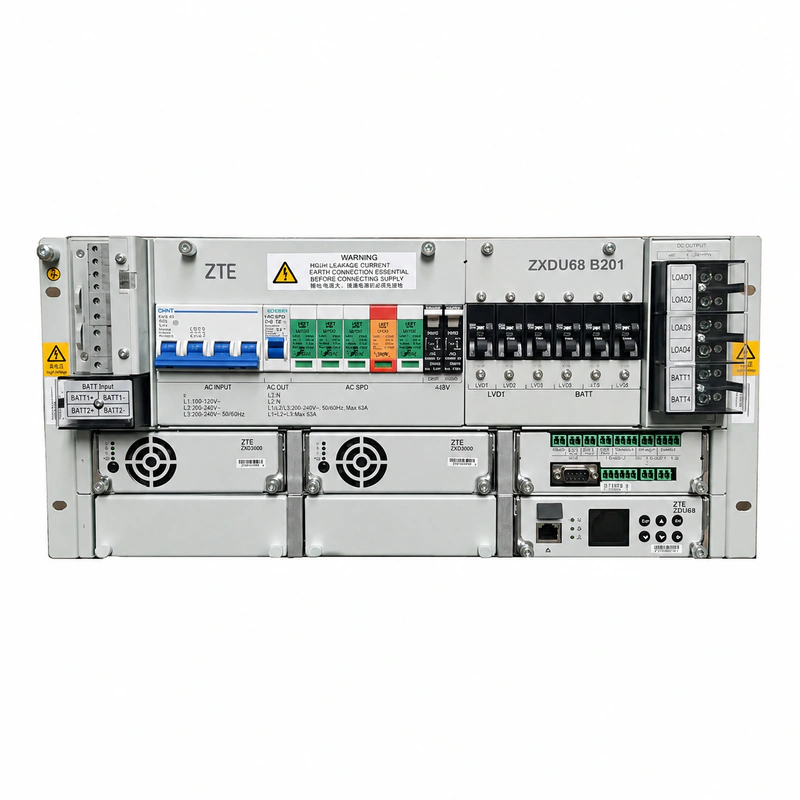
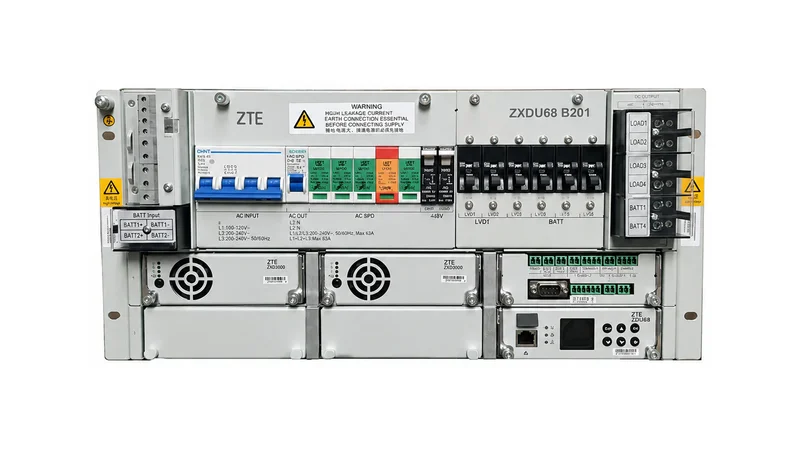
The ZTE ZXDU68 B201 represents a compact, carrier-grade embedded DC power solution engineered specifically for space-constrained telecommunication environments, including 4G/5G macro cellular base stations, optical line terminal (OLT) aggregation sites, and edge computing enclosures. Housed in a standardized 19-inch 5U rack-mount form factor with a chassis depth of only 360mm, this subrack integrates AC power distribution, high-density rectifiers, DC circuit breakers, and an advanced central supervisory unit into a single unified chassis, reclaiming critical vertical rack units for compute and transport electronics.
A foundational design triumph of the ZXDU68 B201 architecture is its strict front-access maintenance philosophy. Field service engineers can execute all AC input terminations, DC branch feeder terminations, battery cabling, breaker actuation, and hot-swap module replacements entirely from the front plane. This eliminates the necessity of rear-aisle clearance, facilitating shallow-depth cabinet configurations, wall-adjacent frame installations, and containerized modular edge deployment models while dramatically slashing mean time to repair (MTTR).
Verify 19-inch standard rack integration with 5U envelope (222.25 mm) and ≤360 mm depth clearance for edge cabinets.
Ensure front-facing cable routing channels maintain minimum bend radius tolerances for heavy-gauge 70mm² battery cables.
Inspect front-panel breaker configuration for integrated AC mains (63A/3P or dual single-phase) and segregated priority DC branches.
Rectifier Modularity, Thermal Derating & Conversion Efficiency
At the core of the ZXDU68 B201's energy delivery are up to four hot-swappable ZTE ZXD3000 50A high-efficiency rectifier modules, delivering an aggregate system capacity of 200A (up to 12kW at nominal -48V DC float voltage). The ZXD3000 modules leverage high-frequency resonant soft-switching topologies and advanced active power factor correction (PFC ≥ 0.99) to achieve a peak thermodynamic conversion efficiency of ≥96.3%. This thermal profile directly curtails cabinet cooling loads, lowering overall operational expenditure (OPEX) and minimizing parasitic air conditioning energy draw across enterprise network lifecycles.
To maximize conversion efficiency during non-peak network traffic intervals, the system incorporates an automated cyclical energy-saving sleep algorithm managed by the central supervisory unit. The controller dynamically models real-time load requirements and throttles redundant ZXD3000 modules into an ultra-low standby state, ensuring active modules consistently operate within their optimal 50% to 80% efficiency plateau. Modules are rotated systematically through runtime wear-leveling schedules, extending the MTBF of internal electrolytic capacitors and variable-speed fan assemblies.
Quantify N+1 redundancy thresholds: 150A continuous load requires 4x ZXD3000 (50A) modules to maintain full redundancy.
Audit thermal derating curves to ensure 100% rated output availability across the continuous ambient operating range of -25°C to +55°C.
Verify rectifier dynamic sleep-mode reactivation times (<50ms) to prevent bus voltage sags during sudden step-load transients.
Dual LVD Battery Management & Power Continuity Assurance
Uninterrupted availability of mission-critical transmission nodes necessitates robust electrochemical energy management. The ZXDU68 B201 embeds a dual Low Voltage Disconnect (LVD) contactor scheme that cleanly segregates load shedding into two autonomous stages: Load Low Voltage Disconnect (LLVD) and Battery Low Voltage Disconnect (BLVD). Upon extended AC mains interruption, non-essential load branches (such as local cooling fans or secondary cellular carriers) are shed at a programmable threshold (typically -43.2V DC), preserving remaining battery capacity exclusively for mission-critical core transmission, baseband, and optical transceivers.
If grid restoration does not occur and battery terminal voltage reaches the critical deep-discharge boundary (programmable down to -42.0V DC), the secondary BLVD contactor cleanly isolates the dual battery strings (protected via 2 × 100A/125A breakers). This prevents irreversible cell polarization, sulfation, and permanent capacity loss. Complementing this hardware isolation is an intelligent three-stage battery charging algorithm featuring negative-temperature coefficient compensation, programmable boost/float voltage transitions, automated periodic discharge health assessments, and real-time State-of-Charge (SOC) and State-of-Health (SOH) telemetry.
Calibrate LLVD contactor drop-out voltage precisely to preserve 30-50% reserve runtime for core network infrastructure.
Configure temperature compensation coefficients between -2mV/°C/cell and -4mV/°C/cell based on specific VRLA or LiFePO4 chemistry.
Validate contactor mechanical latching stability and check reverse battery polarity alarm triggering prior to live commissioning.
Grid Adaptability, Wide AC Tolerances & Surge Suppression
Telecommunications infrastructure is frequently subjected to compromised public utility grids, rural long-line feeds, and transient-heavy industrial circuits. The ZXDU68 B201 directly confronts these hazards via an ultra-wide AC input operating window spanning 80V AC to 300V AC. The ZXD3000 rectifiers sustain full rated output from 176V AC to 300V AC, and seamlessly transition into a linear power-derating mode down to 80V AC without dropping the DC bus or forcing premature battery discharge, significantly buffering electrochemical reserves against minor brownouts.
Transient overvoltage protection is rigorously integrated at the AC intake through an integrated Class C lightning surge protection device (SPD) rated for a nominal discharge current of 20kA and a maximum discharge current of 40kA (8/20μs waveform). The surge suppression matrix operates in common and differential modes, featuring thermal disconnect mechanisms and supervisory fault-state reporting that instantly triggers telemetry alarms upon surge suppression degradation, safeguarding downstream rectifiers and sensitive DC telecom loads.
Verify phase compatibility: ensure subrack AC distribution block is jumper-configured correctly for three-phase 380V/400V or single-phase 220V/230V.
Inspect the physical state of the Class C SPD optical fault indicator flags and test continuity to CSU alarm input loops.
Ensure earthing busbar impedance to station ground measures <1.0 Ohm using a calibrated ground loop tester.
CSU Central Monitoring, Remote Telemetry & Protocol Integration
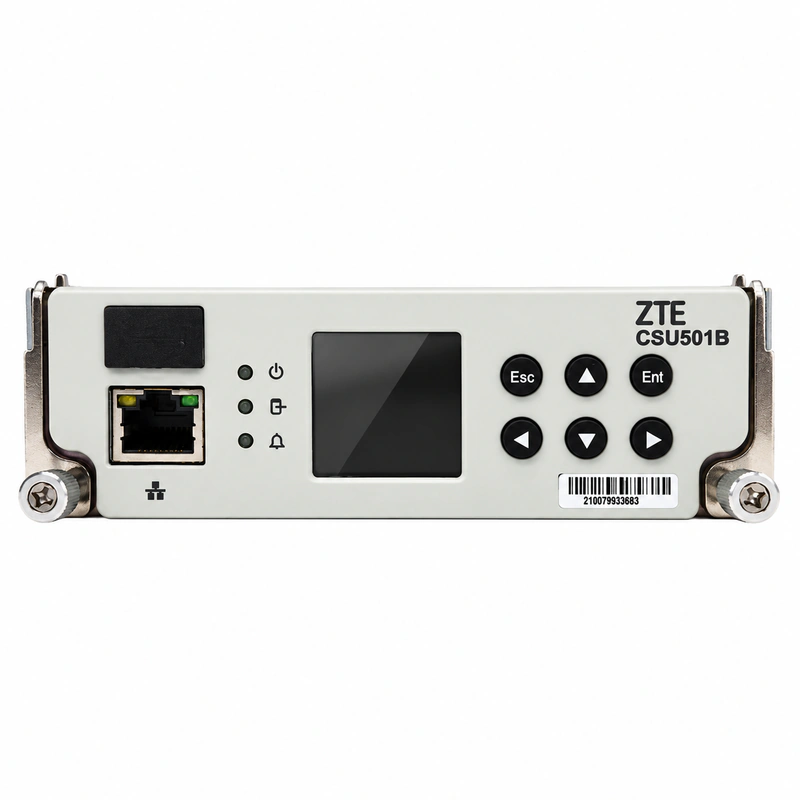
The supervisory brain of the system is the Central Supervisory Unit (CSU / CSU501B), which features a high-contrast 128×64 dot-matrix liquid crystal display and a tactile navigational keypad. The CSU provides localized real-time operational status, displaying total DC load current, system voltage, battery charge/discharge currents, ambient and battery temperatures, and individual rectifier operating metrics. Field technicians can parameterize system thresholds directly through the intuitive front-panel interface without external terminal hardware.
For centralized Network Operations Centers (NOC), the CSU delivers comprehensive northbound integration via Fast Ethernet (10/100Base-T) and serial ports (RS485/RS232). It natively supports industry-standard protocols including SNMP v1, v2c, and secure SNMP v3, as well as an embedded HTTP/HTTPS Web graphical user interface and Telnet CLI. Furthermore, a bank of user-configurable dry contact alarm relays facilitates legacy site integration, reporting critical system failures, AC mains fail, rectifier faults, and LVD events directly to remote telemetry units (RTUs).
Deploy SNMP v3 with robust encryption (AES/SHA) for secure telemetry transmission across untrusted out-of-band management networks.
Configure CSU dry contact outputs to match base station optical multiplexer alarm mapping matrices.
Confirm CSU firmware parity across the network fleet to standardize MIB structures and automated remote diagnostic scripts.
Carrier-Grade Procurement, Testing Protocols & TCO Strategy
Procurement directors and infrastructure architects must evaluate power equipment through the lens of long-term Total Cost of Ownership (TCO) and multi-year Mean Time Between Failures (MTBF > 500,000 hours). System longevity depends upon authentic bill-of-materials integrity, precise component sourcing, and rigorous factory acceptance testing (FAT). Substandard or gray-market rectifiers frequently introduce switching ripple exceeding 200mV peak-to-peak, which degrades baseband radio modules and induces micro-outages across high-speed optical transceivers.
RICEWIND mitigates operational risk by supplying exclusively genuine, factory-certified ZTE ZXDU68 B201 systems and ZXD3000 modules. Every unit undergoes 100% full-load burn-in testing on automated load banks to validate dynamic thermal dissipation, efficiency ratings, and LVD contactor switching integrity prior to dispatch. Strategic procurement teams benefit from consolidated global warehousing, immediate spare parts provisioning, and specialized engineering support. For procurement consultations, tender bidding, and custom DC power architectures, contact RICEWIND technical sales directly via Email: lee@ricewind.com or Phone/WhatsApp: +86 17621197907.
Mandate factory burn-in test documentation and certified load-bank reports for all procurement batches prior to dispatch.
Establish an N+1 spare-parts strategy maintaining 10% module replacement stock for rapid deployment via certified logistics channels.
Engage certified technical channels (Contact: lee@ricewind.com / +86 17621197907) to verify authentic ZTE hardware warranties and firmware validity.
Engineering Procurement & Technical Desk
For technical datasheets, custom power topology design, or volume export quotations, reach out to HEFENGQI engineers.