
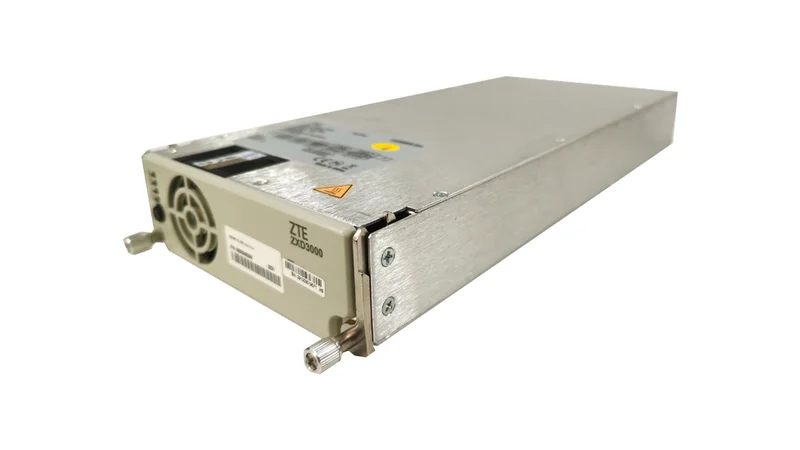
1. Core Electrical Specifications and High-Efficiency Topology
The ZTE ZXD3000 stands as one of the most widely deployed flagship high-efficiency telecom rectifiers across core carrier networks, 5G wireless base stations, and high-density computing facilities. Designed for nominal -48VDC telecommunication bus architectures, it provides an adjustable output range of -42VDC to -58VDC, delivers up to 60A of continuous output current, and achieves a maximum rated DC power output of 3000W. By combining interleaved bridgeless PFC (Power Factor Correction) with a full-bridge LLC resonant soft-switching topology, the module reaches a peak power conversion efficiency of 96.5%, dramatically cutting operational heat dissipation and facility Power Usage Effectiveness (PUE).
The ZXD3000 offers outstanding resilience to unstable power grids, operating across an ultra-wide single-phase AC input range of 80VAC to 300VAC (45Hz to 65Hz). When grid voltage drops between 80VAC and 176VAC, an integrated digital microcontroller executes smooth linear power derating, preserving continuous power delivery without tripping or dropping carrier loads. Obtain the exact revision data sheet for insulation, surge and reverse-polarity protection. EMC compliance requires an applicable declaration or test report; any MTBF figure requires its calculation method and operating conditions. This guide does not establish a certification or reliability figure.
Nominal Ratings: Single-phase 220VAC input, nominal -48VDC output, 60A maximum current, 3000W rated DC capacity
Industry-Leading Efficiency: 96.5% peak energy conversion efficiency, power factor (PF) ≥0.99, total harmonic distortion (THD) ≤5%
Resilient AC Grid Tolerance: 80VAC to 300VAC operational range with linear derating below 176VAC for low-voltage survival
Compact 1U High-Density Enclosure: Standard 1U dimensions (41.5mm H × 132mm W × 300mm D) with front-to-back stepless speed-controlled cooling
2. Hardware Evolution and Revision Identification (V5.0 / V5.1 / V5.5 / V5.6 / V5.8)
Record the ZXD3000 hardware and firmware revision from the offered unit. V5.0, V5.1, V5.5, V5.6 and V5.8 labels alone do not establish a sequence of semiconductor, efficiency, fan or telemetry improvements; obtain matching manufacturer revision records:
For V5.0, verify the mechanical drawing and supported telemetry against its own manufacturer documentation. For V5.1, request the efficiency curve and fan-control specification before claiming a change from V5.0. For V5.5, obtain the actual component or revision documentation and current-sharing limits; the label does not establish a particular MOSFET technology, efficiency or reliability advantage. For V5.6 and V5.8, request documented coating/environmental qualifications and communication timing before comparing them with earlier units; no component grade or telemetry latency is established here.
V5.0: Match the full part number and approved shelf configuration before selecting a spare
V5.1: Verify the documented fan behavior and thermal limits for the supplied unit
V5.5: Obtain its own efficiency curve, revision record and current-sharing specification
V5.6 / V5.8: Request applicable environmental qualification and interface timing records rather than inferring upgrades
3. Power Shelf Topology and Central Monitoring System Compatibility
The ZXD3000 features a slide-in hot-pluggable enclosure measuring 41.5mm × 132mm × 300mm and weighing just 2.05kg. For shelf compatibility, verify the exact backplane, module part number and approved configuration rather than relying on the ZTE ZXDU family name; candidate systems to check include embedded subracks like the ZXDU68 B201 (4 slots), ZXDU68 B301 (6 slots), and outdoor cabinets like the ZXDU68 W101, as well as floor-standing large-scale distribution lineups like the ZXDU68 T601 capable of delivering over 2000A.
Via its rear heavy-duty gold-plated blind-mate connector, verify the ZXD3000 interface and firmware against the exact CSU500B, CSU1200 or CSU502 controller documentation before connection. The supervisor continuously monitors AC voltage, DC bus voltage, per-module load current, heatsink temperature, and fan health, while dynamically executing energy-saving algorithms that sleep redundant rectifiers during off-peak hours. Engineering precautions: Do not mix revisions such as V5.1 and V5.5 unless manufacturer documentation explicitly approves the module, shelf and firmware combination; matching voltage and current settings alone is insufficient. However, never attempt to physically mate the 1U ZXD3000 into legacy 2U ZXD2400 bays, as connector pinouts, dimensions, and backplane bus voltages are incompatible.
Shelf Compatibility: Obtain exact module/backplane approval for ZXDU68 B201, ZXDU68 B301 or ZXDU68 T601
Supervisory Interfacing: Verify CSU500B/CSU1200 firmware, interface and current-sharing limits for the supplied revision
Dynamic Sleep Cycling: Automated energy-saving hibernation of excess modules under light aggregate site loads
Expansion Safeguards: Avoid inter-generation physical cross-mating; align firmware and voltage calibration across parallel modules
4. Field Replacement and Modernization Strategies for Legacy Sites
Global carriers are modernizing legacy base stations to support expanding 5G radio heads and edge compute clusters. Field engineering teams typically follow two replacement paths when dealing with failing power equipment:
The first approach is hot-swap maintenance: when a faulty ZXD3000 unit is identified in an active ZXDU68 chassis, technicians can extract the unit and insert a verified replacement module without interrupting live telecommunication loads. Before full insertion, verify that the float voltage of the replacement unit matches the live DC bus within 0.5V, and inspect front LEDs to confirm yellow run and green load-sharing indications. The second approach is shelf-level modernization: for sites still running obsolete 2U rectifiers like the ZXD2400 or older low-efficiency plant, replacing the entire subrack with a 1U ZXDU68 shelf populated with ZXD3000 modules frees up 2U to 4U of rack space for additional IT equipment or lithium battery backups, while delivering a 5% to 7% reduction in conversion losses.
Non-Disruptive Live Hot-Swapping: Safe live extraction and insertion without service downtime or load disruption
Bus Voltage Alignment: Pre-installation check ensuring DC output matches the system float setting (-53.5V standard)
Subrack Modernization Gains: Upgrading legacy 2U subracks to 1U ZXD3000 doubles available vertical rack density
Energy Savings Calculation: 96.5% efficiency versus 90% legacy systems saves more than 1000 kWh per module annually
5. Sourcing Guide: Identifying Refurbished Units, Counterfeits, and Worn Components
High demand for ZXD3000 replacement parts has led to an influx of low-quality refurbished, repainted, and cosmetically altered modules in the secondary market. Disreputable vendors frequently take heavily degraded modules from decommissioned sites, spray over scratch marks, laser-engrave fraudulent serial labels, and sell them as brand-new units.
Procurement engineers must enforce a disciplined three-step verification process. First, inspect the front bezel and locking latch: genuine modules use flame-retardant industrial polymer with crisp molded lettering and zero paint overspray. Second, examine the rear blind-mate power and signal contacts: authentic terminals display uniform, thick gold plating without micro-arcing pits, scoring, or discoloration. Third, inspect internal high-voltage electrolytic capacitors: genuine ZTE builds employ premium Japanese components (such as Rubycon or Nippon Chemi-Con rated for 105°C continuous operation), with clean solder joints and uniform silicone conformal coating. Finally, confirm that the external laser barcode matches the factory electronic serial number stored inside the module microcontroller EEPROM.
Bezel and Chassis Inspection: Flame-retardant materials, pristine factory silkscreen, and unmarred original chassis fasteners
Rear Connector Contacts: Thick gold plating free from pitting, thermal darkening, or mechanical play
Internal Component Quality: Authentic tier-one 105°C Japanese capacitors and intact factory conformal coating
Digital Serial Number Validation: Absolute match between external barcode label and internal EEPROM telemetry identity
6. RICEWIND Quality Assurance and Global Supply Capabilities
RICEWIND is a premier engineering supplier of telecommunication power systems and critical industrial electrical hardware. For an offered ZTE ZXD3000, request the unit-linked inspection and test records before accepting a testing claim.
Agree a revision-specific acceptance plan for load, temperature, duration, input conditions and parallel sharing, and request dated results linked to the offered serial numbers. Dielectric tests must follow the manufacturer procedure and be performed by qualified personnel; this guide does not establish a universal test voltage or prove completed tests. Confirm available quantities, dispatch terms and anti-static packaging requirements in a dated quotation. Direct engineering support can be contacted for commissioning planning; immediate stock availability is not guaranteed here.
For stock inquiries, technical documentation, system integration schematics, or volume purchasing, contact the RICEWIND engineering team via email at lee@ricewind.com or by phone at +86 17621197907.
Load-Test Evidence: Request serial-number-linked load, temperature, duration and thermal inspection records
Grid and Insulation Evidence: Request actual input-test results and the applicable manufacturer dielectric procedure; do not assume a pass
Export-Grade Secure Packaging: Heavy-duty anti-static barrier shielding with custom shock-absorbing foam inserts
Dedicated Engineering Support: Direct consultation for ZXDU68 integration, shelf mapping, and urgent global dispatch
Engineering Procurement & Technical Desk
For technical datasheets, custom power topology design, or volume export quotations, reach out to RICEWIND engineers.
Read the RICEWIND editorial policy to see how we verify technical content


