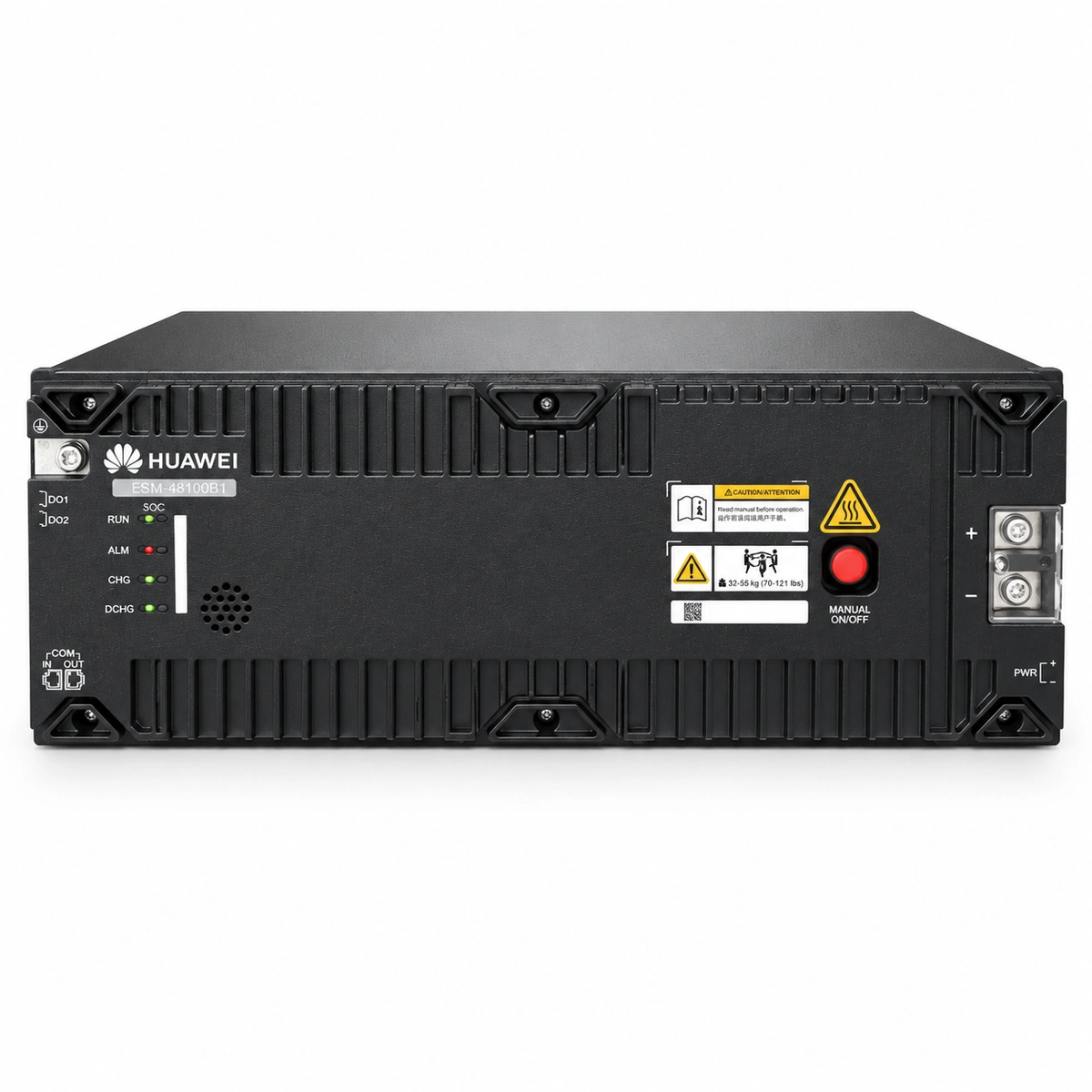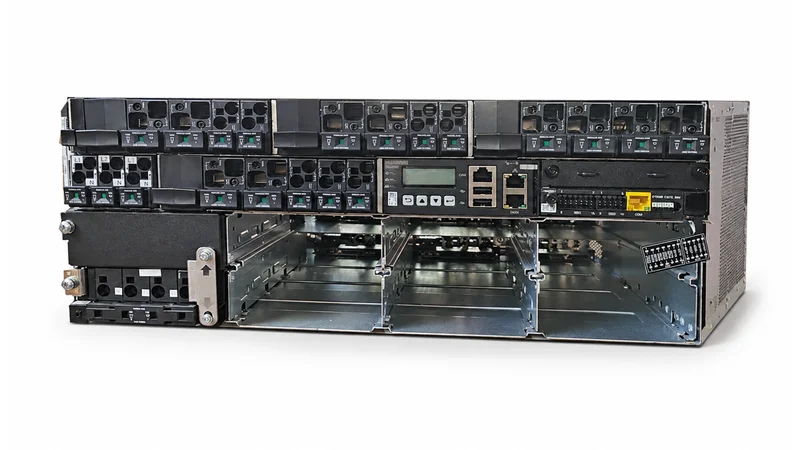
For an ETP48400-C4A1 shelf, choose the R4850G2 when a verified 50 A module configuration meets the site load and the installed shelf is specified for it. Consider the R4875G1 when the project needs its documented 75 A, 4 kW capability, but only after confirming the exact C4A1 subrack variant, slot rating, controller profile, and power-distribution limits. The module's higher rating does not by itself increase the system's safe output.
The decision in one table
Item | Huawei R4850G2 | Huawei R4875G1 | Procurement meaning |
|---|---|---|---|
Role in ETP48400-C4A1 | 50 A rectifier option in the C4A1 configuration notes | 75 A rectifier option | Both are listed choices; confirm the exact equipment code and revision |
Rated output | 50 A per C4A1 configuration notes; other electrical detail omitted here | 4,000 W; 75 A class | Do not compare only by nominal current; check the model's voltage/current curve |
DC output | Not stated here for this R4850G2 variant | 53.5 V default; 42-58 V adjustable | Setpoints and battery profile must match the shelf and battery design |
AC input | Not stated here for this R4850G2 variant | 85-300 V AC; 4,000 W at 176-300 V AC, derated below 176 V | Low input voltage reduces available R4875G1 power; allow for site AC conditions |
Efficiency | Not compared: no matching R4850G2 test condition cited here | Peak 97%; greater than 96% at 230 V AC and 30%-80% load | Peak and load-point figures are not interchangeable |
Module envelope | Not compared | 40.8 x 105 x 269 mm; up to 2.2 kg | Physical fit is only one part of compatibility |
C4A1 module quantity | Configuration notes list up to six rectifier modules | Configuration notes list up to six rectifier modules | Mixed configurations and total current require exact variant confirmation |
The R4875G1 figures come from Huawei's R4875G1 Rectifier User Manual V2.1 (2022-09-01). The ETP48400-C4A1 selection and six-module maximum are stated in Huawei's ETP48400-C4A1 Embedded Power User Manual, Issue 07 (2021-05-10), and the corresponding C4A1 configuration notes. A 50 A label for R4850G2 is retained from those C4A1 option notes; unsupported R4850G2 efficiency, wattage, and derating values are left out rather than filled from another revision.
When the 50 A option is the better fit
R4850G2 is the straightforward choice when the existing C4A1 configuration is documented for it and the measured continuous load, required battery recharge current, and redundancy plan fit the installed module count. It can also be the lower-risk maintenance choice when matching the existing fleet and retaining known spare modules matters more than increasing per-slot capacity. Use the nominal current rating as one input to the sizing review. Check sustained and peak load separately, include the battery recharge window, and apply site temperature and AC-input conditions. Then compare the result with the approved shelf configuration and its required redundancy. A site whose ordinary load is modest can still need additional rectifier capacity during recovery charging or a module failure.
When to assess the 75 A option
R4875G1 is worth evaluating when additional rectifier capacity per slot is useful or when the project is configuring a compatible C4A1 shelf from the outset. Huawei documents 4,000 W at 176-300 V AC, with output derating as input falls from 176 V toward 85 V. Its 53.5 V default output is adjustable over 42-58 V DC. At a 230 V AC input and 30%-80% load, the manual states efficiency above 96%; the separate peak figure is 97%.
These ratings apply to the module; the complete system operating point depends on the specific chassis and backplane, available slots, AC feed and protection, distribution assembly, temperature and altitude, controller configuration, and battery charge limits. The C4A1 manual describes multiple equipment codes and distribution variants, so identify the complete equipment code before selecting modules. For a mixed rectifier bank, obtain confirmation of the approved combination and controller behavior, including current sharing and alarms. A higher module rating can be useful only where the shelf's electrical and thermal design supports it. Likewise, the six-module maximum is a configuration ceiling in the cited notes, not a statement that every variant can use six modules of every type at full output.
Verify the shelf before ordering
Request confirmation against the complete ETP48400-C4A1 code and installed revision. Check that the proposed module is approved for that subrack and controller, that the slot and busbar current ratings cover the intended sustained load, and that AC and DC protection and conductors are suitable. Confirm module communication, current sharing, firmware/profile requirements, and any restrictions on mixing rectifier models. Matching voltage, connector shape, or a shared family name alone cannot establish these details.
Size capacity from the site load plus the required battery charging demand, then apply the project's redundancy criterion. Validate AC input at the site, especially where low-line operation could invoke module derating. Agree on incoming inspection and commissioning records for the exact offered units, including model and revision, alarms, current sharing, output setpoint, and an approved load test. Specify these as acceptance checks; they describe the commissioning evidence to request for the offered units.
For the wider R4875G1 retrofit checks, see RICEWIND's R4875G1 rectifier selection guide. For an example of RICEWIND embedded power equipment, see the ETP48600-C11A1 product page and the power products category. Confirm current availability, condition, price, delivery, warranty, and test scope against the actual quotation and contract.
Engineering Procurement & Technical Desk
For technical datasheets, custom power topology design, or volume export quotations, reach out to RICEWIND engineers.
Read the RICEWIND editorial policy to see how we verify technical content