Start with the electrical comparison
Use this table to choose by operating conditions rather than treating the two 3000 W modules as identical replacements.
The figures below come from Huawei’s R4850G2 User Manual V2.0 and R4850G6 User Manual V1.0. The R4850G6 PDF is filed under a V2.0 filename but identifies itself as V1.0 inside. Ratings are DC output values unless stated otherwise.
Specification | Huawei R4850G2 | Huawei R4850G6 |
|---|---|---|
Maximum output power | 3000 W at 176–290 V AC input | 3000 W at 176–290 V AC input |
Output below 176 V AC | Linear derating from 3000 W at 175 V AC to 1250 W at 85 V AC | Same stated derating range |
AC operating range | 85–290 V AC | 85–290 V AC |
Input frequency | 45–66 Hz; rated 50/60 Hz | 45–66 Hz; rated 50/60 Hz |
Rated input current | ≤16 A | ≤16 A |
Output adjustment range | 42–58 V DC | 42–58 V DC |
Default output voltage | 53.5 V DC | 53.5 V DC or 57 V DC |
Regulated voltage precision | ≤±0.2% Vo | ≤±0.6% Vo |
Efficiency | >96% peak; >95% at 230 V AC and 30–80% load | ≥96.5% at 220 V AC, 25 A; ≥95.5% at 220 V AC, 50 A |
Power factor | ≥0.99 at 100% load | ≥0.99 at 100% load |
THD | ≤5% at 50–100% load | ≤5% at 50–100% load |
Dimensions (H × W × D) | 40.8 × 105 × 269 mm | 40.8 × 105 × 269 mm |
Weight | <2 kg | ≤2 kg |
Operating temperature | −25 to +75 °C | −25 to +75 °C |
Audible noise | ≤55 dB(A) at 40 °C | ≤55 dB(A) at 40 °C |
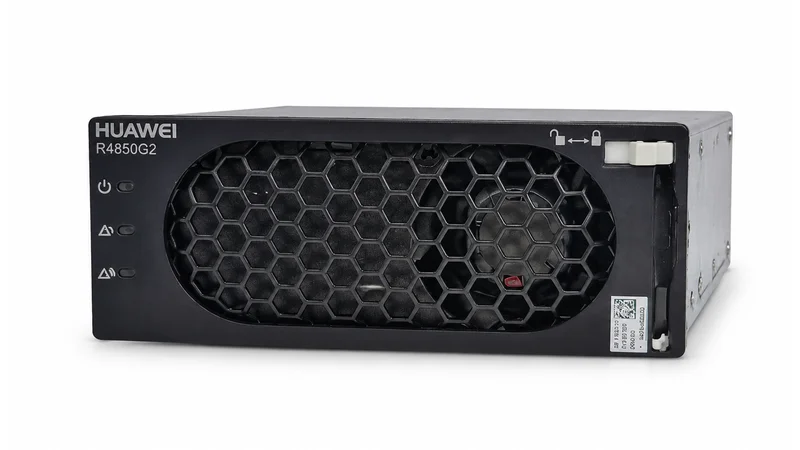
Cooling | Built-in variable-speed fan | Built-in variable-speed fan |
Monitoring interface | CAN bus | CAN bus |
Efficiency depends on the load you actually run
The R4850G6 has the clearer documented efficiency result at a defined mid-load point: at least 96.5% at 220 V AC and 25 A. At 50 A, its stated efficiency is at least 95.5%. The R4850G2 manual instead specifies more than 95% across 30–80% load at 230 V AC and a peak above 96%.
These are not interchangeable test conditions. Do not subtract one model’s peak from the other model’s full-load figure and call the result guaranteed energy savings. For a site running near 25 A per module, the G6 provides the stronger documented case. For mixed loads, compare the efficiency curves at the expected operating points and include low-load operation when sizing N+1 capacity.
For example, a 100 A load can use three modules carrying roughly 33 A each, while four modules reduce the individual load to about 25 A. The actual system must also reserve charging current, account for a failed module, and observe the shelf’s approved capacity. More installed modules improve redundancy but can move normal operation to a different efficiency point.
Voltage precision and default settings matter
The R4850G2 specifies voltage regulation within ±0.2% Vo, compared with ±0.6% Vo for the R4850G6. If the connected equipment has a narrow voltage window, the G2’s tighter specification deserves attention. System-level performance still depends on the controller, settings, cabling, and load transients.
The G6 manual gives two default output possibilities: 53.5 V DC or 57 V DC. Confirm the supplied unit’s configured default before inserting it into a live system. A matching adjustable range does not establish that two modules have identical startup settings or battery-charging behavior.
At low AC voltage, neither module remains a 3000 W source. Both manuals show linear derating to 1250 W at 85 V AC. A site with generator operation or persistent brownouts therefore needs a capacity calculation based on the lowest expected input—not simply a count of 3000 W nameplates.
Same dimensions do not guarantee a drop-in replacement
Both manuals list the same external dimensions, CAN bus support, hot swapping, current sharing, and similarly named rear-connector functions. Those similarities make them practical candidates for the same general class of embedded −48 V DC systems. They do not certify interchangeability in every subrack.
Before ordering, match the complete module part number, hardware revision, slot-detection arrangement, current-sharing behavior, alarm mapping, and controller firmware against the exact shelf. Confirm that the backplane and upstream protection support the intended input current. Have qualified personnel perform installation and live-system replacement.
A useful system-level reference is the RICEWIND Huawei ETP48600-C11A1 DC power system page. It identifies R4850G2-family slots and SMU02 monitoring, but that association should still be checked against the configuration being purchased. You can also review the broader RICEWIND power-management catalog for related shelves and distribution equipment.
Which module fits your project?
Select the R4850G6 when its efficiency at your normal current is the priority, the 53.5 V or 57 V default is confirmed, and the controller accepts the exact unit. It is especially worth evaluating for sites with sustained mid-load operation and meaningful energy or cooling constraints.
Select the R4850G2 when tighter regulated-voltage precision is important, its efficiency curve suits the operating point, or you are maintaining an existing approved configuration. Keeping a validated configuration can reduce integration uncertainty compared with changing module revisions across a shelf.
For either model, inspect the nameplate and rear contacts, confirm the serial-number-linked test scope, and agree on load-test conditions before acceptance. Check output voltage, current sharing, controller alarms, fan behavior, and protection settings under the intended system configuration.
When requesting a proposal, provide the shelf model, existing rectifier and controller part numbers, firmware, normal and peak DC load, battery-charging requirement, minimum AC input, and preferred module quantity. That information allows RICEWIND to assess the two candidates against the real system rather than treating matching dimensions as compatibility.
Engineering Procurement & Technical Desk
For technical datasheets, custom power topology design, or volume export quotations, reach out to RICEWIND engineers.
Read the RICEWIND editorial policy to see how we verify technical content