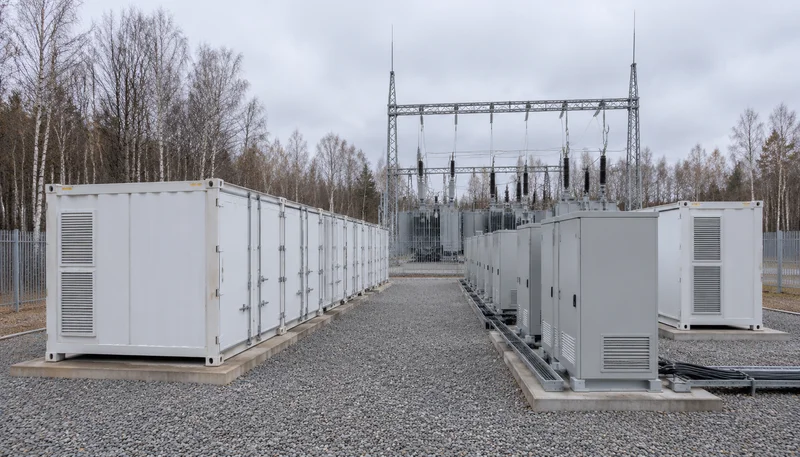
Kehua Tech announced on November 26, 2026 that it has delivered and grid-connected two utility-scale battery energy storage systems (BESS) in Riga, Latvia — 15 MW / 40 MWh in the Biekensalas district and a separate 15 MW / 41.28 MWh installation, 30 MW / 81.28 MWh in combined capacity. Both systems are designed for grid frequency regulation and renewable-energy integration, and both were financed on a non-recourse project basis by regional banks — a combination that says as much about where the Baltic storage market now stands as the hardware itself.
What Kehua delivered in Riga, and how the projects are structured
According to the company's announcement, Kehua Tech acted as system integrator and Power Conversion System (PCS) supplier for the 15 MW / 40 MWh project in Riga's Biekensalas district. The project was developed through the special-purpose company Rigas elektroenergijas uzkratuve VI SIA, counts Aretis Group among its shareholders, and secured non-recourse project financing from Luminor Bank AS.
The second project, rated 15 MW / 41.28 MWh, was developed through Rigas elektroenergijas uzkratuve I SIA, also associated with Aretis Group, with non-recourse financing from Swedbank AS. Kehua states that both projects have successfully connected to the Latvian grid and are intended to provide frequency-regulation services and support renewable-energy integration.
Independent trade coverage by GreentechLead on November 27 put the combined capacity at 30 MW / 81.28 MWh and calculated discharge durations of roughly 2.67 and 2.75 hours at rated output — consistent with frequency-regulation and renewable-firming duty rather than long-duration energy shifting.
Kehua Digital Energy, the company's renewable-energy arm, describes Kehua Tech as a power-electronics company founded in 1988 whose businesses span renewable energy, data centers and critical power, with cumulative global PV installations above 68 GW and energy-storage deployments above 53 GW by the end of 2025. Those cumulative figures are the company's own and are not independently audited, but they indicate the scale at which a vendor long known for UPS and critical-power systems now operates in grid-scale storage.
Why the Baltics are buying frequency-regulation storage first
The Baltic states have managed grid frequency independently since February 2025, when Estonia, Latvia and Lithuania desynchronized from the Russian-controlled BRELL power system and synchronized with continental Europe. Frequency containment and restoration reserves that were once shared across a much larger interconnection now have to be sourced inside three small national markets — and batteries are the fastest assets able to provide them.
The build-out is visible across the region this month. pv magazine reported on November 26 that an Estonian hybrid park energized a 55 MW / 250 MWh battery, one of the largest storage units in the Baltics to date, explicitly framing it as part of the region's post-desynchronization balancing capability. Latvian public media reported in mid-November that transmission system operator AST has increased the frequency of grid-crisis exercises, including cooperation with the armed forces — a reminder that grid resilience in the region is now treated as security infrastructure, not just market plumbing.
Latvian energy-agency data cited in regional reporting this week put installed battery capacity in Latvia at around 550 MW with roughly 1.5 GW in development; those figures should be treated as directional rather than audited, but the direction matches what lenders are doing. Non-recourse financing from Luminor and Swedbank for merchant storage in Riga signals that Baltic frequency-regulation revenue is now considered bankable, not speculative.
What this means for power-infrastructure buyers
The Riga projects are a clean example of the vendor-integrator model: one supplier providing the PCS, the battery integration and grid-connection delivery as a single scope. For buyers in telecom, data centers and industrial power, the significance is convergence — the same power-conversion and battery-integration competence that underpins utility BESS now appears in critical-power catalogs, and vendor roadmaps increasingly assume that storage interacts with the grid rather than merely sitting behind a transfer switch.
The projects also clarify duty profiles. A 15 MW / 40 MWh system cycling daily for frequency regulation is a different machine from a backup battery sized for rare outages: high cycle counts, active thermal management and grid-code-compliant inverters instead of float-charged standby strings. Buyers evaluating storage-backed power for their own sites should specify the duty first — regulation, peak shaving, backup, or a stack of all three — and select components rated for that duty instead of adapting a standby design.
RICEWIND's portfolio sits on the critical-power side of this convergence: telecom and stationary battery systems, DC power systems and rectifiers for sites that increasingly combine grid, battery and renewable inputs. For a view of how the data-center segment is sizing storage across timescales, see our analysis of EVE Energy's three-tier AIDC storage portfolio; ongoing coverage of storage and power infrastructure is collected in the RICEWIND news hub.
What to watch next
Baltic ancillary-service pricing: sustained frequency-reserve prices will determine how quickly the region's roughly 1.5 GW development pipeline converts into financed projects.
Further bank mandates: additional non-recourse storage financings in Latvia, Estonia or Lithuania would confirm lender comfort with the vendor-integrator delivery model.
Grid-code evolution: how AST and its Baltic neighbors refine technical requirements for storage providing frequency services, including response-time and cybersecurity conditions.
Crossover products: whether PCS and battery platforms proven in utility projects are repackaged for commercial, industrial and telecom-site storage at the 100 kW to 5 MW scale.
Questions operators are asking
What exactly did Kehua build in Riga?
Two utility-scale battery energy storage systems, both now grid-connected: 15 MW / 40 MWh in the Biekensalas district and 15 MW / 41.28 MWh elsewhere in Riga, totaling 30 MW / 81.28 MWh. Kehua acted as system integrator and PCS supplier on the first project and delivered its integrated BESS solution on the second. Both are designed for frequency regulation and renewable-energy integration, and both carry non-recourse bank financing — from Luminor and Swedbank respectively.
Why are the Baltic states adding grid-scale batteries so quickly?
Because since February 2025 Estonia, Latvia and Lithuania no longer share frequency reserves with the Russian-controlled power system they left. Operating as part of the continental European grid, the three small national markets must source their own balancing capacity, and batteries are the fastest-deploying assets that can provide frequency containment and restoration services. Regional lenders have begun financing such projects on a non-recourse basis, which accelerates deployment further.
How long can the new Riga battery systems run at full power?
Roughly 2.7 hours. Dividing energy capacity by rated power gives about 2.67 hours for the 15 MW / 40 MWh system and about 2.75 hours for the 15 MW / 41.28 MWh system — a duration suited to frequency regulation and renewable firming rather than multi-hour energy shifting.
Sources and scope
This report draws on Kehua Tech's announcement distributed via PR Newswire on November 26, 2026 (capacities, project structure, financiers and company figures); independent trade coverage by GreentechLead on November 27, 2026 (combined capacity and discharge-duration figures); pv magazine's November 26, 2026 report on the Estonian 55 MW / 250 MWh battery and Baltic frequency independence since February 2025; and LSM's November 13, 2026 reporting on Baltic grid security and AST exercises. Regional investment figures attributed to Latvian energy-agency data are treated as directional. Manufacturer-described cumulative installation figures are company statements rather than independent measurements. Project economics and specific contract terms were not disclosed; order-level pricing and delivery commitments for any equipment category discussed here follow actual quotations and contracts.
Planning a storage-backed power project for a telecom site or data center? RICEWIND supplies rectifiers, DC power systems and telecom batteries with engineering support — send us your load profile and backup-time target for a sized proposal.
Engineering Procurement & Technical Desk
For technical datasheets, custom power topology design, or volume export quotations, reach out to RICEWIND engineers.
Read the RICEWIND editorial policy to see how we verify technical content