9U Subrack Architecture & High-Density Power Distribution
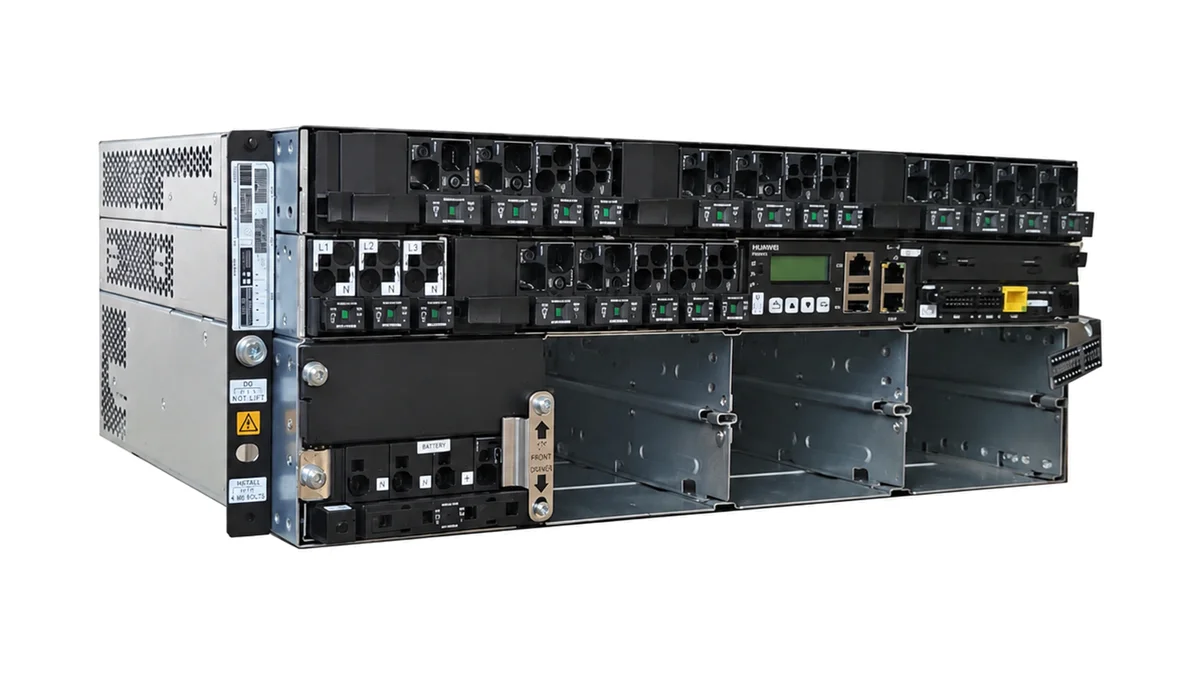
The Huawei ETP48400-C4A1 represents a carrier-grade, high-density embedded DC power system engineered into an industry-standard 19-inch 9U rack-mount chassis. Designed to deliver up to 400A continuous current at a nominal -48V DC bus rating (delivering up to 24kW total capacity), the system accommodates high-draw telecom loads within an exceptionally compact footprint. The subrack is architected with eight dedicated hot-swappable rectifier bays, an integrated AC input distribution section, dual-bus DC load breaker banks, and multi-string battery connection terminals. Its strict front-access physical architecture ensures that cabling, breaker actuation, module replacement, and routine maintenance can be executed entirely from the front aisle, eliminating rear-access clearance requirements in high-density outdoor cabinets or standard ETSI equipment rooms.
Internal power distribution within the ETP48400-C4A1 utilizes heavy-duty copper busbars sized to maintain minimal voltage drop and low operational thermal rise under full 400A continuous loading. The integrated distribution panel segregates outgoing DC power into priority tiers, utilizing precision magnetic-hydraulic circuit breakers engineered for high-vibration resilience and tight trip curve adherence. AC power enters through an integrated multi-pole main breaker capable of handling heavy branch feeds, directing power smoothly across the rectifier backplane. This consolidated 9U integration eliminates the necessity for external, standalone DC distribution frames (DDF) in macro cellular base stations and optical transport nodes, cutting cabling complexity and points of failure.
19-inch 9U standard rack-mount chassis delivering 400A / 24kW nominal -48V DC output capacity
8 dedicated hot-swappable rectifier bays supporting high-density modular N+1 or N+2 expansion
100% full front-access cabling and front-facing breaker layout for streamlined site maintenance
Rectifier Modularity & Conversion Efficiency Topologies
The ETP48400-C4A1 subrack exhibits universal backward and forward compatibility with Huawei 50A high-efficiency rectifier modules, primarily the high-efficiency R4850G2 (96% peak efficiency, 3000W output) and the flagship ultra-efficient R4850G6 (98% peak efficiency). It also supports standard R4850N1 modules. Operating on digital signal processor (DSP) controlled resonant switching topologies, these rectifiers maintain an ultra-flat efficiency curve across wide loading ranges from 30% to 90%. Total Harmonic Distortion (THD) is constrained to under 5% with an active Power Factor Correction (PFC) exceeding 0.99, minimizing upstream electrical pollution and reducing generator sizing requirements during mains outages.
Energy efficiency is maximized via the system's dynamic module energy-saving hibernation cycling managed by the supervisory unit. The controller continuously calculates total DC load demand and transitions redundant rectifier units into an ultra-low power standby state, keeping the active modules operating strictly within their highest efficiency sweet spot (>80% loading). To prevent uneven component aging and thermal fatigue, the system executes an automated cycling wear-leveling algorithm, periodically rotating the active and dormant modules. Integrated speed-controlled forced-air cooling in each module keeps acoustic noise below 55 dBA while maintaining uncompromised full-load output across ambient temperatures ranging from -40°C to +55°C without derating.
Modular interoperability with Huawei R4850G2 (96%) and R4850G6 (98% ultra-efficient) 50A units
Intelligent active/hibernation cycling keeping active rectifiers in optimal efficiency zones
Continuous full-power delivery up to +55°C ambient without thermal derating (-40°C to +65°C range)
Dual LVD Battery Management & Power Continuity
Uninterrupted power continuity in the ETP48400-C4A1 is secured through an advanced Dual Low Voltage Disconnect (LVD) architecture consisting of two high-capacity magnetic latching contactors: Load Low Voltage Disconnect (LLVD) and Battery Low Voltage Disconnect (BLVD). In the event of an extended grid failure, the system discharges the connected energy storage systems while monitoring cell thresholds. When bus voltage drops to the user-programmed LLVD threshold (typically -47.0V to -45.5V DC), the LLVD contactor sheds non-critical auxiliary loads such as site comfort cooling, non-priority transmission links, or local surveillance gear. This sheds load burden and extends available reserve battery autonomy for mission-critical core radio frequency units (RRUs), baseband processors (BBU), and optical transceivers.
If commercial power remains unrecovered and the battery bank approaches its critical deep-discharge boundary, the BLVD contactor activates at the programmed limit (typically -43.2V DC), isolating the battery bank entirely. This prevents irreversible cell polarity reversal, plate sulfation in Valve-Regulated Lead-Acid (VRLA) batteries, or severe cell degradation and undervoltage lockout in Lithium Iron Phosphate (LiFePO4) systems. The platform integrates precise temperature-compensated float and boost charging profiles, automated periodic battery capacity discharge testing, and real-time calculation of State of Charge (SOC), State of Health (SOH), and remaining backup time based on dynamic discharge curve matching.
Independent dual magnetic latching contactors for two-stage LLVD and BLVD automated load shedding
Multi-chemistry charging algorithms supporting VRLA and LiFePO4 with dynamic temperature compensation
Automated periodic offline capacity testing and predictive SOH/SOC battery diagnostic routines
Grid Adaptability & Surge Suppression
Telecommunications infrastructure is frequently deployed in regions characterized by severe electrical grid instability, sustained brownouts, and elevated lightning strike density. The ETP48400-C4A1 addresses these challenges through an ultra-wide AC input operating window spanning 85V AC to 300V AC line-to-neutral, with a line frequency tolerance of 45Hz to 65Hz. The power plant natively supports three-phase five-wire (380V/400V/415V AC) and single-phase three-wire (220V/230V AC) configurations. When incoming grid voltage drops between 85V AC and 176V AC, the internal rectifiers automatically execute a linear power derating curve rather than disconnecting, ensuring ongoing DC bus support and preventing premature battery drain during chronic voltage sag conditions.
Surge protection is fundamentally integrated into the AC input stage via a robust Class C Surge Protective Device (SPD) certified to IEC 61643-11 standards. The SPD module provides lightning impulse protection rated for a nominal discharge current (In) of 20kA and a maximum discharge current (Imax) of 40kA under an 8/20μs waveform. The subrack incorporates active visual fault indicators and remote electrical alarm signaling that alerts the supervisory system immediately upon varistor degradation. Comprehensive secondary protection rounds out the electrical envelope, including output overvoltage electronic latching, self-recovering DC short-circuit protection, and reverse-polarity safeguards on battery terminations.
Wide AC operating window (85V AC to 300V AC) maintaining DC output under severe grid instability
Flexible AC wiring configuration supporting three-phase (380V/400V/415V) or single-phase (220V/230V)
Integrated Class C surge protective device (20kA nominal / 40kA maximum 8/20μs waveform)
SMU02C Central Monitoring & Network Telemetry
System telemetry, autonomous logic control, and remote supervisory visibility are driven by the Huawei SMU02C central controller. The SMU02C integrates a high-contrast LCD screen and tactile navigation keypad directly on its front fascia, enabling field technicians to perform complete local commissioning, alarm diagnostic sweeps, and setpoint adjustments without relying on an external laptop. The controller maintains a non-volatile circular event buffer, capturing historical logs, alarm timestamps, and system performance metrics with second-level precision, safeguarding diagnostic data across unexpected system power cycles.
For carrier-grade centralized operations, the SMU02C features an extensive suite of northbound communication protocols. Its 10/100M Fast Ethernet interface supports SNMP v1, v2c, and v3 (with cryptographic SHA/AES authentication), an embedded HTTPS Web GUI, and native integration into Huawei NetEco Network Management Systems (NMS). Upstream monitoring platforms can retrieve comprehensive telemetry down to individual rectifier voltage, thermal sensor outputs, load current splits, and battery string metrics. Serial connectivity is provided via RS485 and RS232 channels, while an internal Controller Area Network (CAN) bus orchestrates inter-module communication. Configurable digital input/output dry contacts allow seamless integration of site environmental alarms, such as door access, smoke detection, and water ingress.
Northbound network stack including SNMP v1/v2c/v3, secure HTTPS Web GUI, and NetEco integration
Comprehensive telemetry interfaces: RJ45 Fast Ethernet, RS485, RS232, and user-configurable dry contacts
Local LCD controller interface for streamlined on-site commissioning, parameter adjustments, and log audits
Carrier-Grade Procurement, Testing & TCO Strategy
Procurement directors and power infrastructure engineers evaluating the ETP48400-C4A1 must assess the total lifecycle economics rather than initial capital expenditure alone. Specifying 98% ultra-efficient R4850G6 rectifiers yields measurable OPEX reductions by eliminating up to 50% of wasted heat energy compared to legacy 92% systems, which substantially reduces the load on site air conditioning infrastructure. Carrier-grade procurement requirements mandate verification of a Mean Time Between Failures (MTBF) exceeding 500,000 hours, stringent electrical safety conformity (CE, UL, and IEC compliance), and rigorous factory validation consisting of full-load burn-in testing on resistive load banks prior to deployment.
RICEWIND is a premier global engineering distributor specializing in genuine, factory-certified Huawei DC power systems, modular rectifiers, and supervisory controllers. Every Huawei ETP48400-C4A1 system supplied by RICEWIND undergoes strict warehouse QA protocols, including firmware synchronization across rectifier modules, mechanical breaker continuity testing, and complete SMU02C telemetry port verification before global dispatch. RICEWIND maintains extensive inventory reserves to support critical telecom rollouts, emergency spare parts provisioning, and multi-site turnkey expansion. For direct technical specifications, custom distribution breaker configurations, and carrier procurement inquiries, contact RICEWIND power systems engineers directly via Email at lee@ricewind.com or Phone/WhatsApp at +86 17621197907.
Mandatory factory burn-in load bank test certification under 100% continuous load prior to site delivery
Comprehensive TCO optimization utilizing R4850G6 98% efficiency to minimize energy and cooling OPEX
Direct procurement verification and engineering support via RICEWIND (lee@ricewind.com / +86 17621197907)
Engineering Procurement & Technical Desk
For technical datasheets, custom power topology design, or volume export quotations, reach out to RICEWIND engineers.
Read the RICEWIND editorial policy to see how we verify technical content