In an attributed article published on 23 November 2026, Thomas Raggi, Vertiv global product manager for large power converters, describes two UPS control approaches for the fast load changes created by AI training clusters. Battery Shield attempts to absorb part of a power step inside the UPS DC link and avoid unnecessary battery micro-cycling, while Input Power Smoothing (IPS) lets the battery charge and discharge in both directions to smooth the input power drawn from the grid or on-site generators. The two methods act on different parts of the system, so reducing battery involvement and using the battery as a buffer are not the same thing.
What happened
Writing in Data Center News, Raggi describes the synchronized power swings of AI training clusters as millisecond-scale events and notes that repeated micro-cycling can affect the energy storage system as well as upstream generators, transformers and the grid. The article sets out two complementary controls. Battery Shield dynamically adjusts the UPS DC-link reference so that, within the operating range it describes, the UPS absorbs fast steps internally and the battery is not pulled in unnecessarily. IPS uses a digital filter to calculate average output power over a period and then adjusts input power to that target, with the battery supplying energy during load surges and absorbing surplus when load falls.
The control boundaries, applicable equipment and DC-link voltage window of Battery Shield vary by UPS model.
Why the two strategies are not interchangeable
Battery Shield aims to reduce unnecessary battery throughput caused by fast fluctuations. IPS aims to isolate part of the fluctuation from the upstream supply, which means it does use the battery for bidirectional energy buffering. Where the site runs on the utility grid and the priority is fewer battery cycles, an internal absorption strategy can be evaluated. Where on-site generators or interconnection conditions limit ramp rates, IPS may need to be evaluated. The final choice depends on the load profile, the UPS control capability, the kW/s change the generator and grid will accept, and the backup autonomy target.
A public Vertiv technical white paper adds that a smoothing strategy needs filter targets set from the real load's amplitude, frequency and duty cycle, and battery capacity configured for the required smoothing ratio and duration; insufficient charging capability can push state of charge down over time. The SOC window must keep a floor for outage backup while leaving headroom to recharge after load swings.
What engineering teams should measure first
Before deployment, record the power waveform of the GPU cluster, including step amplitude, repetition rate, duration and duty cycle across the day. At the same time, confirm the UPS rating, control mode, configurable filter and ramp parameters, and the bidirectional power the battery is allowed to deliver. For on-site generators, set the input ramp rate from the manufacturer's limits and verify it under grid-connected operation, generator transfer and low-SOC conditions.
Acceptance should not rest on a single snapshot of the input curve. Record load output power, upstream input power, battery charge and discharge power, SOC change and reserve runtime estimates across representative training start-stop cycles and recharge recovery. If smoothing drives reserve SOC to its floor, prevents the system from returning to energy balance, or pushes battery temperature rise or cycle count beyond the manufacturer's limits, reduce the smoothing target or reconfigure capacity.
Three verifiable questions
What is the difference between Battery Shield and Input Power Smoothing?
Battery Shield handles part of the fast power step inside the UPS to reduce battery micro-cycling. IPS reduces upstream input fluctuations by having the battery absorb or release energy. Actual behaviour depends on the UPS model, control settings and load conditions.
Can a UPS battery handle AI load smoothing over the long term?
It can be evaluated, but the battery should not be selected on instantaneous power alone. Verify bidirectional charge and discharge rates, smoothing duration, the reserved SOC window, recharge capability, temperature and cycle life, and keep the energy needed for the outage autonomy requirement.
How should a generator-backed data center set up smoothing?
First obtain the load ramp rate and transient response limits the generator allows, then set the input filter time constant and target smoothing ratio from the measured load profile. Validate the settings with real training load starts, stops and transfers; do not copy generic values that the specific generator set has not confirmed.
What it means for critical power systems
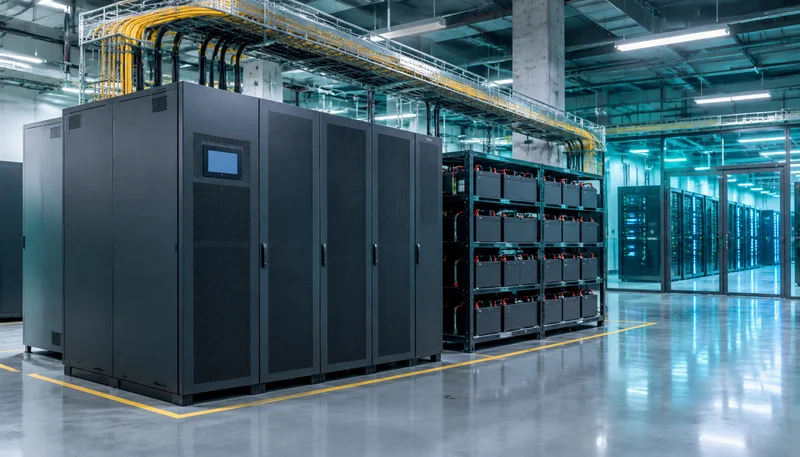
In an AI data center, the UPS may carry power quality, short-term power buffering and outage backup at the same time, and all three share a limited battery power and energy budget. Control strategy does not replace capacity verification of the UPS, generators, batteries and distribution equipment. RICEWIND supports selection of communication and data center power equipment; the final configuration should follow the site single-line diagram, load profile, equipment manuals and contract parameters.
Sources and scope
This article is written by RICEWIND. It interprets an attributed technical viewpoint and does not guarantee the performance of any specific model. Event and article date: 23 November 2026; accessed 24 November 2026; published and modified dates are as displayed on the page.
Thomas Raggi (Vertiv, global product manager for large power converters): "Rethinking battery roles in AI data centres: From passive backup to active power buffer", Data Center News, 23 November 2026.
Vertiv: "Enabling stable power protection in high-performance computing environments", vendor technical white paper.
UPS load characterization, input smoothing configuration and SOC management principles in this article are drawn from the public report and vendor documentation cited above; capacity, configuration and delivery terms should be confirmed against the documentation of the final model.
Engineering Procurement & Technical Desk
For technical datasheets, custom power topology design, or volume export quotations, reach out to RICEWIND engineers.
Read the RICEWIND editorial policy to see how we verify technical content