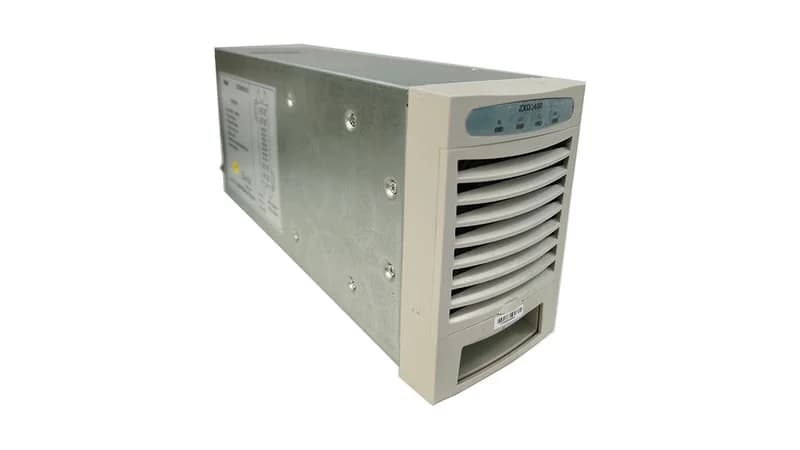
1. Core Electrical Specifications and Power Topology
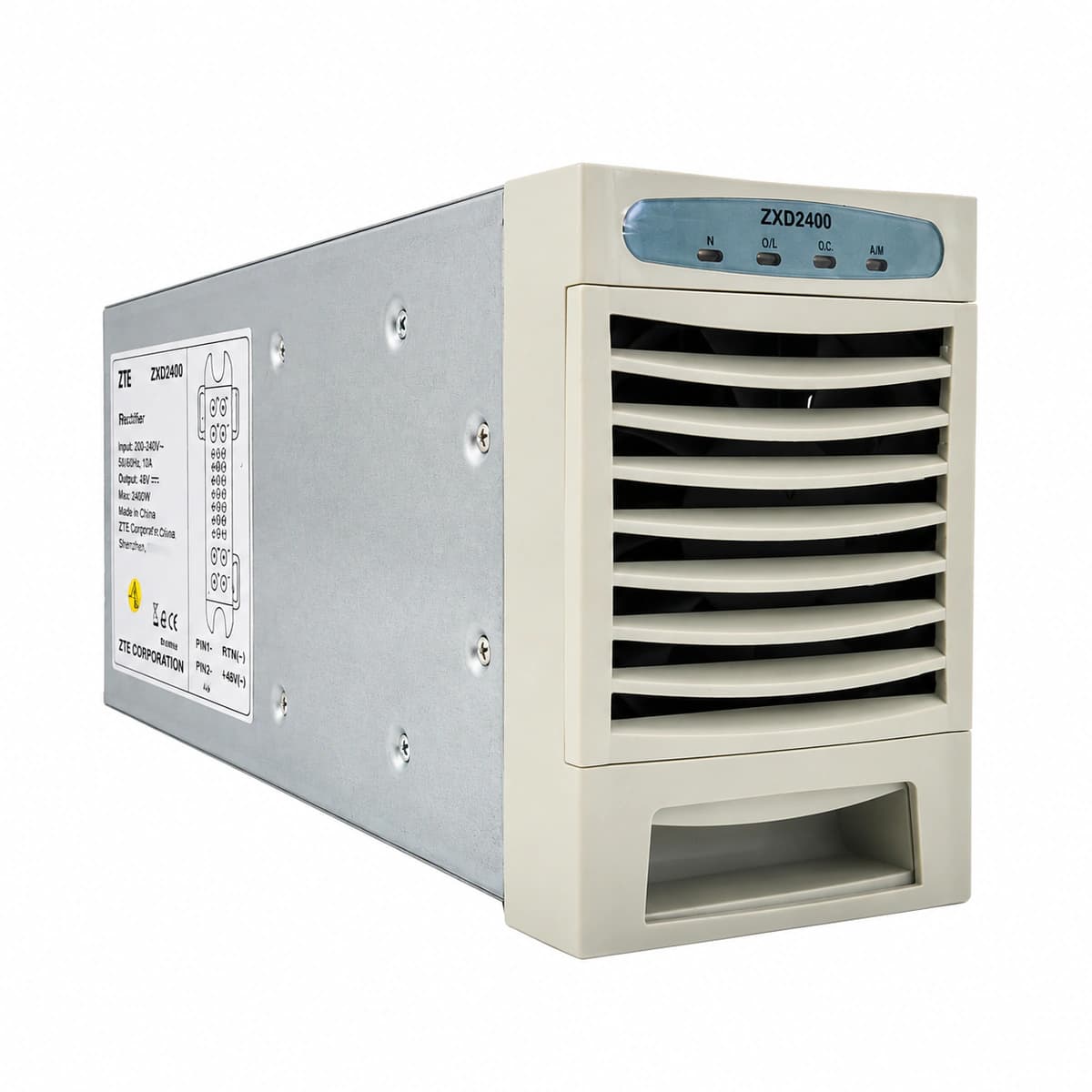
The ZTE ZXD2400 is one of the most established and field-proven 50A switch-mode rectifiers deployed across global telecommunication networks and mission-critical industrial infrastructure. Engineered for single-phase AC input and -48VDC output, it delivers a rated output voltage of -48VDC (adjustable continuously from -42VDC to -58VDC), a continuous rated current of 50A, and an output capacity of 2400W. Its high-frequency resonant topology delivers peak electrical efficiency of over 92.5%, ensuring sustained thermal stability across continuous operational regimes.
With respect to grid resilience, the ZXD2400 accommodates a wide AC input range from 80VAC to 300VAC (45Hz to 65Hz). When facing severe grid undervoltage between 80VAC and 150VAC, its internal DSP controller initiates linear power derating to maintain uninterruptible DC power delivery to critical transceivers and microwave links. The unit features 3000VAC input-to-ground dielectric isolation, compliance with EN55022 Class B telecom EMC limits, internal surge suppression, and automatic short-circuit recovery.
Nominal Ratings: Single-phase 220VAC input, -48VDC/50A output, rated power capacity 2400W
Grid Adaptability: Ultra-wide 80VAC to 300VAC input tolerance with automatic derating below 150VAC
Efficiency and Power Factor: Conversion efficiency ≥91% to 92.5%, PF ≥0.99, and THD ≤5%
Cooling and Acoustics: Front-to-rear forced cooling with stepless variable-speed fan, noise ≤55 dBA at 25°C
2. Hardware Revision Spectrum and Architectural Evolution (V4.0 to V4.6)
Over its operational service history, the ZXD2400 underwent multiple architectural refinements. Engineering teams must understand the physical and electronic characteristics across major hardware suffixes to avoid load sharing imbalances and telemetry issues.
Revisions V4.0 and V4.0A represent the initial robust generation, utilizing classic analog auxiliary circuits and standard transformers with high mechanical endurance. Revisions V4.1 and V4.2 upgraded the active power factor correction (PFC) circuitry and improved internal thermal airflow. Revision V4.3 remains the industry benchmark, widely deployed in carrier macro base stations due to its optimized hybrid digital control and precision zero-voltage switching (ZVS). The recent V4.6 revision incorporates updated high-temperature MOSFET switches, reduced standby loss, and accelerated serial bus responsiveness.
V4.0 / V4.0A: Foundational generation; analog auxiliary architecture suited for legacy like-for-like maintenance
V4.1 / V4.2: Refined active PFC topology; enhanced thermal distribution under partial and medium loads
V4.3: Industry golden baseline; highest deployed volume, mature components, and maximum controller interoperability
V4.6: High-density optimized release; reduced thermal dissipation, higher component thermal headroom, and swift telemetry
3. Chassis Topology and Centralized Monitoring Integration
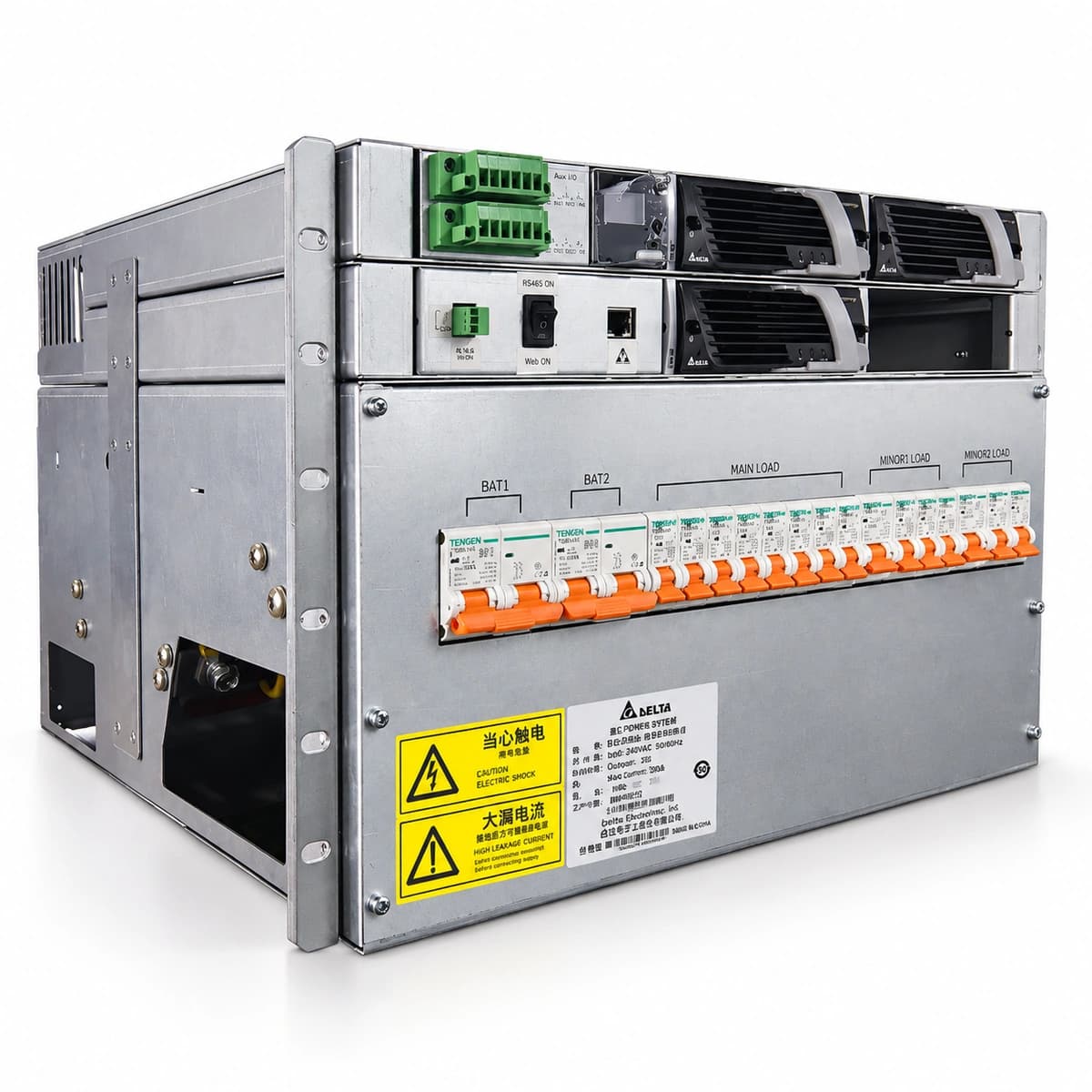
The ZXD2400 employs a hot-swappable drawer-style mechanical format featuring front-to-rear airflow and floating rear blind-mate power and signal connectors. It serves as the primary power building block for ZTE ZXDU systems, including embedded subracks (such as the ZXDU58 B121, ZXDU68 B201, and ZXDU68 B301) and large-scale floor-standing power cabinets (such as the ZXDU68 T601).
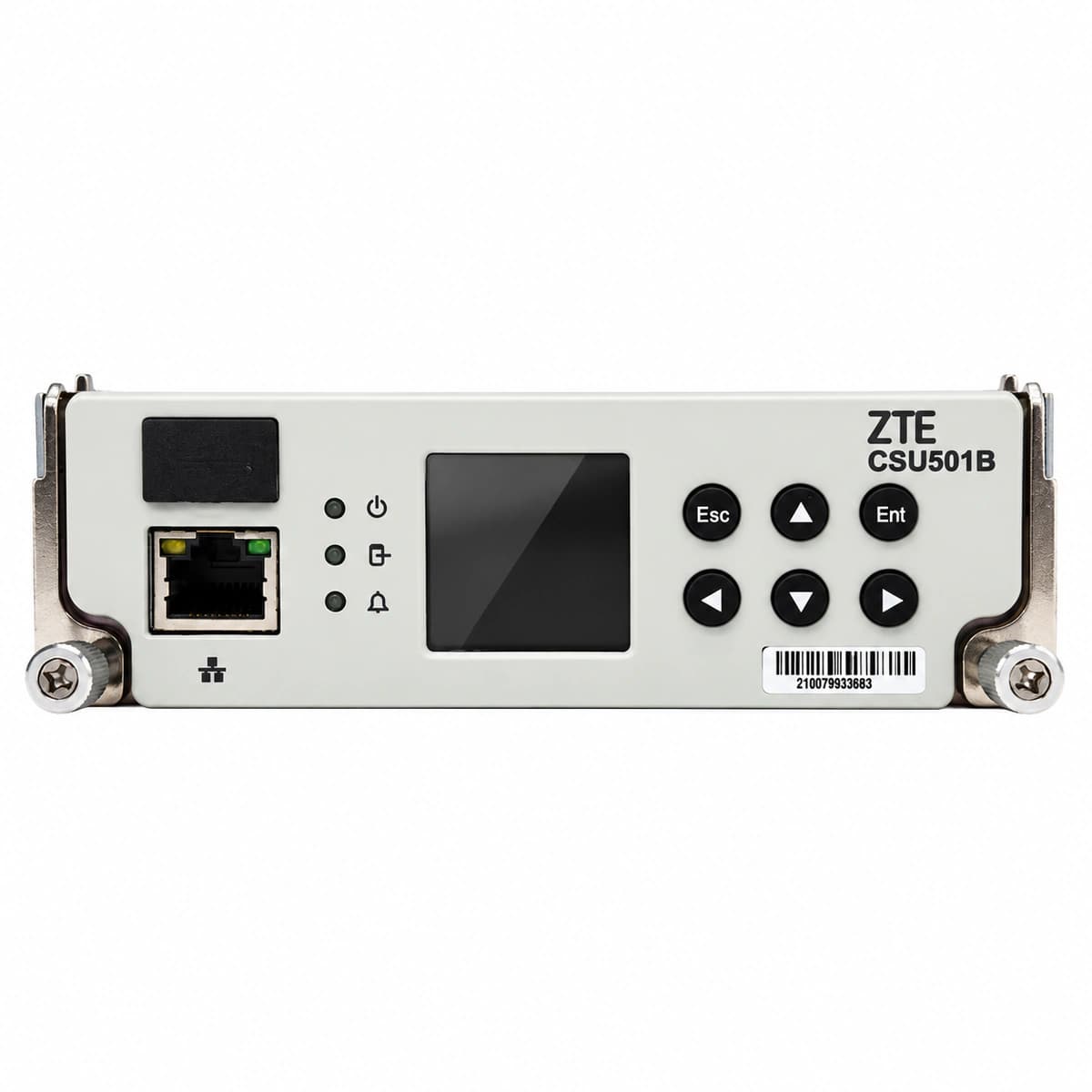
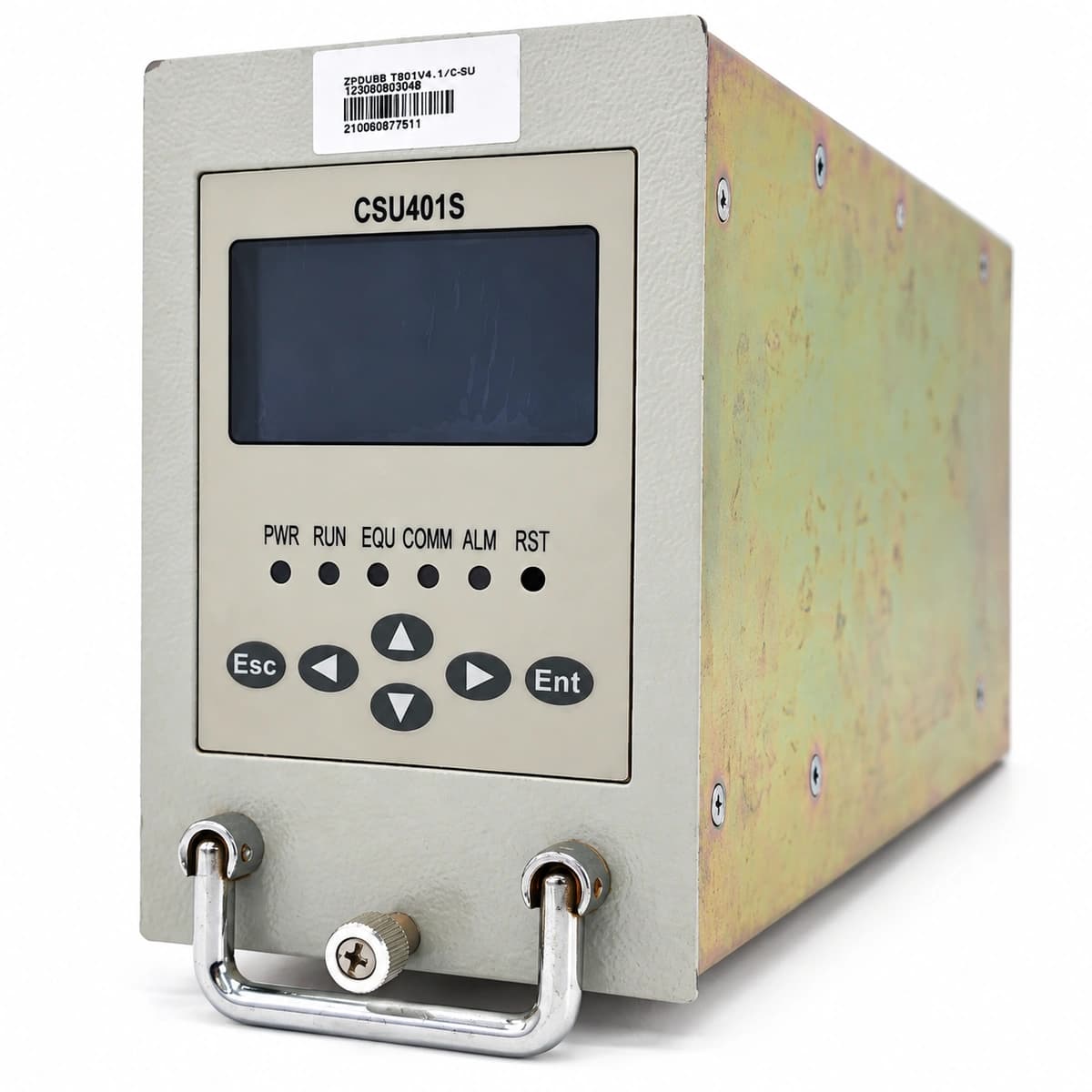
Communication is established over a multidrop serial bus (RS485) communicating with ZTE Central Supervisory Units (CSU500B, CSU1200, and equivalent controllers). This link enables automatic unit addressing, active active-load current sharing (imbalance ≤±3%), remote float/equalize voltage adjustments, and detailed alarm telemetry. Importantly, rectifiers of distinct capacity ratings (such as 50A ZXD2400 alongside 60A ZXD3000) must not be operated in parallel on the same subrack busbar.
Native Subrack Support: ZTE ZXDU58 family (B121, etc.) and ZXDU68 family (B201, B301, T601)
Controller Compatibility: Comprehensive compatibility with ZTE CSU controllers for dynamic active load sharing
Physical Architecture: Modular drawer casing with hot-plug floating connectors and rear locking latches
Intermixing Prohibition: Strict segregation against parallel mixing with ZXD3000 units on shared DC busbars
4. Field Replacement, Capacity Expansion, and Subsystem Modernization
When network operators expand existing telecom cabinets or integrate supplementary industrial DC loads, deciding between maintaining the ZXD2400 platform or migrating to newer modules is a critical capital expenditure consideration.
If the installed power frame is a legacy ZXDU58 subrack with 50A-rated slot backplanes, procuring authentic, tested ZXD2400 modules (preferably V4.3 or V4.6) is the safest and most cost-effective path, eliminating subrack replacement downtime and wiring rewrites. If the facility operates high-capacity ZXDU68 subracks or plans total rack renewal, transitioning toward the 1U high-density ZXD3000 rectifier provides a 20% power density increase within identical vertical rack units.
Seamless Drop-in Replacement: In-chassis replacement of failed units with identical ZXD2400 modules under hot-swap conditions
AC Breaker Capacity Check: Verify branch breaker sizing (16A to 20A per rectifier slot under maximum AC draw)
DC Busbar Thermal Clearance: Inspect DC distribution copper bars and battery cabling when operating fully populated slots
System Transition Path: Plan complete ZXDU68 subrack retrofits when requiring 1U form factors and 60A modular increments
5. Strategic Procurement: Refurbishment Detection and Verification Rules
Given the substantial aftermarket demand for ZXD2400 units, procurement channels frequently contain substandard refurbished units, remarketed scrap modules, and units with replaced substandard internal components.
Verification requires strict multi-point inspection. First, inspect the front panel bezel and latching assembly: original ZTE parts are molded from flame-retardant ABS/PC with crisp silk-screened labels, whereas cheap refurbishments show repainted surfaces or inconsistent fonts. Second, check the internal electrolytic capacitors: authentic modules utilize high-grade Japanese capacitors (Nichicon or Nippon Chemi-Con rated for 105°C), while unauthorized repairs substitute low-cost consumer parts. Finally, confirm matching serial numbers across the chassis label, printed barcode, and internal PCB silkscreen.
Front Enclosure and Bezel: Check for factory-grade mold lines, undamaged latches, and authentic silk screening
Rear Terminal Integrity: Inspect heavy-current gold-plated blind-mate terminals for arc pits, corrosion, or wear
Capacitor and Magnetics Inspection: Confirm genuine 105°C Japanese electrolytic capacitors and uncharred transformer windings
Traceability Alignment: Ensure barcode serials correlate with revision tags and factory QA markings
6. RICEWIND Testing Protocols and Global Engineering Supply Assurance
At RICEWIND, our mission as an industrial and telecom power infrastructure supplier is to deliver verified reliability. Every ZTE ZXD2400 rectifier module undergoes rigorous full-load automated bench validation before international export dispatch.
Our testing procedure includes full AC input sweep testing, 50A continuous full-load burn-in cycles, active current sharing verification, and 3000VAC dielectric withstand safety isolation checks. We provide worldwide carrier-grade warranties, shock-absorbent export crating, and direct engineering support to telecommunication operators, data centers, and engineering contractors.
For bulk procurement requests, legacy system replacement cross-referencing, or immediate shipment availability, contact the RICEWIND engineering desk at lee@ricewind.com or via technical direct telephone at +86 17621197907.
100% Full-Load Burn-in: Extensive 4-hour continuous 50A rated testing under elevated ambient thermal conditions
Dielectric Safety Clearance: High-potential insulation testing up to 3000VAC input-to-ground with leakage tracking
Export-Grade Packaging: Multi-layer electrostatic shielding and reinforced shockproof cartons for air and sea transit
Dedicated Technical Support: Complete engineering consultation on system topologies and field deployments
Engineering Procurement & Technical Desk
For technical datasheets, custom power topology design, or volume export quotations, reach out to HEFENGQI engineers.