Micro-Modular Containment & Elevated Temperature Aerodynamics
The proliferation of edge-based neural network inferencing and high-density enterprise computing has elevated thermal heat fluxes to unprecedented levels, regularly reaching 15 kW to 35 kW per standard EIA-310-E rack enclosure. Traditional perimeter downflow Computer Room Air Conditioning (CRAC) units reliant on underfloor raised plenums fail under these conditions due to severe static pressure decay, turbulent boundary-layer separation, and uncontrollable aerodynamic bypass mixing. In contrast, micro-modular architectures resolve these volumetric transport limits by structurally coupling the IT enclosures directly to the thermal rejection apparatus within an enclosed containment envelope. Hot Aisle Containment (HAC) has emerged as the definitive aerodynamic strategy over Cold Aisle Containment (CAC), establishing an isolated high-temperature, low-pressure kinetic sink directly behind the server exhaust chassis, which strictly isolates cold supply streams from ambient air intrusion.
Thermodynamically, HAC allows the return air temperature entering the cooling coil to be elevated to steady-state regimes between 37°C and 42°C without imposing thermal stress on the server inlet plane, which remains compliant with ASHRAE A1 Recommended envelopes (18°C to 27°C). Operating at an elevated return air temperature fundamentally alters the thermodynamic baseline of the cooling coil. According to the Carnot theorem, the theoretical maximum Coefficient of Performance (COP) of a vapor compression refrigeration cycle is governed by the ratio of evaporating temperature to the difference between condensing and evaporating temperatures. By raising the return air dry-bulb temperature, the saturated evaporating temperature (SET) inside the direct expansion (DX) coil can be adjusted upward from legacy baselines of 7°C to upwards of 14°C to 16°C. This compression ratio reduction significantly reduces specific compressor power consumption while entirely eliminating localized micro-climate hot spots across the server faceplate.
Implement structural Hot Aisle Containment (HAC) with elastomeric, flame-retardant perimeter brush seals to limit air leakage to less than 1.5% of total volumetric airflow.
Calibrate supply air thermal delivery setpoints to maintain 22°C to 24°C at the server inlet while tolerating 37°C to 42°C return air inside the contained hot duct.
Size containment volume to preserve an aerodynamic cross-sectional face velocity below 1.8 m/s, preventing static pressure spikes across adjacent server exhaust fans.
Close-Coupled In-Row Precision Cooling Dynamics & EC Fan Modulation
Close-coupled In-Row Precision Air Conditioners (In-Row CRAC/CRAH) disrupt the volumetric transport inefficiencies of legacy designs by co-locating the heat exchanger directly within the equipment rack row. By reducing the physical transit distance of both the chilled air delivery and the high-temperature return air from tens of meters down to less than one meter, the external static pressure (ESP) requirements of the air-moving system collapse from upwards of 250 Pa down to 20 Pa to 40 Pa. Consequently, close-coupled in-row architectures reduce fan transport power by 35% to 50% relative to conventional underfloor raised-plenum topologies, dramatically reallocating operational power budgets directly to compute loads while minimizing parasitic system overhead.
Airflow management within these units relies on backward-curved centrifugal or mixed-flow fans powered by Electronically Commutated (EC) brushless DC motors, modulated via continuous digital differential pressure (delta-P) feedback loops. These EC arrays dynamically trim fan rotational velocity to maintain a neutral or slightly negative sub-Pascal pressure differential (-1.0 Pa to -3.0 Pa) across the contained hot aisle relative to the open room environment. Operating in tandem with variable-speed inverter scroll compressors charged with low-Global Warming Potential (GWP) refrigerants—specifically R32, R454B, or R1234ze—the cooling capacity seamlessly modulates between 20% and 100% of nominal rating. This dynamic modulation tracks rapid fluctuations in server CPU/GPU processor thermal dissipation without inducing severe cycling, compressor hunting, or thermal overshoot.
Deploy modular EC fan assemblies utilizing integrated Hall-effect sensors modulated via 0-10V or Modbus RTU control to maintain a target -2.0 Pa hot aisle pressure.
Specify variable-frequency inverter scroll compressors featuring a minimum 5:1 turndown ratio to dynamically match server transient step-load profiles.
Select next-generation low-GWP refrigerants (R32, R454B, or R1234ze) engineered for high volumetric cooling capacity and minimal GWP ratings under current environmental mandates.
Fluorinated Refrigerant Pump Natural Cooling Dual-Loop Economization
The integration of a fluorinated refrigerant pump economizer transforms the standard direct expansion (DX) mechanical cooling circuit into an advanced, three-stage dual-loop natural economization system. The physical architecture comprises an inverter-driven hermetic scroll compressor, a dedicated micro-channel outdoor condenser/fluid cooler, an electronic expansion valve (EEV), an indoor evaporator coil, and a magnetically coupled, oil-free canned motor refrigerant pump arranged in a parallel bypass circuit. When outdoor ambient temperatures exceed 18°C, the system operates in Direct DX Mode, using mechanical vapor compression to reject heat. As ambient temperatures descend into the intermediate range of 10°C to 18°C, the system initiates Mixed Economizer Mode: the canned motor pump pre-circulates condensed liquid refrigerant, reducing compression lift requirements and allowing the inverter compressor to operate at reduced partial-load RPM.
When ambient temperatures fall below 10°C, the system transitions autonomously into 100% Free Cooling Pump Mode, completely bypassing the mechanical compressor via an array of motorized three-way directional solenoid valves. In this operating state, the high-power compressor is de-energized, and only the ultra-low-power canned motor refrigerant pump (consuming less than 1.2 kW of electrical power per 60 kW of heat rejection capacity) circulates liquid fluorinated refrigerant through the closed cycle. The liquid phase change occurs isothermally within the indoor evaporator coil as it absorbs server heat, after which natural vapor pressure differences transport the gaseous phase to the outdoor micro-channel coil for condensation. This process reduces annualized cooling subsystem energy consumption by up to 75% compared to non-economized baseline systems, driving annualized micro-modular PUE metrics below 1.15 in sub-tropical to sub-arctic climatic zones.
Incorporate an oil-free, canned motor refrigerant pump equipped with internal ceramic hydrodynamic bearings to eradicate lubricant migration and seal-degradation risks.
Implement automated three-way bypass valve sequencing with a minimum 60-second transition buffer to prevent hydraulic shock and suction pressure collapse during mode changes.
Verify liquid subcooling thresholds (minimum 3.0 K) at the refrigerant pump suction port using real-time pressure-temperature transducers to prevent pump cavitation.
Electrical Redundancy & DC-Backed Thermal Continuous Operation Architecture
Thermal continuity within ultra-dense micro-modular facilities is as critical as electrical reliability; losing heat rejection for as little as 15 to 30 seconds under a 35 kW per rack thermal load will cause catastrophic server throttling and subsequent junction-temperature shutdown. To mitigate this risk, modern cooling skids must be architected with fully redundant mechanical and electrical topologies, typically operating under distributed N+1 or 2N multi-skid configurations. Cooling modules are powered via dual-bus Automatic Transfer Switches (ATS) connected to isolated utility and uninterrupted power supply (UPS) feeds, ensuring uninterrupted phase tracking and automatic sub-cycle switching during grid voltage sags, phase loss, or sudden utility blackouts.
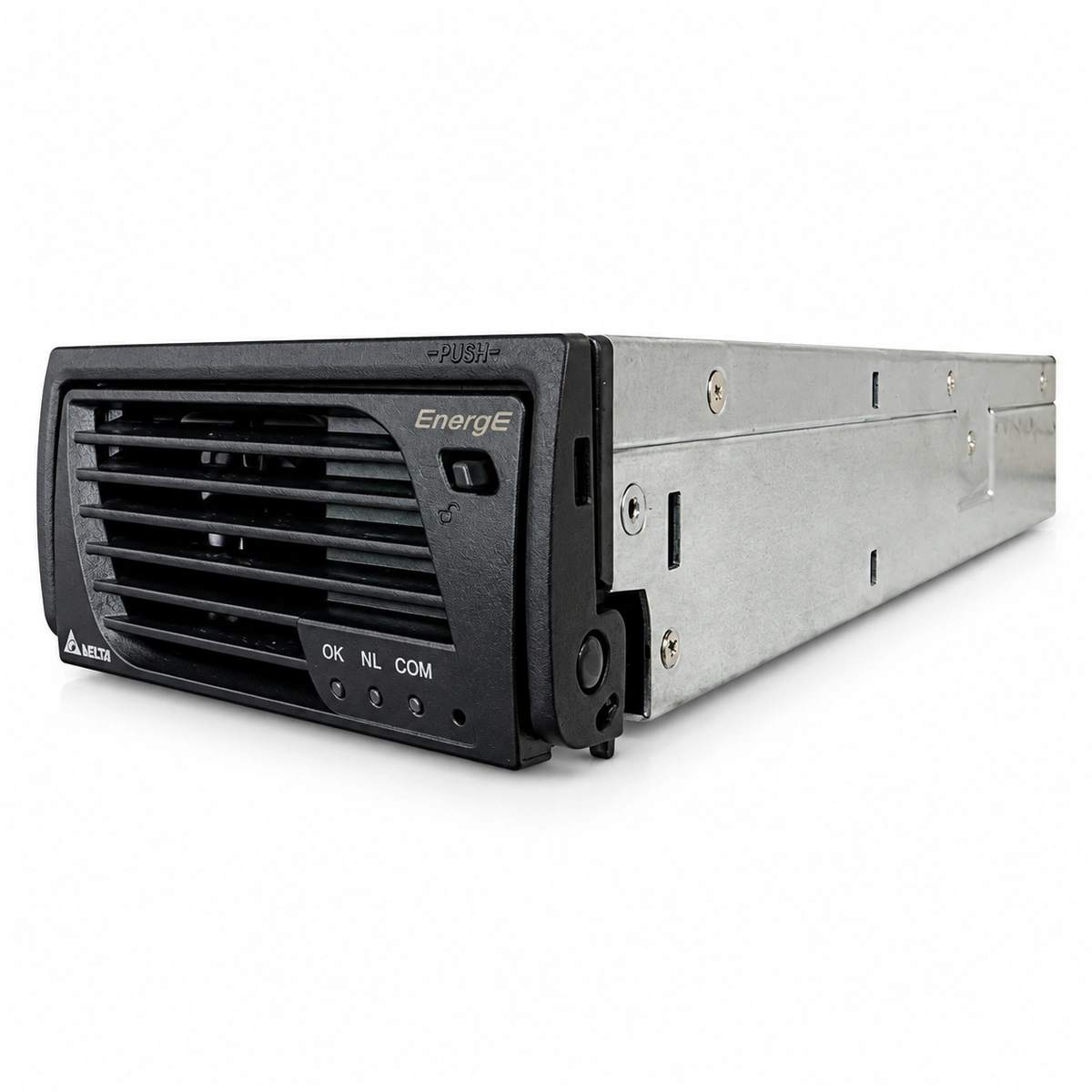
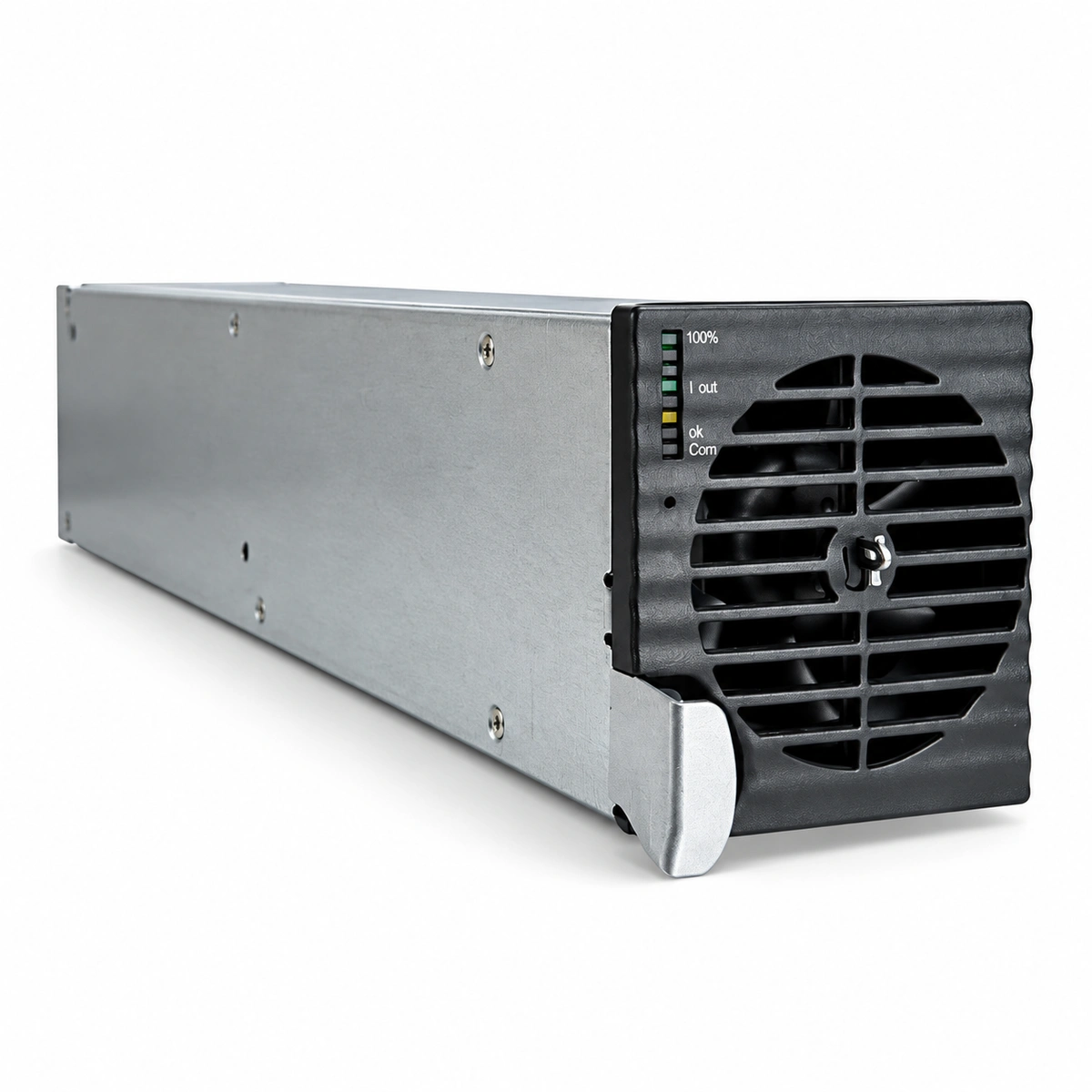
To achieve zero-loss thermal continuity, auxiliary controls, critical sensors, variable-speed EC fans, and the refrigerant economizer canned pumps are directly interfaced with a centralized or distributed telecom-grade -48V DC rectifier backup system. Alternatively, they can be sustained by dedicated in-row LiFePO4 UPS energy storage packs. During the 10-to-60 second transition window while standby diesel generators start and synchronize, this DC-backed architecture prevents zero-flow convective boiling within the evaporator coils. By sustaining continuous forced-air circulation through the chassis and keeping the low-power refrigerant pump operational, the system provides reliable thermal ride-through, absorbing transient thermal capacitance and eliminating the risk of localized thermal runaway.
Integrate telecom-grade -48V DC auxiliary bus bars to continuously power indoor EC fans, EEV steppers, and system PLCs during main power switchgear events.
Configure dual-source ATS power logic with an active transfer time below 16 milliseconds to prevent microprocessor control resets during power source commutation.
Dimension the thermal ride-through capacitance to guarantee less than a 3°C rise in server inlet temperature across a 60-second utility-to-generator transfer window.
Distributed IoT Sensor Fusion & Dew-Point Condensation Prevention Controls
Precise thermodynamic control within micro-modular contained aisles requires high-resolution environmental observability across both spatial and temporal dimensions. Legacy control frameworks relying on a single return-air thermistor are replaced by distributed IoT sensor grids deployed across the server rack faceplates. Tri-level sensor nodes are positioned at the bottom, middle, and top vertical elevations of every rack's cold supply and hot exhaust planes, collecting calibrated dry-bulb temperature, relative humidity, and laser-anemometer airflow velocity metrics. These telemetry streams feed directly into localized Edge Controller Programmable Automation Controllers (PAC), executing multi-variable Model Predictive Control (MPC) algorithms that adjust individual EC fan RPM and Electronic Expansion Valve (EEV) stepper positions in real time.
A critical responsibility of this real-time telemetry processing is dynamic condensation mitigation. In-row cooling units operating at high sensible heat ratios (SHR approaching 1.0) must strictly prevent dehumidification, which degrades efficiency and creates localized static discharge hazards, while fully avoiding water condensation on chilled metal surfaces. The supervisory logic continuously computes the psychrometric dew point from ambient temperature and relative humidity telemetry. It then modulates the evaporator's Saturated Evaporating Temperature (SET) via the EEV to maintain cooling coil surface temperatures at least 1.5°C above the local dew-point threshold. This dynamic psychrometric balancing guarantees dry-coil operation, eliminates the parasitic latent cooling energy wasted on condensing moisture, and removes the need for maintenance-intensive condensate drain pans and pump lines within edge environments.
Deploy a minimum of six calibrated digital temperature/humidity sensor probes per server cabinet, arranged in vertical tri-level arrays on both inlet and exhaust faces.
Program supervisory PAC firmware to enforce a minimum safety delta of +1.5°C between the calculated air dew point and the minimum evaporator coil surface temperature.
Integrate Modbus/BACnet multi-variable telemetry streams directly into the central DCIM to enable automated thermal anomaly detection and predictive fan degradation alerting.
Modular Skids Commissioning, Leak Integrity & Low-GWP Environmental Compliance
The economic viability of rapid micro-modular data center deployments relies heavily on standardized off-site manufacturing and stringent Factory Acceptance Testing (FAT). Mechanical cooling circuits are engineered as fully integrated, pre-piped, and pre-wired skids that arrive on site with sealed, factory-verified base charges. To guarantee long-term field hermeticity, skids undergo deep vacuum dehydration down to less than 200 microns of mercury, followed by ultra-sensitive helium mass-spectrometry tracer gas leak testing during simulated high-frequency transportation vibration profiling. This rigorous quality gate ensures that microscopic capillary fractures and mechanical joint micro-fissures are intercepted prior to field installation, drastically lowering on-site commissioning timelines from weeks to hours.
Stringent adherence to international environmental legislation—such as the European Union F-Gas Regulation (EU 2024/573), the global Kigali Amendment to the Montreal Protocol, and UL 60335-2-40 safety mandates—governs the mechanical architecture of these cooling skids. When using mildly flammable ASHRAE Class A2L refrigerants like R32 and R454B, specific mitigation countermeasures must be integrated directly into the skid chassis. These include factory-calibrated optical or non-dispersive infrared (NDIR) refrigerant leak sensors, automatic hermetic solenoid shutoff valves that isolate localized piping runs upon vapor detection, and emergency spark-proof purge ventilation fans designed to displace accumulated refrigerant vapor from contained aisles well before flammability thresholds (LFL) are reached.
Subject all modular cooling skids to off-site helium mass-spectrometer testing, validating an absolute leak rate of less than 5.0 x 10^-6 mbar·l/s prior to logistics dispatch.
Incorporate active A2L safety systems complying with UL 60335-2-40, featuring redundant NDIR leak detectors and intrinsically safe (ATEX/IECEx-rated) exhaust fans.
Establish baseline FAT run-off testing verifying that automated transition sequences between Direct DX, Mixed, and Refrigerant Pump Free Cooling modes complete within factory tolerances.
Engineering Procurement & Technical Desk
For technical datasheets, custom power topology design, or volume export quotations, reach out to HEFENGQI engineers.