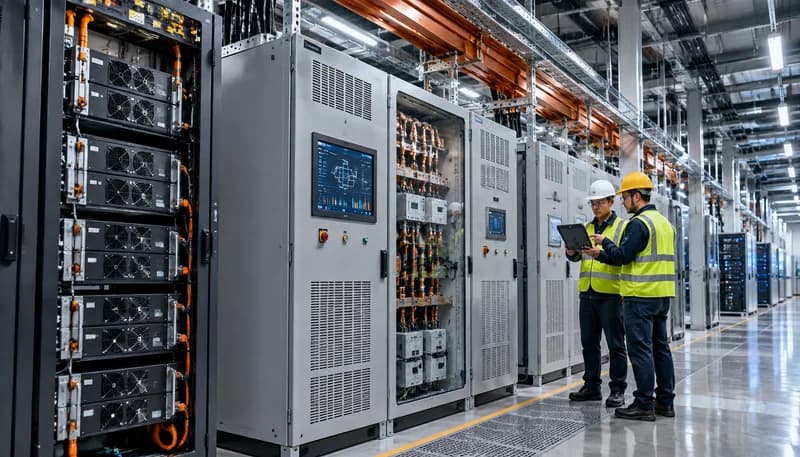
The Outage Paradox: Why Centralized UPS Systems Became the Leading Single Point of Failure
For decades, the monolithic double-conversion uninterruptible power supply (UPS) served as the cornerstone of mission-critical availability, engineered to isolate sensitive IT loads from raw grid anomalies, line-voltage sags, and harmonic distortions. However, empirical telemetry from enterprise and hyperscale facilities reveals that this centralized consolidation has inverted system reliability. According to Uptime Institute 2026 data, power-related incidents account for more than 20% of all critical IT service outages, with centralized UPS plant failures leading the failure matrix at 39%, substantially surpassing automatic transfer switch (STS/ATS) failures at 34% and backup generator failures at 28%. The mechanical and electrical complexity of monolithic multi-megawatt systems—encompassing static bypass thyristors, common DC busbars, and complex parallel control logic—creates expansive blast radiuses where a localized internal fault inevitably cascades into a facility-wide loss of critical bus voltage.
The vulnerability profile is further compounded by the physical aggregation of energy storage. Monolithic UPS architectures traditionally consolidate megawatt-scale lithium-ion or valve-regulated lead-acid (VRLA) battery strings into centralized battery rooms. With high-energy-density chemistries, any single-cell thermal runaway incident introduces extreme deflagration risks, demanding onerous fire-suppression infrastructures compliant with NFPA 855 and driving elevated insurance liabilities. Furthermore, the operational maintenance of centralized plants requires routine manual interventions, static bypass transitions, and capacitor bank replacements on intermediate DC links. These procedures expose the critical path to human error and component-level aging phenomena that directly violate the continuous fault-tolerance requirements defined by Tier IV concurrent maintainability standards.
Audit existing monolithic UPS plants for single-point control logic, common static bypass cabinets, and DC-bus tie breaker single-failure paths.
Verify cell-level thermal runaway propagation barriers and off-gas detection telemetry in centralized battery rooms against NFPA 855 standards.
Quantify the downstream IT load impact (blast radius) for catastrophic rectifier, inverter, or bypass short-circuit faults across all medium-voltage (MV) and low-voltage (LV) lineups.
The Inverted Protection Paradigm: Shielding the Utility Grid from AI Dynamic Load Swings
The emergence of distributed AI model training on contiguous gigawatt-scale clusters has driven a complete functional inversion of critical power conditioning. Historically, power electronics were deployed to protect compute silicon from external utility fluctuations, lightning transients, and voltage unbalance under IEEE 446 recommendations. In contemporary high-density AI clusters, however, synchronous compute execution—such as parallel tensor contractions, distributed matrix multiplications, and collective all-reduce operations—triggers synchronized current draw spikes. When models switch between computational epochs and weight checkpointing phases, cluster power demand swings by tens to hundreds of megawatts in tens of microseconds. Left unmitigated, these severe di/dt transients propagate back into the regional transmission interconnection, inducing phase-angle instability, localized frequency excursions, and tripping utility protective relays.
Consequently, the primary duty of the modern power conversion system has reversed: it must now actively shield the utility transmission grid and on-site generation from the volatile dynamic load steps of the AI compute plane. This inverted paradigm mandates front-end active front ends (AFE) and local power-conditioning electronics capable of high-bandwidth dynamic load leveling, sub-cycle synthetic inertia emulation, and aggressive active harmonic filtering. Power stages must maintain unity power factor and low Total Harmonic Distortion (THDi < 3%) while dynamically absorbing or injecting real power to damp computational resonance, effectively transforming the facility interface from a volatile non-linear load into an electronically governed, predictable grid asset compliant with IEEE 1547 and IEEE 2800 grid interconnection mandates.
Deploy high-bandwidth active power-smoothing algorithms within front-end converters to limit utility-facing ramp rates to less than 5 MW per second.
Implement sub-cycle dynamic reactive power compensation (STATCOM functionality) directly at the main utility point of common coupling (PCC).
Conduct power hardware-in-the-loop (PHIL) stress testing to evaluate grid protection relay behavior during 100 MW collective checkpointing transients.
Hyperscale DC Topologies: OCP BBUs, 800V DC Sidecars, and In-Rack Energy Decoupling
To eliminate centralized single points of failure and streamline thermal paths, hyperscalers have shifted away from multi-stage AC distribution toward decentralized direct current (DC) distribution architectures. Rooted in Open Compute Project (OCP) standards, this structural shift initially placed decentralized 12V and 48V Battery Backup Units (BBUs) directly on the rack busbar, ensuring that backup energy storage is co-located with the compute load. In high-density AI clusters operating at 100 kW to 300 kW per rack, however, low-voltage distribution collapses under excessive I²R busbar conduction losses and unmanageable copper mass. This physical constraint has driven the deployment of 800V DC distributed sidecar architectures, placing dedicated power-conversion and localized energy-buffering cabinets immediately adjacent to compute rows.
Within an 800V DC sidecar topology, intermediate double-conversion stages (AC-to-DC-to-AC-to-DC) are collapsed into a highly efficient single rectification and isolation stage utilizing high-frequency silicon carbide (SiC) MOSFET semiconductors. A common 800V DC nominal distribution bus directly couples the rectifiers, localized energy storage modules (such as high-rate lithium iron phosphate cells or ultra-fast supercapacitor arrays), and the downstream point-of-load (PoL) buck regulators powering accelerator silicon. Sub-millisecond transient ride-through is handled entirely at the DC busbar level, isolating the upstream facility infrastructure from computational di/dt spikes. Furthermore, solid-state circuit breakers (SSCBs) and bidirectional DC-DC converters limit microsecond fault energies, restricting any component failure to an isolated rack or sidecar domain without destabilizing adjacent compute assets.
Calculate I²R busbar losses and copper volume savings transitioning from 48V DC to 800V DC distribution at rack power envelopes exceeding 150 kW.
Integrate solid-state circuit breakers (SSCB) capable of isolating DC short-circuit faults within less than 15 microseconds to prevent bus voltage collapse.
Validate cell balancing, cycle life, and thermal dissipation performance of localized sidecar energy storage during repetitive dynamic step-load cycles.
Solid-State Transformers (SST) & Hybrid Power Electronics: Replacing Mechanical Transfer Switches
Mechanical transfer switches (ATS and STS) constitute 34% of data center power failures due to contact erosion, phase synchronization mismatches, and mechanical actuator stiction during emergency transfers. The integration of medium-voltage Solid-State Transformers (SST) and Hybrid Intelligent Transformers (HIT) eliminates these electromechanical vulnerabilities by merging galvanic isolation, voltage transformation, and source arbitration into a unified solid-state conversion stage. Operating at switching frequencies between 10 kHz and 50 kHz via medium-voltage SiC power modules, SSTs replace bulky, oil-immersed 50/60 Hz copper-and-iron transformers with compact high-frequency magnetic links, reducing system footprint by more than 40% while directly converting distribution-level 13.8 kV or 34.5 kV AC down to regulated 800V DC.
Beyond volumetric compactness, solid-state and hybrid transformers deliver sub-millisecond dynamic source arbitration. Rather than relying on physical contactor transitions between disparate primary and secondary feeds, multi-port SST topologies continuously arbitrate between the utility medium-voltage grid, campus-level energy storage systems, and local prime power generation at the power-electronic control layer. By executing instantaneous zero-voltage-switching (ZVS) transitions across parallel inverter modules, the SST maintains an uninterrupted DC output voltage during full loss-of-grid events. In addition, the high-frequency isolation barrier natively cancels upstream harmonics and neutral-point shift, rendering obsolete the complex external harmonic filtering and centralized transfer switch lineups that historically impaired system reliability.
Specify multi-port SST conversion stages using medium-voltage (MV) SiC MOSFETs to achieve greater than 98% full-load electrical conversion efficiency.
Verify sub-millisecond source arbitration timeframes across redundant MV feeds to eliminate voltage sag propagation to the downstream IT DC bus.
Implement thermal stress monitoring and junction-temperature telemetry on SST high-frequency planar transformer modules and switching devices.
Campus BESS & Microgrid Integration: Transforming Emergency Backup into Grid-Interactive Assets
As data center power demands approach gigawatt scales, the historical reliance on idle, oversized diesel generators and monolithic lead-acid UPS rooms has become economically and operationally unsustainable. Modern architectural models formally decouple sub-second transient bridging—assigned to distributed rack BBUs, 800V DC sidecars, or supercapacitors—from multi-hour campus-scale Battery Energy Storage Systems (BESS). Situated outside the primary white space, modular BESS installations utilize containerized, liquid-cooled Lithium Iron Phosphate (LFP) or sodium-ion chemistries equipped with multi-tier thermal runaway suppression systems, eliminating fire risks within the compute envelope and complying fully with insurance underwriting and local municipal mandates.
Critically, these campus-scale BESS assets are engineered not merely as passive emergency reserves, but as active, grid-interactive microgrid assets. Utilizing grid-forming (GFM) inverters governed by virtual synchronous machine (VSM) algorithms, the campus BESS establishes an independent voltage and frequency reference, facilitating true microgrid black-start capabilities without relying on mechanical diesel crank sequences. During standard continuous operation, these installations participate in wholesale energy arbitrage, dynamic peak shaving during training-model runs, and utility ancillary services, including fast frequency response (FFR). By providing programmatic synthetic inertia to the regional transmission operator under IEEE 1547-2018 guidelines, the data center transitions from a grid vulnerability into an active stabilizing resource.
Incorporate grid-forming (GFM) inverter controls capable of autonomous voltage-source establishment and black-start coordination without diesel synchronization.
Physically isolate multi-megawatt-hour containerized BESS assets to external utility yards, adhering to NFPA 855 separation distances and containment rules.
Deploy dynamic energy management software to co-optimize energy arbitrage, peak demand clipping, and minimum state-of-charge (SoC) reserves for critical backup.
The AI Power Train Engineering Blueprint: Tiered Resiliency, Millisecond Ride-Through, and Commissioning Verification
To establish deterministic uptime within gigawatt-scale AI infrastructure, electrical engineering reference designs must implement a tiered resiliency hierarchy that strictly maps physical response speeds to operational requirements. Tier 1 comprises the in-rack and sidecar 800V DC energy buffers, which provide microsecond-to-millisecond ride-through to absorb computational di/dt transients and sustain the DC bus during short-circuit clearing. Tier 2 consists of the solid-state transformer or hybrid power-electronic interface, executing sub-millisecond source arbitration and dynamic line conditioning. Tier 3 encompasses the external, grid-forming campus BESS, which handles multi-minute facility bridging, active load shaping, and black-start energy delivery until Tier 4 assets—such as on-site natural gas reciprocating engines, hydrogen-ready microturbines, or dual-feed utility substations—achieve operational synchronization.
Validating this decoupled power train requires exhaustive, physics-based commissioning protocols that deviate significantly from legacy steady-state testing. Integrated systems testing (IST) must simulate worst-case multi-accelerator step transitions using programmable medium-voltage and low-voltage load banks capable of generating repetitive 0% to 100% load steps at slew rates exceeding 50 A/µs. Engineers must verify protection coordination curves between upstream solid-state circuit interrupters and downstream fast-acting pyrofuses under high fault-current conditions. Commissioning mandates must explicitly verify that during full grid disconnection, static transfer elimination, and subsequent microgrid islanding, the 800V DC bus maintains voltage regulation within strict server power supply unit (PSU) tolerances without tripping overvoltage or undervoltage protection.
Execute integrated systems testing (IST) using programmable regenerative load banks to simulate instantaneous 100 MW step-load dynamics and checkpointing shedding.
Perform protection coordination analysis confirming clearing time discrimination between solid-state circuit breakers (SSCB) and mechanical backup interrupters.
Validate DC bus voltage regulation (maintaining nominal +/- 5% limits) during transient step tests, seamless grid-loss transitions, and campus BESS take-overs.
Engineering Procurement & Technical Desk
For technical datasheets, custom power topology design, or volume export quotations, reach out to HEFENGQI engineers.