The Anatomy of Speculative Power Requests and Transmission Queue Saturation
Regional transmission organizations across North America, including PJM Interconnection, ERCOT, and MISO, are experiencing unprecedented interconnection queue backlogs driven by speculative artificial intelligence data center developers. Power reservation requests frequently exceed actual technical and financial deployment capability by orders of magnitude. Developers engage in multi-gigawatt land-banking, submitting identical 500 MW to 1,000 MW interconnection applications across multiple service territories without site control or capital expenditure backing, artificially saturating regional transmission planning horizons.
Empirical utility interconnection metrics reveal that over 70% of queued large-load requests never reach commercial operation date (COD). This phantom capacity triggers cascading system impact studies, misallocates transmission planner engineering resources, and forces utilities to model false thermal overloads and contingency constraints. Consequently, legitimate capital-intensive projects face multi-year study delays while regional operators plan hundreds of millions of dollars in network upgrades for projects destined to be withdrawn at the first financial milestone.
Audit existing regional interconnection queue applications to identify redundant or speculative duplicate filings across adjacent balancing authorities.
Implement rigorous load-flow screening to isolate phantom load models from confirmed baseload industrial development pipelines.
Large-Load Tariff Architectures, Take-or-Pay Ratchets, and Ratepayer Fencing
To protect captive retail and small commercial ratepayers from stranded transmission and generation asset costs, regulatory commissions and investor-owned utilities are replacing traditional industrial cost-of-service rates with dedicated Large-Load Tariffs (LLTs). These regulatory frameworks establish high-demand floors, enforcing minimum demand ratchets requiring hyperscalers to commit to 80% to 90% Take-or-Pay capacity charges over contract horizons extending 10 to 15 years, regardless of actual IT rack utilization or operational delays.
Under these restructured tariffs, utilities mandate 100% upfront Contribution in Aid of Construction (CIAC) for all direct-assignment interconnection facilities and designated network upgrades. Furthermore, RICEWIND analysis emphasizes the requirement for irrevocable letters of credit (LCs) or cash escrow bonds covering ongoing decommissioning, transmission line reinforcement, and unamortized substation asset costs. This comprehensive financial fencing guarantees that if a hyperscaler scales down its cluster or vacates the premises, utility capital recovery remains completely insulated from the broader rate base.
Structure long-term electric service agreements with an 85% minimum Take-or-Pay billing ratchet tied directly to contract capacity reservation.
Require dynamic collateral posting schedules that scale with utility equipment procurement obligations and engineering civil works milestones.
Queue Reform Mechanics and Readiness Milestones Under FERC Order 2023
The implementation of FERC Order 2023 marks a definitive shift from legacy first-come, first-served frameworks to rigorous first-ready, first-served cluster study processes. Transmission providers now enforce stringent financial readiness hurdles, requiring non-refundable study deposits that escalate up to $5,000 per megawatt requested, coupled with mandatory commercial viability milestones prior to Phase 1 and Phase 2 system impact evaluations.
Demonstrable readiness under reformed tariffs requires concrete physical and logistical verification. Interconnection customers must provide fee-simple title or executed long-term options for 100% of site acreage, fully executed OEM production slots for long-lead 230kV or 500kV power transformers, and completed environmental impact permits. Failure to achieve defined engineering readiness triggers swift queue position revocation, automated redistribution of unallocated transmission capacity, and progressive deposit forfeitures designed to penalize queue camping.
Establish verifiable proof of site control and primary OEM production reservations prior to cluster study entry window closure.
Enforce automated study withdrawal penalty clauses to immediately purge unviable projects and reallocate substation busbar headroom.
On-Site Substation Engineering, Bus Topologies, and Phased Energization Schedules
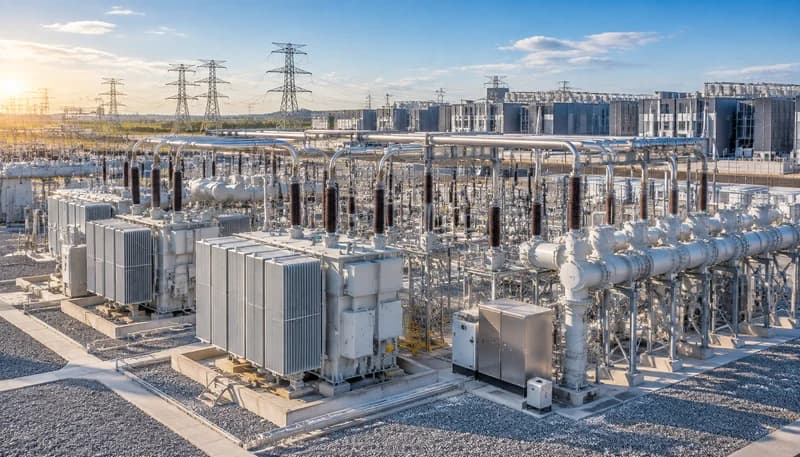
Hyperscale AI campus interconnections require highly resilient high-voltage substation topologies capable of handling massive step-down transformations from bulk transmission lines (115kV, 230kV, or 500kV) to medium-voltage distribution systems (typically 34.5kV). Engineering best practices demand a breaker-and-a-half or double-bus double-breaker configuration for the high-voltage switchyard, providing complete physical isolation for transformer maintenance and continuous power delivery under N-1 and N-2 line and bus contingencies.
Because transmission operators cannot immediately supply 300 MW to 1 GW of instantaneous capacity without bulk grid destabilization, substation engineering must incorporate phased ramp-up contractual agreements. A typical schedule establishes an initial energization tranche of 50 MW for auxiliary systems and the initial compute block, scaling by 50 MW to 75 MW increments over a 36-month commissioning envelope. This phased ramp matches generation capacity additions and utility system upgrades while avoiding severe localized voltage depressions and reactive power imbalances.
Deploy breaker-and-a-half high-voltage bus switchyard topologies with dual physical feeder separation to eliminate common-mode failure points.
Formalize ramp-rate and power-factor enforcement contracts synchronizing IT load scaling with regional system protection schemes.
Behind-the-Meter Generation and Utility-Interactive Microgrid Integration
Given the four to seven year interconnection queue timelines across major power corridors, hyperscale operators are deploying Behind-the-Meter (BTM) distributed generation assets to act as bridging power and reliability assets. Fast-ramping, low-emission natural gas reciprocating internal combustion engines (RICE) combined with solid oxide fuel cells (SOFC) and large-scale lithium-iron-phosphate (LFP) Battery Energy Storage Systems (BESS) provide multi-megawatt firm capacity, allowing campus construction and initial model training to proceed ahead of full utility transmission interconnection.
These BTM installations operate under sophisticated microgrid controller architectures capable of seamless transitions between islanded and grid-parallel modes. By integrating grid-forming inverters, the microgrid provides synthetic inertia, autonomous primary frequency response, and active sub-cycle voltage support. When grid capacity becomes active, the BTM assets transition to peaking reduction, capacity firming during regional transmission emergencies, and Participation in Ancillary Services (spinning reserves and frequency regulation), turning a potential load burden into an active grid asset.
Integrate 4-hour LFP battery storage with grid-forming inverters to provide instantaneous black-start capability and transient frequency stabilization.
Program microgrid energy management systems for automated export limitation to comply strictly with non-export utility interconnection agreements.
Strategic Roadmap for Mission-Critical Power Procurement and Grid Co-Design
Accelerating AI data center deployment while safeguarding the electric grid requires an evolution toward collaborative utility-customer co-design governed by bilateral Utility Development Agreements (UDAs). Hyperscalers and grid operators must partner early in the asset lifecycle, establishing joint engineering task forces to coordinate transformer procurement, right-of-way easement acquisitions, and long-term transmission planning before submitting formal interconnection requests.
Modern hyperscale architectures must incorporate bi-directional, high-resolution telemetry via SCADA, DNP3, and IEC 61850 protocols, granting balancing authorities real-time visibility into campus power profiles. By architecting AI workloads with flex-load capabilities—dynamically throttling non-critical batch training cycles during peak system strain—data centers transition from passive, speculative loads into dispatchable, grid-enhancing infrastructure that earns wholesale capacity credits and drives sustainable transmission expansion.
Execute formal Utility Development Agreements establishing open-book transmission cost-sharing and mutual engineering milestones.
Deploy high-speed SCADA telemetry interfacing data center energy management systems directly with transmission operator dispatch consoles.
Engineering Procurement & Technical Desk
For technical datasheets, custom power topology design, or volume export quotations, reach out to HEFENGQI engineers.