The 200 GW Inflection Point: Macro Grid Physics and AI Compute Density
Global data center electrical power demand is accelerating past a systemic inflection point, projected to exceed 200 gigawatts (GW) by 2030. Historically, hyperscale developments operated as predictable, grid-connected nodes consuming between 20 MW and 40 MW. The contemporary paradigm shift has expanded baseline single-campus requirements into contiguous 500 MW to 1.5 GW mega-loads. This expansion is governed by computational density demands: server enclosures housing cutting-edge dense clusters have leaped from legacy limits of 10 to 30 kW per rack to sustained footprints of 80 to 150 kW, with next-generation liquid-cooled AI factory enclosures scaling up to 1 to 2 MW per cabinet envelope.
This volumetric step-function collapses traditional electrical utility capacity margins. As AI models scale training parameters exponentially, computational clusters demand sustained, un-diverted, highly uniform baseload electricity rather than cyclic diurnal profiles. Feeding these thermal-electrical aggregates introduces severe transmission constraints, leading to thermal bottlenecks on existing rights-of-way, voltage instability, and regional interconnection queues extending past seven years. Modern facility design can no longer treat the high-voltage transmission grid as an infinite electrical bus; campuses must be engineered with deep awareness of regional power flow physics and localized capacity constraints.
At RICEWIND, our infrastructure engineering research institute evaluates these megawatt-per-cabinet platforms as localized, industrial-scale transmission nodes. Deploying 1 to 2 MW cabinets necessitates direct-to-chip single-phase or two-phase liquid cooling loops tied into closed-loop cooling towers or district thermal rejection networks. These massive cooling and computation footprints challenge downstream medium-voltage distribution systems, dictating that 415 V step-down transformers move directly adjacent to the IT enclosure to eliminate parasitic low-voltage I2R resistive copper losses.
Transition primary compute distribution architecture from 480V-120/208V topologies to direct medium-voltage (34.5 kV to 415V/240V) transformation directly adjacent to row end-caps.
Implement closed-loop liquid-to-liquid heat exchanger distribution manifolds engineered for 1.2 MW continuous cabinet thermal extraction at 35°C to 45°C supply water temperatures.
Perform regional N-1-1 static var and dynamic power flow modeling before finalizing campus interconnection requests exceeding 250 MW.
The Dual-Clock Dilemma: Silicon Cycles vs. Utility Planning Decades
Hyperscale AI infrastructure planning confronts an intrinsic structural friction known as the dual-clock dilemma. Silicon advancement cycles—typified by architectures transitioning across Hopper, Blackwell, and Rubin families—operate on an aggressive 18-to-24-month horizon. These cycles drive sudden step-functions in power draw, voltage ripple tolerances, and dynamic load transient profiles. Conversely, public utility commissions, transmission operators, and power generation syndicates operate on a 15-to-30-year planning, capitalization, and asset-depreciation horizon governed by long-duration regulatory filings and environmental impact assessments.
This temporal mismatch destabilizes classic procurement models. Regulated utilities are statutorily prohibited from socializing the capital expenditure of multi-hundred-million-dollar substation expansions or multi-GW line reconductoring onto residential and light-commercial ratepayer bases. Consequently, utilities require data center operators to execute 15- to 20-year Power Purchase Agreements (PPAs) coupled with strict 'take-or-pay' capacity reservation tariffs. If a cluster shifts its architectural roadmap or relocates compute workloads mid-cycle, the hyperscaler remains legally obligated to amortize the multi-decade utility infrastructure investment.
Bridging this systemic divide mandates flexible physical and contractual architectures. Developers must engineer campus substations and internal distribution corridors using modular, open-ended interfaces that maintain backward compatibility with legacy 80 kW air/liquid hybrid systems while integrating forward-compatible headroom for 2 MW fully submerged or direct-cold-plate pods. Contractual commitments require structuring staged ramp-rate interconnect agreements, where initial utility offtake matches initial silicon footprints while subsequent capacity tranches clear regulatory review.
Structure multi-tiered take-or-pay energy contracts containing dynamic step-up provisions that correlate with incremental chip cluster energization schedules.
Design modular civil and electrical substation footprints capable of accepting dry-type step-down transformer retrofits without disrupting live, active IT halls.
Establish contractual clawback indemnification structures that shield municipal ratepayers from non-amortized substation construction capital if compute loads migrate.
Hybrid On-Site Generation and Islanding Topologies
Because utility interconnection timelines can defer commercial energization by 60 to 90 months, the industry is adopting behind-the-meter (BTM) hybrid generation topologies. Rather than remaining passive grid-dependent consumers, 1 GW AI campuses are architected as self-sufficient microgrids equipped with islanding capabilities. Primary base-load generation is increasingly provided by aero-derivative simple-cycle or combined-cycle gas turbines (CCGT) operating on pipeline natural gas, designed for transition to low-blend hydrogen mixtures.
To achieve low-carbon baseline requirements, campuses are deploying multi-technology generation portfolios. Solid oxide fuel cells (SOFC) configured in parallel multi-megawatt blocks offer base-load power with negligible criteria air pollutants, while deep enhanced geothermal systems (EGS) are increasingly co-located where tectonic geologies permit. These baseload continuous assets are coupled with grid-forming, multi-hour Battery Energy Storage Systems (BESS) utilizing lithium iron phosphate (LFP) or emerging sodium-ion chemistries. The BESS assets do not merely provide reserve energy; they provide synthetic inertia and instantaneous black-start capability.
In this hybrid configuration, synchronous generators and inverter-based resources operate in parallel with the regional high-voltage transmission grid via advanced synchronization switchgear. When transmission anomalies or high-pricing events strike the bulk power system, high-speed static transfer switches (STS) and medium-voltage vacuum breakers disconnect the campus in under 4 milliseconds. This shifts the 500 MW to 1 GW AI compute facility into an autonomous, islanded electrical entity without inducing computational disruption or server restarts.
Specify aero-derivative gas turbine packages equipped with fast-start capabilities capable of achieving 100% baseload capacity from cold start in under 5 minutes.
Incorporate grid-forming BESS inverters equipped with droop control and virtual synchronous machine algorithms to synthesize system inertia during islanded operation.
Implement dual-feed automated static transfer systems operating with sub-cycle isolation times (<4 ms) to decouple from the grid during high-voltage transients.
Dynamic Demand Response & Active Grid Interactivity
The sheer magnitude of gigawatt-scale AI campuses transforms them into critical systemic elements within regional balancing authorities. Rather than operating as static, unyielding loads, modern AI facilities are engineered as dynamic grid-interactive assets. Unlike legacy enterprise clouds where latency penalties prevent rapid load shedding, deep-learning training workloads exhibit computational elasticity. By synchronizing with machine learning orchestration layers, distributed compute clusters can trigger automated checkpointing processes that safely throttle compute load by hundreds of megawatts within seconds.
This dynamic demand response capability is executed through advanced telemetry cross-connected between data center energy management systems (EMS) and regional transmission organization (RTO) energy management platforms. During grid stress events—such as summer peak air-conditioning surges or unexpected generator trips—the data center can execute coordinated load modulation. The facility can instantly trim power consumption by running GPU clocks at reduced frequencies, pausing non-critical training epochs, or discharging on-site BESS systems back through bi-directional inverters into the municipal interconnect point.
These fast frequency response (FFR) services position the AI campus as a stabilizing virtual power plant (VPP). By injecting real power (MW) within 200 milliseconds of a grid frequency decay event, or absorbing dynamic reactive power (MVAR) to regulate voltage sags, the facility secures multi-million-dollar ancillary service revenue credits. This active participation neutralizes local political and regulatory friction, proving that gigawatt-class infrastructure can protect rather than destabilize municipal grid reliability.
Deploy bi-directional utility-interfaced EMS nodes supporting automated OpenADR 2.0b and IEC 61850 protocol translation for real-time load dispatch.
Integrate automated GPU clock-throttling APIs coupled to workload schedulers to modulate cluster-level electrical power by 30% in under 500 milliseconds.
Configure on-site BESS firmware to reserve 20% operational capacity exclusively for regional transmission organization Fast Frequency Regulation (FFR) markets.
High-Voltage Substation Engineering (230kV / 500kV) and Power Delivery Topologies
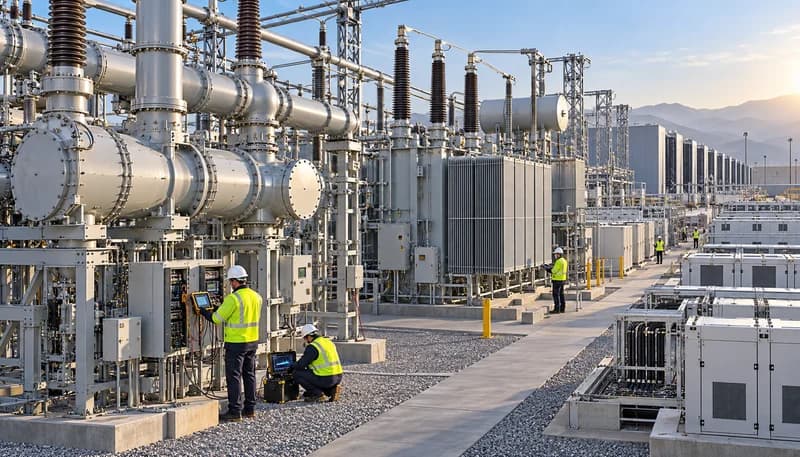
Connecting a gigawatt-scale campus directly to the bulk electric system requires high-voltage substation engineering executed at transmission voltages of 230 kV, 345 kV, or 500 kV. At these electrical potentials, air-insulated switchgear (AIS) substations become spatially prohibitive, demanding tens of acres of perimeter land. Modern designs standardize on high-reliability SF6 or clean-air Gas-Insulated Switchgear (GIS) architectures, which compress the primary substation footprint by up to 85% while providing immunity to environmental contaminants and atmospheric phase flashovers.
A typical 1 GW data center substation blueprint employs a dual-bus, double-breaker topology across four parallel quadrants to ensure continuous concurrent maintainability without interrupting downstream capacity. Primary high-voltage transmission lines terminate into redundant 500 kV/230 kV auto-transformers, which subsequently feed multiple 230 kV to 34.5 kV primary step-down transformers rated at 80 to 120 MVA each. Downstream of the main transformers, power is distributed across the campus via isolated-phase bus ducts or enclosed 34.5 kV medium-voltage cable trench networks engineered with continuous forced-air or liquid cooling to mitigate intense mutual heating.
Severe electrical challenges arise from high fault currents and harmonic distortions inherent to large quantities of switched-mode power supplies. Substation designs must integrate explosive series fault current limiters (FCL) or high-impedance grounding reactors to restrict short-circuit levels below standard 63 kA switchgear breaking limits. Concurrently, dynamic tuned harmonic filter banks and Static Synchronous Compensators (STATCOMs) are installed at the 34.5 kV bus level to suppress the 3rd, 5th, and 7th harmonic emissions generated by massive non-linear rectifier-inverter topologies in dense server power distribution units.
Implement a Gas-Insulated Switchgear (GIS) double-bus, double-breaker topology rated for 500 kV service to ensure continuous concurrent maintainability.
Install fast-acting solid-state Fault Current Limiters (FCL) to maintain prospective symmetrical short-circuit currents within standard 63 kA switchboard ratings.
Integrate 34.5 kV bus-level STATCOM systems to deliver continuous +/- 50 MVAR dynamic reactive power compensation and suppress non-linear harmonic distortion.
Long-Term Strategic Site Selection & Capital Expenditure Framework
The site selection calculus for hyperscale data centers has undergone a fundamental transformation. Historically, corporate real estate teams optimized for sub-millisecond fiber latency to major metropolitan hubs, municipal tax incentives, and low-cost land parcels. In the 200 GW AI era, spatial geography is strictly dictated by a tripartite hierarchy: high-voltage transmission headroom, comprehensive water resource resilience for high-efficiency evaporative or adiabatic heat rejection, and absolute ratepayer economic insulation.
Capital expenditure modeling reveals that capital allocated to physical IT enclosures and high-density liquid infrastructure is significantly higher than historical norms. Generation investments can exceed hundreds of millions of dollars, yet an on-site hybrid generation plant represents a rational capital trade-off when compared against the cost of a multi-year commercial delay caused by utility interconnection queues. Generating baseload power on-site de-risks multi-billion-dollar GPU clusters that would otherwise sit idle, oxidizing capital and facing market obsolescence before energization.
To mitigate the risk of stranded generation assets as bulk grids eventually expand transmission lines toward these campuses, developers must construct modular, convertible energy centers. Power generation assets installed in early phases should be engineered for relocation or reconfigured as grid-exporting wholesale generation facilities. By structuring project finance vehicles around decoupled generation entities (GenCos) operating adjacent to compute entities (DataCos), developers can syndicate institutional infrastructure debt efficiently while preserving strategic agility across changing energy markets.
Deploy multi-variable site scoring matrix prioritizing locations with verified N-1 transmission thermal capacity exceeding 1 GW within 5 miles of existing rights-of-way.
Perform localized watershed sustainability audits to guarantee 100% reliance on non-potable or recycled industrial water for all auxiliary cooling operations.
Execute corporate legal and financial separation between generation assets (GenCo) and computing assets (DataCo) to optimize balance-sheet debt utilization.
Engineering Procurement & Technical Desk
For technical datasheets, custom power topology design, or volume export quotations, reach out to HEFENGQI engineers.