The Behind-the-Meter Power Paradigm: From Standby Backup to Unregulated Prime Generation
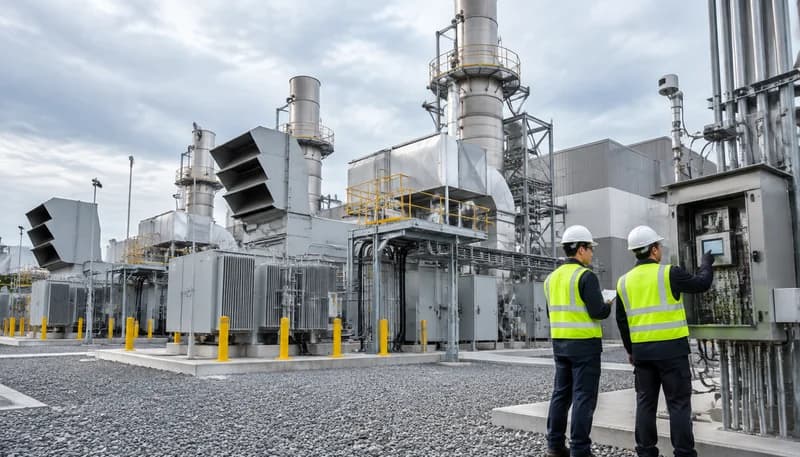
Hyper-scale artificial intelligence clusters require unprecedented electrical load densities, often exceeding 50 to 100 megawatts per facility. As regional transmission operators (RTOs) face multi-year interconnection queues and substation transformer shortages, data center developers are deploying behind-the-meter (BTM) generation schemes to bridge the utility gap. This operational shift fundamentally alters the asset classification: reciprocating internal combustion engines (RICE) and aeroderivative gas turbines that historically operated strictly under emergency-standby exemptions (such as 40 CFR Part 60 Subpart IIII, restricted to 100 non-emergency hours annually) are now being installed as continuous prime-power or peak-shaving units.
The enforcement action taken by the New Jersey Department of Environmental Protection (NJDEP)—levying a $1.07 million administrative penalty against DataOne in Vineland for operating 62 unpermitted natural gas generators—illustrates the severe technical and financial exposure facing operators who treat prime generation as temporary plant equipment. In regulatory physics, aggregating dozens of mobile or modular gas reciprocating engines creates a stationary point source. When aggregate potential to emit (PTE) thresholds are breached, the facility forfeits categorical exemptions and triggers immediate civil liabilities, including mandatory cease-and-desist orders that can strand compute infrastructure indefinitely.
Audit existing on-site generation to determine whether nameplate assets operate under emergency standby or continuous prime power classifications.
Aggregate cumulative heat input and mass emission rates across all deployed modular units to establish a defensible Potential to Emit (PTE) baseline.
Review local state implementation plans (SIP) regarding the temporal thresholds that classify 'temporary' or skid-mounted units as permanent stationary sources.
Clean Air Act Mechanics: Title V, New Source Review, and Major Source Thresholds
Under the United States Clean Air Act (CAA), an unpermitted transition from grid power to fossil-fueled generation implicates the New Source Review (NSR) permitting regime and Title V Major Source operating requirements. A stationary source is designated as a Title V major source if its actual or potential emissions exceed 100 tons per year (tpy) for any criteria pollutant (NOx, CO, PM10/PM2.5, SO2, VOCs), or significantly lower thresholds (such as 25 tpy of NOx or VOCs) within severe ozone nonattainment designations. Deploying 62 natural gas engines, even modern lean-burn units rated at 1 to 2 MW each, produces aggregate unmitigated NOx emissions that dwarf major source thresholds within days of continuous prime operation.
Furthermore, facilities located in attainment areas face Prevention of Significant Deterioration (PSD) review if PTE exceeds 250 tpy (or 100 tpy for listed source categories), requiring the installation of Best Available Control Technology (BACT) and extensive ambient air quality impact modeling. In nonattainment regions, the requirements are even more punitive: operators must install Lowest Achievable Emission Rate (LAER) technology without economic consideration and acquire certified emission reduction credits (ERCs) at high market ratios to offset newly added localized tonnage.
Perform site-specific Nonattainment New Source Review (NNSR) applicability determinations for localized ground-level ozone precursors (NOx and VOCs).
Calculate synthetic minor permit boundaries to verify if enforceable physical or operational constraints can legally cap emissions below Major Source thresholds.
Quantify hazardous air pollutant (HAP) potential, specifically formaldehyde emissions from natural gas combustion, against the 10 tpy single-HAP and 25 tpy aggregate-HAP limits.
Combustion Mechanics and Criteria Pollutant Profiles in Gas-Fired Prime Power
Reciprocating internal combustion engines running on natural gas exhibit complex combustion kinetics that drive strict emissions control challenges. In lean-burn spark-ignited (LBSI) engines, high excess air ratios lower in-cylinder peak combustion temperatures, which reduces thermal NOx formation via the Zeldovich mechanism. However, this lower temperature regime introduces significant trade-offs, prominently elevated emissions of products of incomplete combustion, including carbon monoxide (CO), non-methane hydrocarbons (NMHC), and formaldehyde (CH2O), alongside high methane slip that exacerbates localized greenhouse gas calculations.
Conversely, if operators deploy simple-cycle aeroderivative natural gas turbines to secure quick power increments, the thermal profile yields intense thermal NOx production unless advanced Dry Low-NOx (DLN) or Dry Low-Emissions (DLE) combustor cans are installed. Turbines operating outside their narrow optimal load band (e.g., during AI computing dynamic transient ramping) suffer flame destabilization, resulting in catastrophic spikes in CO and unburned hydrocarbons. Environmental compliance architectures must therefore match the precise prime mover engine mechanics to the dynamic load curve of the data hall power distribution units (PDUs).
Map transient IT electrical load step profiles against prime mover thermal efficiency curves to anticipate incomplete combustion excursions.
Verify engine manufacturer test data for compliance with 40 CFR Part 60 Subpart JJJJ (Spark Ignition RICE) or Subpart KKKK (Stationary Combustion Turbines).
Establish fuel sampling protocols to continuously measure the higher heating value (HHV) and sulfur content of supplied pipeline natural gas.
Flue Gas Abatement Engineering: SCR Integration and Catalytic Mitigation
Meeting BACT or LAER standards for continuous on-site prime generation mandates the design and integration of advanced post-combustion exhaust treatment systems. Selective Catalytic Reduction (SCR) serves as the industry standard for high-efficiency NOx reduction, capable of achieving nominal deNOx efficiencies exceeding 90 to 95 percent. The engineering design relies on injecting aqueous or anhydrous ammonia—or a high-purity diesel exhaust fluid (DEF/urea) solution—upstream of a base-metal, zeolite, or vanadium-titanium catalyst bed. The reagent reduces NO and NO2 into molecular nitrogen (N2) and water vapor across an optimal operating thermal window typically between 550°F and 850°F (288°C to 454°C).
SCR operational reliability depends heavily on precise dosing controls. Under-injection leads to immediate permit exceedances for NOx, while over-injection results in excessive 'ammonia slip' (unreacted NH3 exhausted through the stack), which is strictly regulated down to 5 to 10 parts per million volumetric dry (ppmvd) to avoid localized secondary fine particulate (PM2.5) nitrate formation. Furthermore, natural gas reciprocating engines require complementary oxidation catalysts (Oxi-Cat) positioned upstream or integrated within the catalyst housing to passively convert CO, VOCs, and toxic aldehydes into CO2 and H2O via precious-metal catalytic surfaces (platinum/palladium).
Size SCR reactors to maintain space velocity requirements that guarantee design NOx reduction across all partial-load states without exceeding 5 ppmvd ammonia slip.
Implement closed-loop reagent dosing controllers coupled directly to real-time NOx and exhaust temperature telemetry arrays.
Incorporate oxidation catalyst elements rated to meet Subpart ZZZZ National Emission Standards for Hazardous Air Pollutants (NESHAP) destruction efficiencies.
Atmospheric Dispersion Modeling, NAAQS Verification, and Ambient Monitoring
Before an air installation permit can be issued for utility-scale on-site prime generation, environmental engineers must demonstrate that combustion exhaust will not cause or contribute to an exceedance of the National Ambient Air Quality Standards (NAAQS). This requires rigorous atmospheric dispersion simulation utilizing the EPA-approved AERMOD modeling platform. The physical design of the exhaust infrastructure—including stack height, orientation, flue gas exit velocity, and thermal buoyancy—must be engineered to overcome aerodynamic downwash caused by adjacent data center building structures and multi-story cooling towers.
The short-term 1-hour NO2 (100 ppb) and 24-hour PM2.5 (35 µg/m³) NAAQS thresholds represent the tightest operational bottlenecks for clustered generator stacks. Merely routing 60+ individual exhaust pipes horizontally out of modular container units inevitably triggers modeled localized ground-level exceedances. Instead, engineering teams must manifold exhausts into elevated, vertically discharging common stacks with high discharge velocities, while integrating continuous emission monitoring systems (CEMS) certified under 40 CFR Part 60 Appendix B (Performance Specifications 2, 3, and 4) to record real-time NOx, CO, and O2 diluent concentrations.
Execute comprehensive AERMOD building downwash simulations incorporating accurate facility geometry (BPIPPRM) to optimize stack placement and height.
Design manifolded vertical exhaust stacks designed with zero rain-caps or directional obstructions that restrict upward plume momentum.
Deploy certified Continuous Emission Monitoring Systems (CEMS) or continuous automated parameter monitoring systems (CPMS) with data acquisition and handling software (DAHS).
Enterprise Environmental Governance: Establishing Programmatic Air Compliance Roadmaps
The Vineland enforcement precedent underscores that multi-million-dollar enforcement liabilities and emergency injunctions stem primarily from operational silos between IT infrastructure deployment teams and environmental health and safety (EHS) engineers. Data center infrastructure buildouts must incorporate comprehensive air quality compliance schedules directly into critical-path capital project governance. Lead times for major source Title V and Prevention of Significant Deterioration permits regularly exceed 12 to 24 months, encompassing public notice periods, air dispersion reviews, and regulatory consultations.
Operators must adopt programmatic engineering audits across their pipeline portfolios to verify that bridge generation, transitional prime units, and black-start generation comply with clean air statutes from the moment of ground mobilization. Broad corporate sustainability statements regarding net-zero compute do not supersede statutory clean air laws. Mitigating business interruption risks requires rigorous site-level air accounting, contractual operational caps, active acoustic and emissions monitoring, and transparent community interface mechanisms.
Integrate air quality permit acquisition critical paths (12-24 month lead times) directly into data center site selection and commissioning roadmaps.
Institute enforceable fuel-usage, hour-logging, and mass-emissions tracking protocols with automated alerts at 80% of permitted limits.
Establish an institutional cross-functional gate review requiring environmental engineering sign-off prior to the procurement, delivery, or electrical connection of on-site generators.
Engineering Procurement & Technical Desk
For technical datasheets, custom power topology design, or volume export quotations, reach out to HEFENGQI engineers.