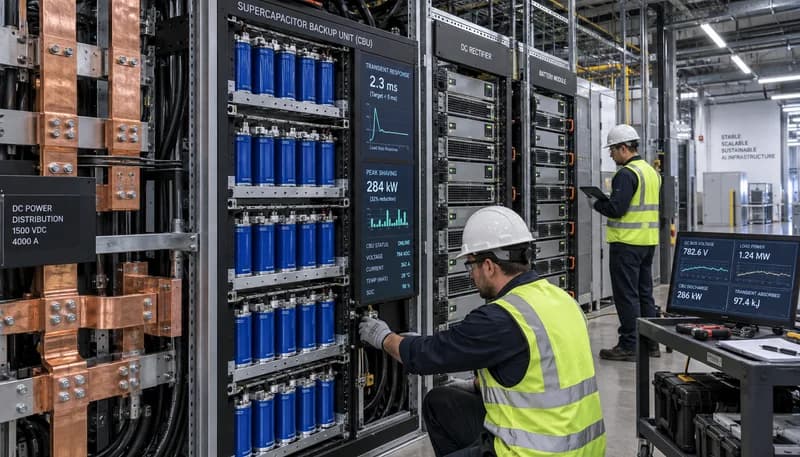
The Physics of AI Power Transients: di/dt Slew Rates and Upstream Latency
Modern hyperscale AI compute clusters utilizing advanced accelerators, such as NVIDIA Blackwell and next-generation Rubin architectures, induce extreme electrical dynamics uncharacteristic of classical enterprise workloads. During large language model training and distributed inference bursts, barrier synchronization routines such as AllReduce, GEMM operations, and FlashAttention kernel launches cause compute execution states to transition synchronously within microseconds. These synchronous transitions produce di/dt current slew rates exceeding several thousand amperes per microsecond at the silicon die level, translating to rack-level step-load swings of 150% to 200% of nominal thermal design power within a sub-millisecond to tens-of-milliseconds window.
Conventional upstream power distribution infrastructure is structurally incapable of tracking these ultra-fast dynamic swings. Double-conversion static uninterruptible power supply (UPS) systems and utility substation transformers function as low-pass electrical filters whose active closed-loop regulation bandwidth is physically constrained to between 10 Hz and 100 Hz. When a 100 kW to 250 kW AI rack transitions instantaneously from an idle baseline to full computational saturation, the impedance of the distribution line, combined with converter control loop delay, results in severe DC bus voltage droop, high harmonic distortion, and potential rectifier overcurrent tripping before upstream supplies can respond.
Without dedicated ultra-fast localized energy storage capable of immediate energy injection, the resultant voltage fluctuations on the 48V or 54V rack bus breach IT equipment operating margins. When the bus voltage collapses below transient operating tolerances (typically plus or minus five percent), onboard point-of-load (PoL) multiphase buck converters experience input undervoltage lockouts, destabilizing the GPU core rails and generating computational pipeline resets or silent data corruption across the training cluster.
Quantify cluster-level di/dt slew rates across distributed barrier synchronization phases to establish dynamic headroom bounds.
Establish transient bus voltage tolerance limits at the server backplane (standardized at plus or minus five percent nominal deviation).
Benchmark upstream UPS and power shelf control loop bandwidth to delineate passive filtering thresholds from active mitigation domains.
Supercapacitor Energy Storage Mechanics vs. Chemical Batteries
Mitigating sub-second dynamic transients requires a radical divergence from conventional electrochemical storage physics. Lithium-ion battery chemistries (such as LiFePO4 and NMC) rely on faradaic intercalation, wherein lithium ions migrate through a liquid or solid electrolyte and diffuse into the crystal lattice of the electrode. This phase change and ionic transport mechanism introduces significant charge-transfer resistance and diffusion limitations, restricting battery discharge rates to roughly 5C to 20C bursts while accelerating mechanical degradation, solid electrolyte interphase (SEI) layer growth, and thermal runaway risks under repetitive micro-cycling.
In contrast, Electric Double-Layer Capacitors (EDLCs) utilize purely electrostatic charge accumulation at the Helmholtz double layer formed along high-surface-area porous carbon electrodes. Because no chemical phase transition occurs, EDLCs exhibit equivalent series resistance (ESR) figures below 0.5 milliohms per cell, delivering specific power densities exceeding 10 kW/kg and cycling endurance beyond 1,000,000 deep charge-discharge cycles without capacity fade. However, EDLCs feature modest energy densities (5 to 10 Wh/kg), making them unsuitable for sustained hold-up power beyond several seconds.
Bridging this operational divide, Lithium-Ion Capacitors (LICs) and pseudocapacitive materials employ hybrid storage mechanisms: an electrostatic EDLC-type cathode combined with a pre-lithiated faradaic anode or fast surface redox reactions. LICs deliver intermediate energy densities of 20 to 30 Wh/kg while maintaining round-trip energy efficiencies above 95% and cycle lives surpassing 200,000 events. This hybrid electrochemistry permits the delivery of multi-second high-rate pulse currents without inducing the thermal fatigue or severe calendar life derating that impairs standard battery backup systems.
Select EDLC cells with ultra-low equivalent series resistance (ESR < 0.5 mOhm) for sub-millisecond dynamic peak absorption.
Evaluate Lithium-Ion Capacitors (LIC) where transient pulse durations extend between two seconds and ten seconds.
Enforce thermal and mechanical operating envelopes to guarantee endurance across more than 500,000 repetitive pulse-load cycles.
Power Shelf Integration: Capacitor Backup Units (CBUs) vs. Battery Backup Units (BBUs)
To achieve resilient transient suppression within Open Rack Standard (such as ORV3) 54V architectures and emerging 800V DC bus ecosystems, hyperscale facilities are adopting modular Capacitor Backup Units (CBUs). In traditional power shelf deployments, Battery Backup Units (BBUs) are configured solely to bridge the multi-second transfer gap between grid utility loss and standby diesel generator synchronization. Attempting to use these BBUs to continuously shave sub-second AI computational peaks induces continuous micro-cycling, accelerating battery degradation and generating uncontrolled localized heating.
The integration of dedicated CBUs creates a functionally decoupled, dual-tier energy storage hierarchy. Power shelf rectifiers can be sized strictly for mean thermal design power (TDP) rather than peak dynamic loads, reducing overall rectifier capital expenditures and footprint. When GPU execution initiates an aggressive step load, the parallel-connected CBU discharges autonomously within sub-millisecond timescales, injecting kilovolt-ampere reactive and active power to prevent the power shelf rectifiers from entering current-limiting foldback or magnetic core saturation.
Advanced rack-level topologies allocate standardized 1U or 2U chassis slots that accommodate swappable CBU or BBU modules depending on workload profiles. For dense inference and training clusters, hybrid architectures deploy a 1:2 or 1:3 ratio of CBU to BBU capacity. The CBU acts as a localized high-frequency dynamic low-pass filter, absorbing dynamic swings from 10 milliseconds to two seconds, while the chemical BBU remains in a passive float state, reserved exclusively for macroscopic utility outages.
Implement dedicated CBU subracks parallel to 54V or 800V busbars to decouple rectifier thermal sizing from peak transient spikes.
Calibrate CBU autonomous discharge thresholds to engage within 200 microseconds of detected negative bus voltage deviation.
Deploy modular CBU/BBU mechanical chassis configurations allowing hot-swappable ratio reconfigurations based on cluster workload density.
Power Electronics Dynamics and DC-DC Converter Bandwidth Constraints
The effectiveness of a supercapacitor mitigation system is heavily dictated by the power electronics topology interfacing the storage bank to the common DC bus. Because the energy stored in an electrostatic capacitor is governed by the relation E = 0.5 * C * (V_max^2 - V_min^2), extracting full energy capacity requires operating across a wide terminal voltage swing, often down to 50% of maximum rated voltage. Connecting supercapacitors directly across a regulated 54V DC bus without an active interface yields less than 20% effective energy extraction and exposes the bus to unregulated capacitance dynamics.
To overcome this constraint, bidirectional DC-DC converters are deployed between the CBU bank and the server distribution rail. However, as noted in advanced power topology research, the dynamic response speed of the system is constrained by the converter loop bandwidth and inductive energy transfer rates rather than the intrinsic electrostatic speed of the capacitor cells alone. If the converter input filter inductors and switching control loops cannot achieve slew rates matching the load step, bus voltage droop will occur regardless of supercapacitor cell performance.
To resolve this bandwidth bottleneck, our infrastructure engineering research institute designs multi-phase interleaved bidirectional buck-boost topologies utilizing wide-bandgap (WBG) Gallium Nitride (GaN) and Silicon Carbide (SiC) power semiconductors. Operating at switching frequencies from 200 kHz to over 1 MHz, these interleaved stages slash required filter inductance, drastically boost converter current-slew capabilities beyond 100 A/us per phase, and eliminate high-frequency ripple currents through phase cancellation, achieving bidirectional round-trip conversion efficiencies above 97%.
Utilize multi-phase interleaved GaN/SiC bidirectional converters operating above 200 kHz to maximize control loop bandwidth.
Design converter magnetic components with low-loss nanocrystalline cores to minimize core losses under high-frequency load cycling.
Optimize converter control transfer functions using direct digital control (DDC) with feed-forward bus voltage compensation.
Reliability, Failure Modes, and Five-Nines (99.999%) Grid Interoperability
Integrating supercapacitor systems into Tier IV mission-critical facilities requires uncompromising adherence to five-nines (99.999%) operational availability standards. While supercapacitors do not exhibit thermal runaway hazards comparable to chemical batteries, their primary degradation mechanism centers on electrolyte degradation and internal pressure rise. Organic electrolytes, such as acetonitrile or quaternary ammonium salts in propylene carbonate, undergo decomposition over time, leading to equivalent series resistance (ESR) growth and volumetric capacitance loss.
This aging process strictly follows Arrhenius kinetics, where the operational lifespan halves for every 10 degrees Celsius rise in core operating temperature or for every 100 millivolt increase above nominal rated cell voltage. To prevent premature failures, modern CBUs incorporate active cell balancing networks utilizing bidirectional switched-capacitor or synchronous buck-boost circuits. These circuits maintain individual cell potentials within a tight ten-millivolt tolerance, eliminating local overvoltage stress during rapid recharge cycles following an AI compute burst.
At the utility interface level, localized CBU transient absorption prevents high-frequency load steps from propagating upstream to medium-voltage distribution switchgear. Without rack-level buffering, synchronized AI barrier synchronization generates low-frequency voltage interharmonics and repetitive voltage flicker that violate IEEE 519 and IEEE 1453 grid compliance standards. By dampening dynamic step loads locally, supercapacitor systems isolate substation transformers from severe magnetostrictive acoustic fatigue and prevent nuisance tripping of upstream protective relays.
Incorporate active voltage balancing circuitry capable of maintaining inter-cell variance within plus or minus 10 millivolts.
Apply Arrhenius-based thermal derating profiles, maintaining cell core temperatures below 45 degrees Celsius via directed liquid or forced-air cooling.
Monitor rack-level harmonic injection to ensure utility substation compliance with IEEE 519 and IEEE 1453 flicker metrics.
Comprehensive Engineering Blueprint and TCO Deployment Framework
Executing a production-grade supercapacitor deployment within 100 kW to multi-megawatt AI clusters requires precise mathematical sizing. Sizing calculations must balance transient peak energy absorption (Joules) against total capital expenditure. The required capacitance C is determined by dividing double the burst energy delta (P_transient * delta_t) by the product of the bidirectional converter efficiency and the differential square of operational cell voltages (eta * (V_max^2 - V_min^2)). For typical Blackwell-class deployments with 30-millisecond step transients of 60 kW above baseline, a localized 1.5 Farad to 3.0 Farad bank per rack shelf delivers complete dynamic shielding.
From a total cost of ownership (TCO) perspective, the economic viability of CBUs is realized through battery preservation, power component downsizing, and cluster compute availability. By redirecting cyclic micro-bursts away from lithium-ion BBUs, BBU operational lifespan is extended from an impaired two-to-three years under high-transient AI cycling to its full rated calendar life of eight-to-ten years. Furthermore, power shelf rectifiers can be downsized from 200% peak overload ratings to 110% continuous thermal capacity ratings, generating substantial CAPEX and volumetric efficiency gains across the data center.
Our infrastructure engineering research institute recommends a phased retrofitting strategy for hyperscale operators transitioning to high-density compute. Facilities should initially deploy modular 1U CBU drawers into existing ORV3 rack frames alongside existing BBU configurations, tuning converter trigger parameters to absorb pulses shorter than three seconds. As rack power scales toward 200 kW and beyond, transition to hybridized 800V DC bus architectures with co-located wide-bandgap CBU sub-systems will represent the definitive standard for industrial-scale AI infrastructure.
Execute dynamic Joules-based sizing calculations based on cluster-specific AllReduce and GEMM power excursion profiles.
Model TCO advantages by factoring in extended BBU calendar longevity, avoided rectifier over-provisioning, and reduced thermal cooling overhead.
Implement a modular, phased retrofitting protocol utilizing standard 19-inch and 21-inch open rack power shelf form factors.
Engineering Procurement & Technical Desk
For technical datasheets, custom power topology design, or volume export quotations, reach out to HEFENGQI engineers.