Nokia / SFP optical transceivers

Nokia 9.8G SFP+ 1.4km Transceiver Equipment information & support

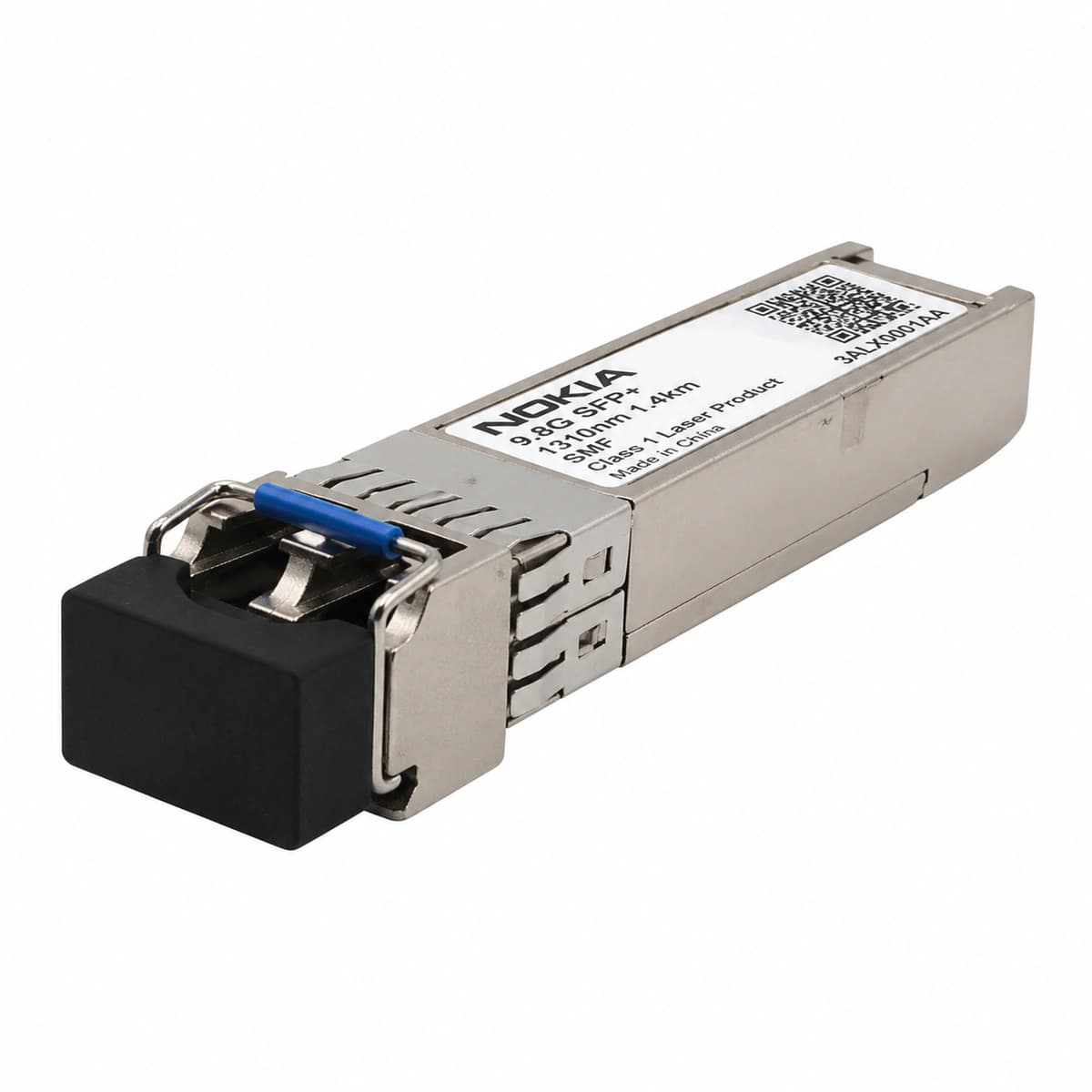
The Nokia 9.8G SFP+ 1310nm 1.4km optical transceiver is an industrial-hardened module engineered for Nokia AirScale and Flexi cellular base station fronthaul, delivering 9.8304Gbps (CPRI Option 7) line-rate transmission up to 1.4km over single-mode fiber with duplex LC interface.

Equipment information

Brand
Nokia
Equipment model
Nokia 9.8G SFP+ 1.4km Transceiver
Equipment type
SFP optical transceivers
Controller / software version
Confirm against the installed equipment
View full product specifications
Nokia 9.8G SFP+ 1.4km Transceiver Official Product View 3

Information below comes from the current product catalogue. Confirm the controller, software version and configuration of the installed equipment separately.

Data Rate
9.8304 Gbps
Central Wavelength
1310 nm
Maximum Distance
1.4 km
Fiber Type
Single-Mode Fiber (SMF) (SMF)
Typical Power Consumption
< 1.0 W
Optical Connector
Duplex LC (blue pull-tab latch)

Alarms & troubleshooting

OPT_RX_LOS (Optical RX Loss of Signal)
Port Link/Activity LED off, system Alarm LED solid red
Broken or disconnected patch cord; far-end SFP+ TX laser disabled or damaged; severely contaminated LC connector ferrule; total link attenuation exceeds receiver sensitivity threshold (<-14.4 dBm).
1. Verify physical seating of the SFP+ module and LC optical patch cord latch. 2. Inspect and clean optical connectors and transceivers using an LC dry-cleaning cassette or pen. 3. Measure incoming optical power using an optical power meter (OPM) to verify it falls within operating range (-14.4 dBm to -1 dBm). 4. Check remote BBU/RRU port status via CLI to ensure TX is active; replace remote transceiver if defective.
TX_FAULT (Transmitter Hardware Fault)
Port LED solid amber, hardware TX_FAULT pin pulled high
Internal DFB laser diode degradation or breakdown; laser bias current exceeds factory threshold; module internal power rail out of tolerance.
1. Query DDM parameters via CLI (`show port optical`) to examine laser bias current and TX launch power. 2. Execute a port admin down/up toggle to reset the internal transmitter driver circuit. 3. Reseat the SFP+ transceiver in the cage to rule out pin contact oxidation or misalignment. 4. If the alarm reasserts and output power remains out of specification, replace the Nokia 9.8G SFP+ module.
SFP_TEMP_HIGH (Transceiver DDM Over-Temperature)
Chassis thermal LED blinking amber, port status LED amber
BBU chassis fan unit failure; clogged air filter restricting convective cooling; ambient site temperature exceeds industrial rating (>85°C); poor thermal coupling to the chassis cage.
1. Inspect DDM temperature telemetry via CLI to verify if warning (75°C) or critical (85°C) thresholds are exceeded. 2. Check chassis fan tray status to ensure all fans are running at optimal speed without failure alarms. 3. Clean or replace chassis intake dust filters to restore unrestricted airflow. 4. Verify site cooling/HVAC operation; consider leaving vacant ports between high-power transceivers to mitigate localized thermal clustering.
OPT_RX_PWR_LOW (Optical RX Power Degraded / Low Warning)
Port Link LED solid green, NMS reports yellow warning
Fiber cable macro-bend or tight bending radius along routing; contaminated ODF bulkhead adapter; aging splice loss; distance approaching 1.4km limit with excessive insertion losses.
1. Check current RX optical power via CLI (`show port optical`) to evaluate margin against the -11.4 dBm low warning threshold. 2. Inspect the fiber run for tight zip-ties or pinch points; maintain a minimum bend radius >30 mm. 3. Clean both sides of the ODF bulkheads and patch cables using lint-free optic cleaners. 4. If attenuation persists, perform an OTDR trace to identify high-loss splices or bad patch points along the 1.4km span.
LINK_CRC_ERR (Link Flapping & Excessive CRC/FCS Errors)
Port LED alternates/flashes rapidly between green and amber
Oxidized gold finger pins or poor electrical contact in SFP+ cage; optical RX power hovering right at receiver sensitivity threshold; CPRI line rate mismatch (e.g. Option 7 9.8304 Gbps vs 10GbE LAN); link jitter or high bit error rate (BER).
1. Review port error counters (`show port detail`) to monitor CRC, FCS, and code violation rates. 2. Verify that both local and remote ports are strictly locked to CPRI Option 7 (9.8304 Gbps) rather than auto-negotiate. 3. Wear an ESD wrist strap, remove the SFP+, gently clean gold finger contacts with an electronic contact swab, and reseat securely. 4. If bit errors continue to accumulate, replace the optical patch lead and swap the SFP+ module.

Access Complete Maintenance & Full Alarm Troubleshooting Manual

This page lists high-frequency critical alarm codes commonly encountered in field maintenance. Comprehensive manufacturer troubleshooting matrices, board-level repair guides, detailed electrical schematics, and firmware commissioning manuals are delivered alongside equipment upon formal project procurement, accompanied by dedicated FAE technical support.

Share on-site information

  1. 01

    Identify the exact model

    Record the nameplate, system model and controller or module model.

  2. 02

    Keep the alarm details

    Record the full alarm text, indicator colour, timing and whether it persists.

  3. 03

    Describe recent changes

    Note recent replacements, software updates or configuration changes.

Record information visible in the existing interface. Electrical measurements, disassembly and replacement should follow the applicable manufacturer's manual and be performed by qualified personnel.

Your model and these details will be added to the enquiry form for you to review before sending.

Related technical articles

Browse the technical guides or send a question about this model.

View all articles

Need a replacement module or supporting equipment?

Confirm the full model, system configuration and compatibility requirements before enquiring about suitable products.

Ask about suitable products

Have a model and an on-site issue?

Share the exact model, alarm text and observed symptoms to help identify relevant information and compatibility requirements.

Request technical support