Huawei / SFP optical transceivers

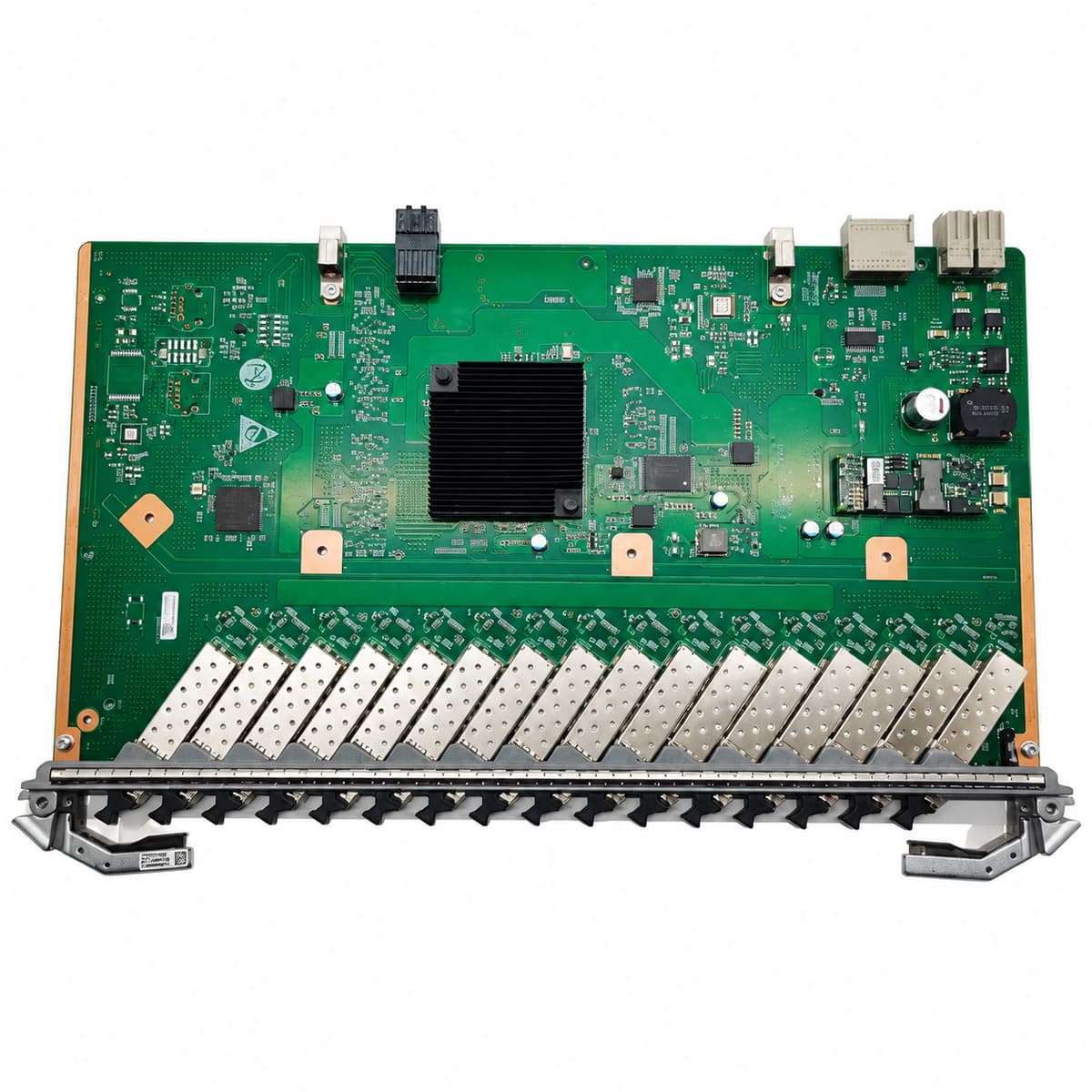
Huawei H805GPUF 16-Port GPON Board Equipment information & support

The Huawei H805GPUF is a high-density 16-port GPON service interface card for Huawei SmartAX MA5680T, MA5683T, and MA5608T OLT optical chassis, supporting up to 2,048 FTTH subscriber ONUs with a 1:128 optical split ratio and Class B+/C+/C++ transceivers.

Equipment information

Brand
Huawei
Equipment model
Huawei H805GPUF 16-Port GPON Board
Equipment type
SFP optical transceivers
Controller / software version
Confirm against the installed equipment
View full product specifications
Huawei H805GPUF 16-Port GPON Board Official Product View 4

Information below comes from the current product catalogue. Confirm the controller, software version and configuration of the installed equipment separately.

Board Type
Enhanced 16-port GPON OLT central-office service interface board
Port Density & Specs
16 full-line-rate GPON SFP ports
Supported Chassis
Huawei SmartAX MA5680T / MA5683T / MA5608T
Subscriber Capacity
Maximum subscriber capacity per board: 2048 subscribers
Split Ratio
Supports 1:128 split ratio
Typical Power Consumption
Typical operating power consumption approx. 55W (with intelligent dynamic sleep energy saving)

Alarms & troubleshooting

LOS (Loss of Optical Signal)
RUN/ALM LED steady red, corresponding PON port LED off
Feeder/distribution fiber cut, damaged optical splitter port, loose SFP module, or RX optical power below receiver sensitivity
1. Check if the pigtail of the affected PON port is bent, loose, or dirty; 2. Measure the input/output optical power using an optical power meter to ensure ODN attenuation is within budget; 3. Run 'display port info' to check SFP transceiver status and DDM optical parameters; 4. Clean or replace the fiber patch cord and GPON SFP module; if all ports fail, inspect board backplane power and seating.
ROGUE_ONT (Rogue ONT Detected)
RUN/ALM blinking green or amber slowly, corresponding PON port LED flashing rapidly
An ONT laser under this PON port is continuously transmitting out of assigned TDMA timeslots, causing collisions and taking down all other ONUs
1. Run 'display rogue-ont' to locate the affected PON port and identify the suspicious ONT ID; 2. Enable the OLT rogue ONT isolation feature or administratively deactivate/blacklist the faulty ONT; 3. If auto-detection fails, selectively disconnect splitter branch fibers to isolate the offending ONT; 4. Dispatch field tech to replace the defective ONT hardware and restore the ODN branch.
TEMP_OVER (Board / Optical Module High Temperature)
RUN/ALM LED steady red or double blinking red
Subrack air filter clogged, fan tray failure/stall, ambient room temperature exceeding 55°C, or thermal buildup from high-density high-power SFP modules
1. Inspect and clean the subrack air filters and clear airflow blockages at front/rear doors; 2. Run 'display fan' to verify fan tray operation; replace fan unit if RPM is zero or reported faulty; 3. Run 'display temperature' to isolate whether the board core or specific SFP transceivers are overheating; 4. Check ambient HVAC settings (target 20°C-25°C); replace any degraded SFP module exhibiting abnormal thermal dissipation.
OPT_TX_FAULT (Transmitter Laser Fault / Bias High)
RUN/ALM LED steady green, corresponding PON port ACT LED permanently off or abnormally solid
Aging laser diode (LD), Tx bias current exceeding safety threshold, driver IC damage, or poor pin contact in the H805GPUF SFP cage preventing optical transmission
1. Run 'display port ddm-info' to inspect Tx optical power and Tx bias current on the port; 2. Reseat the SFP module and check golden finger pins for dust, oxidation, or bent contacts; 3. If Tx bias current exceeds threshold or optical power is below -inf/cutoff, replace with a tested Class B+/C+/C++ SFP; 4. If the fault persists across multiple SFPs, migrate services to a spare port and send the H805GPUF board for RMA repair.
OPT_RX_POWER_LOW (Optical Receive Power Below Threshold)
RUN/ALM LED green blinking slowly, corresponding PON port LED flashing normally or solid
Excessive optical loss on the ODN link between ONT and OLT, dirty optical adapter/bulkhead, degraded fiber splices, or macrobending causing RX power to drop near or below sensitivity (-28 dBm)
1. Run 'display ont optical-info' to identify whether low RX power affects a single ONT or all ONUs on the PON split; 2. If all ONUs show degraded RX, use an OTDR to inspect the feeder cable, main splice trays, and primary splitter input; 3. If isolated to one ONT, clean customer-premise connectors and check drop cable for macrobends or pinching; 4. Re-splice high-loss joints and replace degraded splitters to bring optical power within standard -12 dBm to -27 dBm margins.

Access Complete Maintenance & Full Alarm Troubleshooting Manual

This page lists high-frequency critical alarm codes commonly encountered in field maintenance. Comprehensive manufacturer troubleshooting matrices, board-level repair guides, detailed electrical schematics, and firmware commissioning manuals are delivered alongside equipment upon formal project procurement, accompanied by dedicated FAE technical support.

Share on-site information

  1. 01

    Identify the exact model

    Record the nameplate, system model and controller or module model.

  2. 02

    Keep the alarm details

    Record the full alarm text, indicator colour, timing and whether it persists.

  3. 03

    Describe recent changes

    Note recent replacements, software updates or configuration changes.

Record information visible in the existing interface. Electrical measurements, disassembly and replacement should follow the applicable manufacturer's manual and be performed by qualified personnel.

Your model and these details will be added to the enquiry form for you to review before sending.

Related technical articles

Browse the technical guides or send a question about this model.

View all articles

Need a replacement module or supporting equipment?

Confirm the full model, system configuration and compatibility requirements before enquiring about suitable products.

Ask about suitable products

Have a model and an on-site issue?

Share the exact model, alarm text and observed symptoms to help identify relevant information and compatibility requirements.

Request technical support